
Types of Skin Types

Skin types vary widely, including oily, dry, normal, oily, sensitive, pigmented, non-pigmented, and acne-prone skin. Since care methods also differ by skin type, today I will talk about skin types.
How to Find Out Your Skin Type
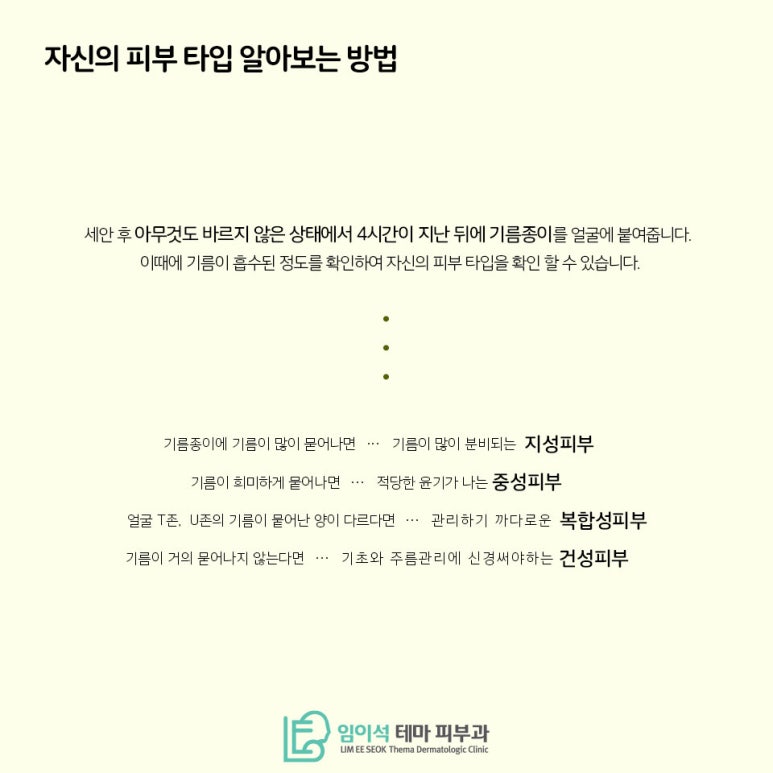
After washing your face and leaving it bare for 4 hours without applying anything, place oil blotting paper on your face. By checking how much oil is absorbed at that time, you can determine your skin type.
Dry skin – almost no oil
Normal skin – a faint amount of oil
Combination skin – different amounts of oil depending on the area of the face
Oily skin – a lot of oil is produced
This test is a simple yet reliable way to check your condition. You can try it after washing your face without applying any basic skincare products. It is a test that determines skin type based on how much sebum is secreted. Dry skin produces almost no oil, while oily skin will show a lot of oil absorbed into the blotting paper. In the case of combination skin, you can see a lot of oil on the T-zone, where sebum is produced heavily, and little to no oil on the dry U-zone.
Characteristics by Skin Type
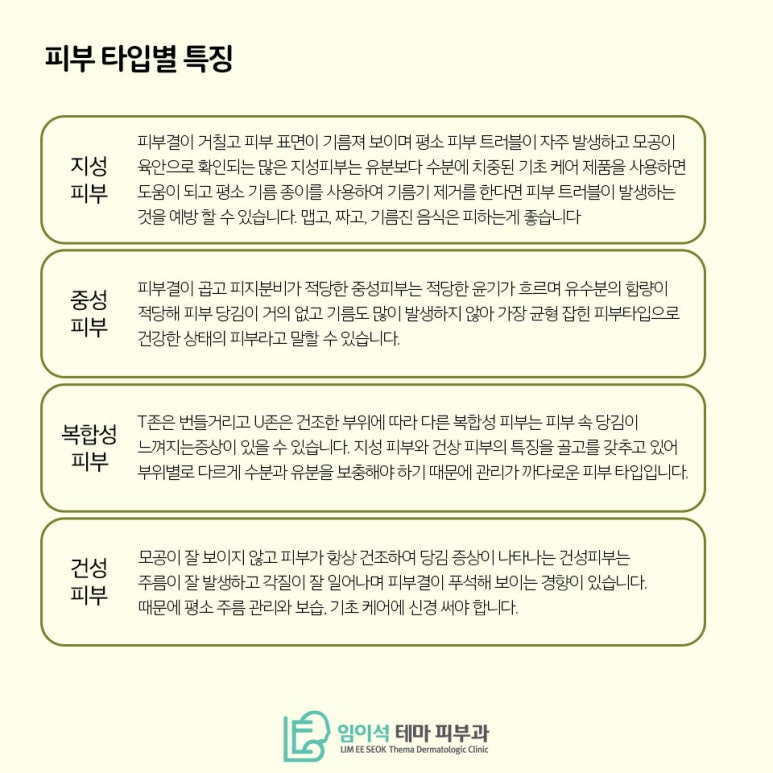
Dry skin: Pores are not easily visible, and the skin is always dry, causing tightness. Wrinkles develop easily, flaking occurs frequently, and the skin texture tends to look rough. Therefore, you should pay attention to wrinkle care, moisturizing, and basic skincare in daily life.
Normal skin: The skin texture is fine, and sebum secretion is moderate. The skin has a healthy amount of radiance, and the balance of oil and moisture is appropriate, so there is little tightness and not much oil. This is the most balanced skin type and can be said to be healthy skin.
Combination skin: This refers to a condition that differs depending on the area of the face. You may feel tightness inside the skin, and the T-zone is oily while the U-zone is dry. It combines the characteristics of both oily and dry skin, making it the most difficult skin type to manage. Because moisture and oil must be replenished differently by area, it is a tricky skin type to care for.
Oily skin: The skin texture tends to be rough, and the surface of the skin looks greasy. Skin troubles often occur, and pores are large enough to be visible to the naked eye. Even if you do not apply moisturizing cosmetics to your face, it does not feel tight, but that does not mean you should skip moisturizers altogether. Using basic care products that focus more on hydration than oil can help, and using oil blotting paper regularly to remove excess oil can help prevent skin troubles to some extent. For oily skin, it is also better to avoid spicy, salty, and greasy foods when eating.
Sensitive Skin

Unlike the tests above, sensitive skin is determined through the patient's subjective reaction level and the doctor's examination. If a patient diagnoses themselves as having sensitive skin through a self-test, various problems can arise, so a specialist's opinion is needed. Because sensitive skin cannot be identified 100% through a self-diagnosis test alone, if you suspect sensitive skin after a self-test, it is better to visit a clinic and hear a specialist's opinion. If your skin matches the items below, you may want to suspect sensitive skin.
- Skin changes occur depending on the external environment
If your skin becomes sensitive to dry weather, yellow dust, seasonal changes, or other environmental changes and you experience itching or stinging, you should suspect sensitive skin. New house syndrome can also be considered sensitive skin. In the case of sensitive skin, it does not mean the skin is weak, but rather that the protective barrier is weaker than that of normal skin.
- When you press the facial area with your fingernail, the mark lasts a long time
Some people feel stinging or develop skin troubles whenever they change cosmetics or start using a new functional cosmetic product. In such cases, it may not be that the cosmetic ingredients do not suit them, but rather that they have sensitive skin. A characteristic of such people is that their skin does not recover well, so when skin is irritated, such as by a fingernail mark, it tends not to recover quickly.
- The skin is dry and has many flakes or fine wrinkles
The drier the skin, the higher the likelihood of sensitive skin. Normally occurring facial wrinkles are caused by the skin losing elasticity, stretching, and then becoming slack. Sensitive-skin wrinkles, however, begin with flaking, which then leads to fine wrinkles.
- Facial redness or visible capillaries appear
Visible blood vessels mean that the skin layer is thin, which, as mentioned earlier, means the skin barrier is thin. Therefore, there is a high chance of sensitive skin, and redness may also accompany this condition. If you suspect this type of skin, it is a good idea to reduce spicy and salty foods in daily life.
In addition to the skin types based on oil and moisture levels discussed today, there are also skin types such as pigmented skin, telangiectatic skin, and acne-prone skin. Skin type can change depending on blood circulation, the condition of pigmentation, and the state of the pores, and individual lifestyle habits, environment, and genetic factors can also affect skin type.
As shown above, many different skin types exist. Please use self-diagnosis methods only as a reference, and if you want to know your exact skin type, consultation with a dermatologist is necessary.