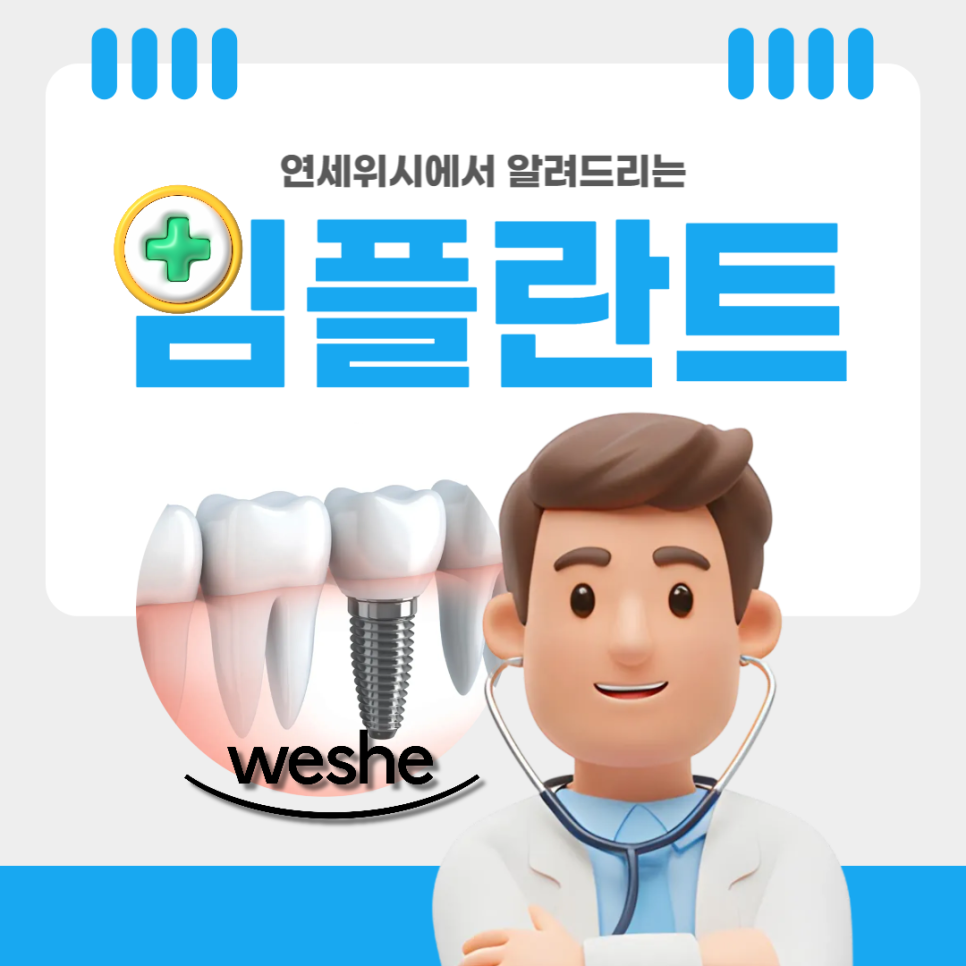
Teeth mainly serve three roles.
-
Mastication
-
Aesthetics
-
Pronunciation
Because they perform essential functions in daily life,
losing even one tooth can lead to discomfort.
So after a tooth is extracted, a prosthetic is placed
to replace it, and today I prepared information related to [implants].
I will introduce related information while looking at the photos prepared by the Magaok dental clinic.
Immediate Placement
If you have had an implant placed right after extraction,
you may have heard this before.
"It can be placed immediately after extraction."
This means placing a fixture that can replace
the role of the root after the tooth is removed.
That can shorten the treatment time and reduce
unnecessary rounds of anesthesia, so many people prefer it.
However, if there is severe inflammation after
periodontitis or tooth decay and a large amount
of bone tissue has been lost,
it may be more advantageous to allow some time
rather than placing it immediately after extraction.
For a tree to take root firmly, it needs good soil.
If the soil is not fertile,
it will wither quickly.
Therefore, creating an environment in which it can remain strong
for a long time can be seen as the first step in treatment.
So the Magaok dental clinic believes that in cases with poor oral conditions,
rather than shortening the treatment period, the priority can be to restore health first.
By allowing some time, inflammation can naturally improve
and recovery can take place.
If it is judged difficult to secure enough bone
because a large amount of bone tissue has been lost,
additional procedures such as extraction socket preservation
may be performed to help secure alveolar bone.
After recovery, if it is determined that a screw can be placed,
the screw can be inserted.
First, through various materials,
steps are taken to check the position, length, and diameter.
Usually, a simulation is performed using Panorama and CBCT.
By examining the amount and quality of the remaining alveolar bone,
we check where placement would have a good prognosis,
whether it can bear force, and other factors.
I will explain in a bit more detail the items checked at Magaok dental clinic.
When classifying bone quality, it is usually divided into D1 to D4.
The higher the number, the softer the bone, but if it is too soft or too hard,
it becomes difficult to place the screw.
D1 is relatively easy to achieve firm osseointegration
when considering mastication.
However, because there are very few blood vessels,
nutrition is mainly obtained from the periosteum.
In addition, during the bone preparation stage,
there is a relatively high chance of needing re-placement due to overheating.
Because it is sensitive to heat, this point must be handled carefully,
and necrosis should be considered in advance.
D2 is known to have excellent interface healing,
so bone integration is favorable.
Even after shaping to increase bone width,
if there is enough contact area at the interface,
it can be considered stable.
Because there are sufficient blood vessels within the bone,
bleeding occurs during drilling, which helps prevent overheating.
It also provides adequate nutrition,
so this can be judged as a very suitable environment.
D3 can be drilled with a minimal drill width,
so when there is not enough cortical bone,
countersink and bone tap are omitted.
Even so, because there are enough blood vessels distributed evenly,
healing is fast and cooling is helped when the bone is prepared.
Therefore, the chance of necrosis caused by heat is low.
However, if the cortical bone that forms the outer appearance is thin
and it is difficult to secure strength,
an even smaller drill should be used to prevent lateral perforation.
That way, the contact area can be secured,
which helps achieve strength.
It is also possible to obtain bicortical fixation
by perforating through.
In addition, the final starting point should be set at about 0.5 to 1 mm
in order to prevent later protrusion toward the lingual side.
D4 is similar to what was explained earlier at Magaok dental clinic,
but can be considered more severe.
Because initial fixation itself is very difficult,
it should not be shaped to the final size with a drill,
and in the later stage, an osteotome can be used to
form the bone not by shaping it,
but by compression.
The speed and pressure should be set as low as possible,
but this is not easy.
That is why D2 to D3 is considered preferable.
Based on the indicators explained above, if the bone has the appropriate softness
and sufficient bone quality is secured,
first the fixture is positioned so that the crown can later be stably placed,
then the diameter and length are chosen
and the simulation process is carried out.
The implant fixture is then placed.
Various materials are reviewed again.
By reviewing Panorama or CBCT data,
we evaluate whether the fixture has been placed in the correct position.
If it is judged to be stable, observation continues
and the healing process proceeds.
In addition, initial fixation is checked.
This is professionally called ISQ (Implant Stability Quotient).
It is expressed from 1 to 100, and the higher the number,
the more stable it is considered.
The ISQ explained earlier at Magaok dental clinic is evaluated numerically
through machine vibration.
There are cases in which a certain degree of initial fixation is secured,
and in those cases, loading can be chosen
so that a temporary tooth can be placed immediately.
If initial fixation is not sufficient,
it is better to delay the loading time.
During the healing stage, if a temporary crown is forced on
in an effort to improve aesthetics,
unnecessary force may be transmitted and affect the healing process.
Therefore, it is best to carefully check how much initial fixation is secured early on,
classify whether it is the appropriate case,
and choose the correct method.
There is no one method that is always better between immediate loading and loading after some time,
because both have different advantages,
so the appropriate one should be chosen for each case.
The key point during recovery is to follow the instructions.
a. Get enough rest.
b. Cold compresses help with swelling.
c. There may be bleeding on the first day,
but it is better not to spit and to swallow if possible.
d. Until the stitches are removed,
not brushing the area or touching it with your hands helps healing.
e. If possible, it is better to stop smoking and drinking during recovery.
f. Be sure to visit on the scheduled date
and receive a checkup.
Recovery will proceed while following the other instructions provided.
After that, if the ISQ value shows 70,
loading will be carried out.
Using the method explained earlier,
ISQ can be used to evaluate it numerically.
If that value is 70, the alveolar bone and the titanium fixture
can be considered sufficiently integrated.
Then, after tightening the abutment on top,
the prosthesis is placed and the implant is completed.
Finally, I briefly organized the frequently asked questions at Magaok dental clinic.
| Q. It still feels a little awkward. Is that okay? |
|---|
| A. Because mastication efficiency was reduced during treatment, it may feel awkward after the prosthesis is placed. So you may feel uncomfortable, but in most cases it feels comfortable after about a week. |
| Q. How should I take care of it? |
|---|
| A. The spaces between the crowns should be cleaned carefully so that inflammation does not develop later. It is good to clean well using interdental brushes or dental floss. |
| Q. Do I really need scaling? |
|---|
| A. Because it is difficult to notice problems even if they arise after treatment, it is best to receive checkups at the appropriate time. During the examination, if a large amount of tartar is judged to have accumulated, care should be provided using a dedicated scaler so that the crown surface is not scratched. |
| Q. I finished treatment a while ago, but it has become loose and wobbly. |
|---|
| A. After improvement is complete, other measures may be needed due to screw loosening or prosthesis breakage. If wobbling is observed, the screw may have loosened, so you should get examined and take appropriate action. |
Today at Magaok dental clinic, after a tooth was extracted,
we introduced what points are considered when placing an implant
and what is checked during the process.
Before receiving treatment, I prepared information that could be helpful,
and I hope this was useful.
Next time, I plan to write a similar post on a different topic.
Did you find the information I shared today helpful?
That concludes this post.
Yonsei Wish. Thank you.