Hello,
I’m the smile designer who can turn your wishes into a beautiful smile,
Yeosangho, a dentist at Maggok Dental Clinic.
There are times when a molar hurts so badly
that patients come in having decided on extraction.
However, after an examination,
there are cases where the tooth can be saved
instead of being removed.
What should be done if
the pain continues at the root tip
even after root canal treatment,
or if treatment is difficult
with conventional methods?
Today, I’d like to take a detailed look at
tooth replantation, which can be considered
in cases like these.
What is tooth replantation?
This is a method in which a tooth that is difficult to heal even with root canal treatment or other methods is temporarily extracted,
and then the inflammation and lesion at the root tip are removed and treated.
The tooth is then placed back in its original position
to preserve it,
and this is a highly advanced procedure
that takes a preservation-oriented approach.
It is an option to consider when there is no other way
besides removal.
It is mainly used when root canal treatment has failed,
re-treatment is not possible,
or when there is a periapical lesion
but the periodontal ligament and remaining bone
are in good condition.
What is checked during the examination process
An oral examination and radiographic examination
are performed first.
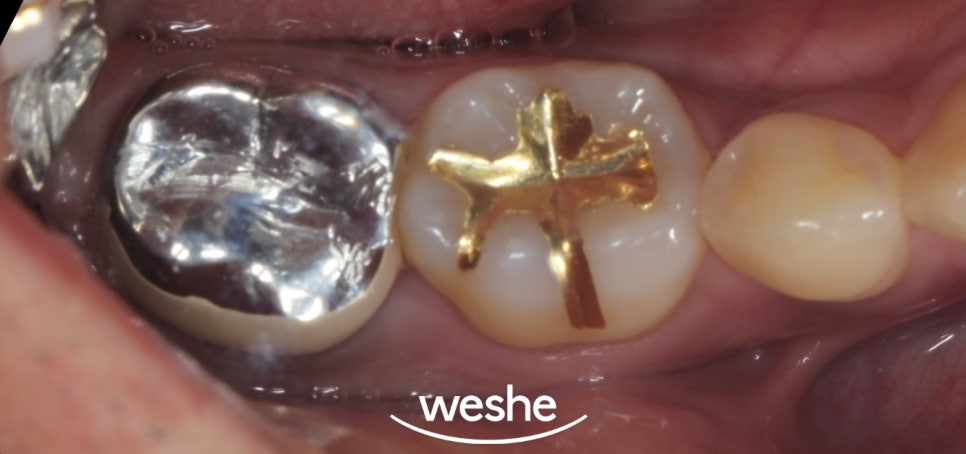
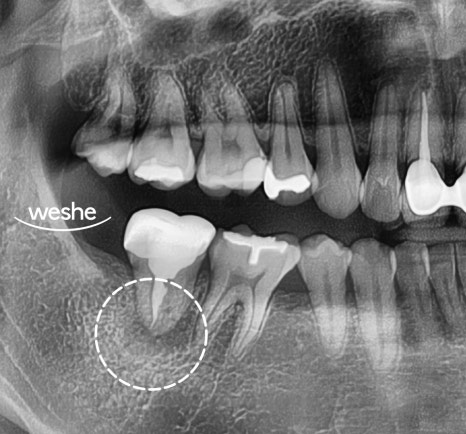
20250716
At Maggok Dental Clinic,
if you look at the lower right molar area,
the mandibular second molar,
it has already undergone root canal treatment,
and signs of inflammation are observed at the root tip.
At this point, a CT scan is used
to carefully check the condition of the alveolar bone around the apex region,
excluding the root tip area.
If the alveolar bone is in good condition,
that becomes a condition under which
tooth replantation can be considered.
In particular,
it is important to evaluate whether the tooth can be extracted
without damaging the natural tooth and major tissues,
and whether the remaining periodontal ligament and bone
are healthy.
Treatment planning
Even if you want a quick extraction
because you have travel plans in the near future,
if the patient is young
and the tooth is worth preserving,
Maggok Dental Clinic believes it is better
to recommend tooth replantation
with sufficient explanation.
This is because preserving the natural tooth may be more favorable
for the prognosis than extracting the tooth and placing an implant.
Of course, this treatment is not possible in every case,
and it must be determined carefully
according to the health of the natural tooth and surrounding tissues.
Before treatment, based on oral diagnosis
and radiographic findings,
the skill of the treating medical staff
can affect the prognosis.
How is the treatment performed?
At Maggok Dental Clinic,
when performing tooth replantation,
we explain that extraction must be done quickly
without damaging the root.
After the tooth is removed, if a large amount of inflamed tissue
is observed when checking the root tip area,
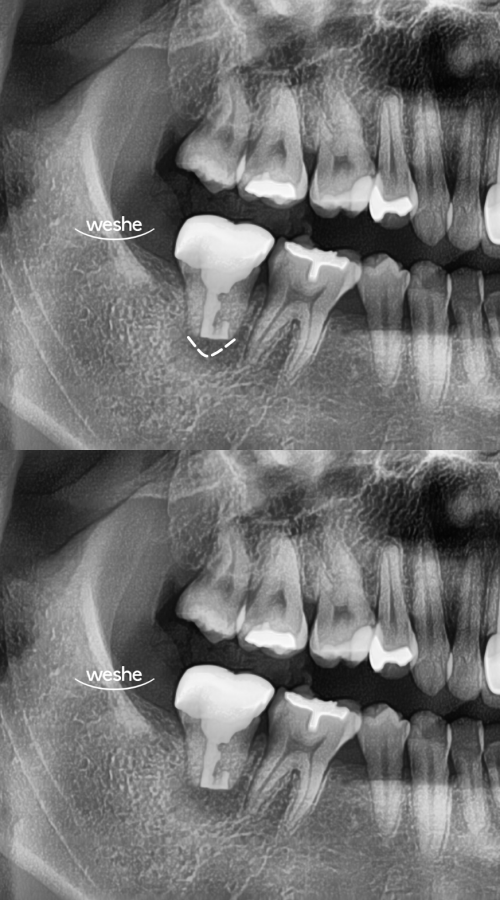
20250716
The inflammation is thoroughly removed,
and to prevent bacteria from penetrating the root canal,
biocompatible materials such as MTA are used
to perform retrograde filling and seal the area.
After that, the tooth is replanted
back into its original position and fixed in place,
and during this process, the extraoral time must be limited
to around 30 minutes
so that periodontal ligament cells can survive
and root resorption can be prevented.
It is fixed for 2 to 4 weeks after treatment,
and you should return after 3 days
to check whether there is any discomfort
and observe the progress.
Regular follow-up is also necessary afterward.
Post-treatment care and prognosis
At Maggok Dental Clinic,
after treatment,
we explain that during the stabilization period for the natural tooth,
you should avoid hard foods,
take the prescribed medication,
and maintain oral hygiene thoroughly.
After 2 to 4 weeks, the gum bone heals
and chewing function is restored,
but long-term survival rates may vary depending on
the size of the lesion, periodontal condition,
and the patient’s oral hygiene management.
Some studies have reported survival rates of more than 50%
even in cases with periodontitis.
A history of infection within the root canal or periodontitis,
as well as root fracture, can affect the prognosis,
so caution is needed.
If treatment fails,
it can be converted to implant treatment after extraction.
I believe preserving the natural tooth is important.
But rather than trying to save every tooth unconditionally,
it is a priority to provide the correct treatment direction
through an accurate diagnosis.
In the end, tooth replantation is one alternative
before extraction and implant treatment,
and an individualized plan is necessary.
This was Yeosangho, a dentist at Maggok Dental Clinic.
Thank you for reading this long post.
20250716