Hello : )
I am Yeo Sang-ho, a dentist at Magok Dental Clinic, working to create the beautiful smile you Wish for.
If you have already experienced toothaches several times
and have even had root canal treatment,
this word will naturally come to mind.
Ah... If it hurts again this time,
it really feels like I’ll have to extract it..
What should I do..?
I have seen many cases where people,
feeling completely hopeless,
keep putting off coming to the clinic.
What was truly regrettable was that
if they had come just a little earlier,
there might have been a way to save the natural tooth.
Even after root canal treatment,
if inflammation continues at the root tip,
and it seems impossible to treat
with conventional methods,
what solution can be provided?
What is dental reimplantation?
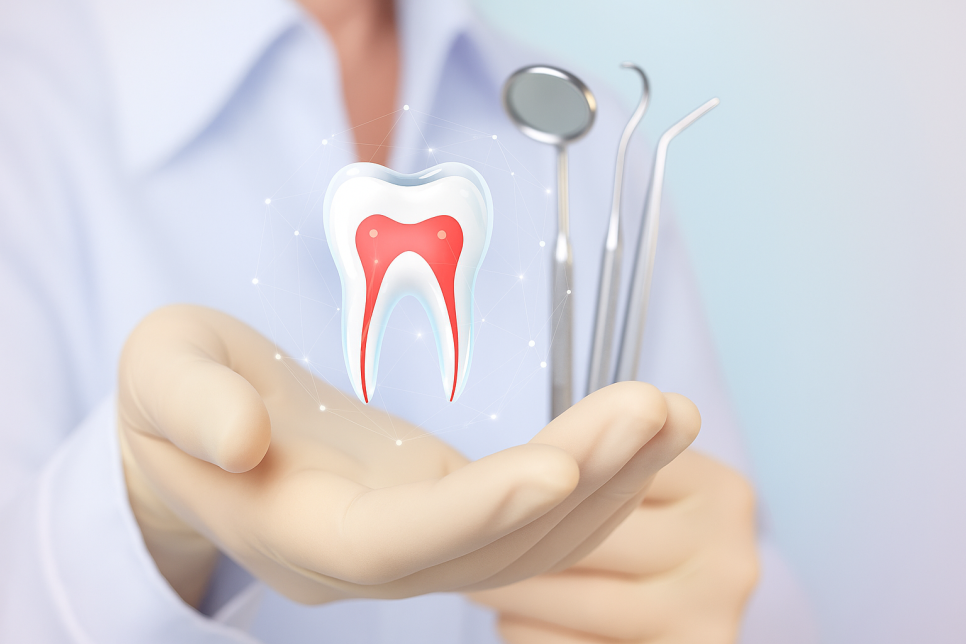
It is the last card for saving a natural tooth:
dental reimplantation.
At Magok Dental Clinic,
I will explain in detail what this is
and how the process works.
This solution removes the inflammatory and diseased tissue
located at the root tip and treats the tooth,
and can be performed when cases are difficult to resolve
with conservative root canal treatment or apical surgery.
For example, this applies to cases where retreatment is difficult,
such as apical lesions in anatomically hard-to-access locations,
severely curved root shapes,
or filling materials that remain deep inside.
This approach is known as a very advanced procedure,
and the reason is that
it involves extracting the tooth,
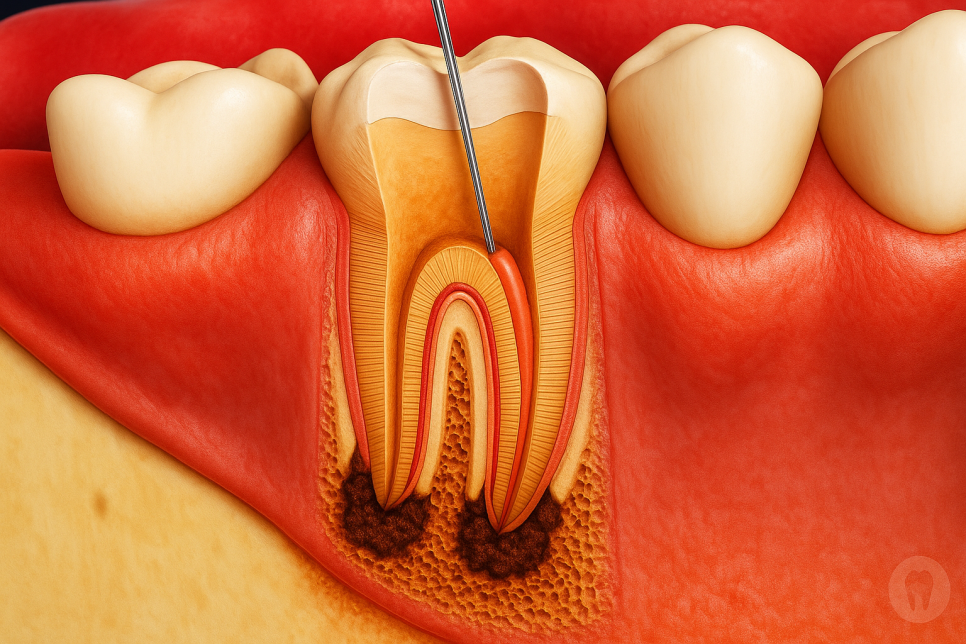
removing the inflammatory tissue at the root end,
performing reverse filling with MTA,
and then placing it back in the socket.
When I explain it like this, many people
ask back with a surprised expression:
Wait... that works..?
Yes, it does.
However, as mentioned earlier,
this is a method used for special cases,
so it is not recommended for everyone.
First, it can be performed when there is a lesion at the root tip
but the periodontal ligament and remaining bone
are in good condition,
and for this reason,
careful preoperative evaluation is carried out.
On the other hand, you may wonder,
'Is it really necessary to extract it?'
But if treatment is carried out inside the mouth as it is,
there are cases where it is difficult to secure visibility,
and cases where instrument access is limited,
and as mentioned earlier,
when there is a complex root structure,
you face the limitation of not being able to see it directly.
If we compare it to cleaning an air conditioner filter,
rather than just blowing dust away from the outside and spraying water,
it is better to open the cover and take out the filter
to clean it directly.
Likewise, once it is temporarily extracted like this,
you can directly observe the problem area under a microscope,
and you can also identify tiny accessory canals and cracks,
as well as perform accurate MTA reverse filling,
while also having the advantage of being able to completely remove
the infected area.
In the first place, it would have been best if the initial treatment had succeeded...
That is true. If the root canal treatment had gone well from the start,
and if follow-up care had been handled properly,
this stage might not have been necessary.
However, there are cases where that becomes difficult
for the reasons below,
and I will briefly explain them
at Magok Dental Clinic.
First, inside the crown there is not just a single canal,
but various structures including the main canal, accessory canals,
secondary canals, and the isthmus.
Also, their shapes differ slightly from person to person.
Because of this, depending on the case,
complex structures can create areas that cannot be accessed with standard tools,
and due to bacteria remaining in those areas,
pain can return as before.
And this kind of decay and pain
does not arise from the area where a prosthesis is placed.
Tiny gaps at the edge of the prosthesis,
cracks so small they are not visible to the eye..
Bacteria can invade through places like these,
and because the tooth that has undergone root canal treatment
has lost its nutrient supply,
its structure becomes much more fragile.
So if bacteria invade through such paths,
it can break down easily, so caution is needed.
Dental reimplantation process
Now I will explain in detail the process of reimplantation,
which is performed for the reasons mentioned above,
at Magok Dental Clinic.
1️⃣ First, as the initial step,
a oral and radiographic examination is performed.
Based on the X-rays taken this way,
we decide in which direction treatment should proceed.
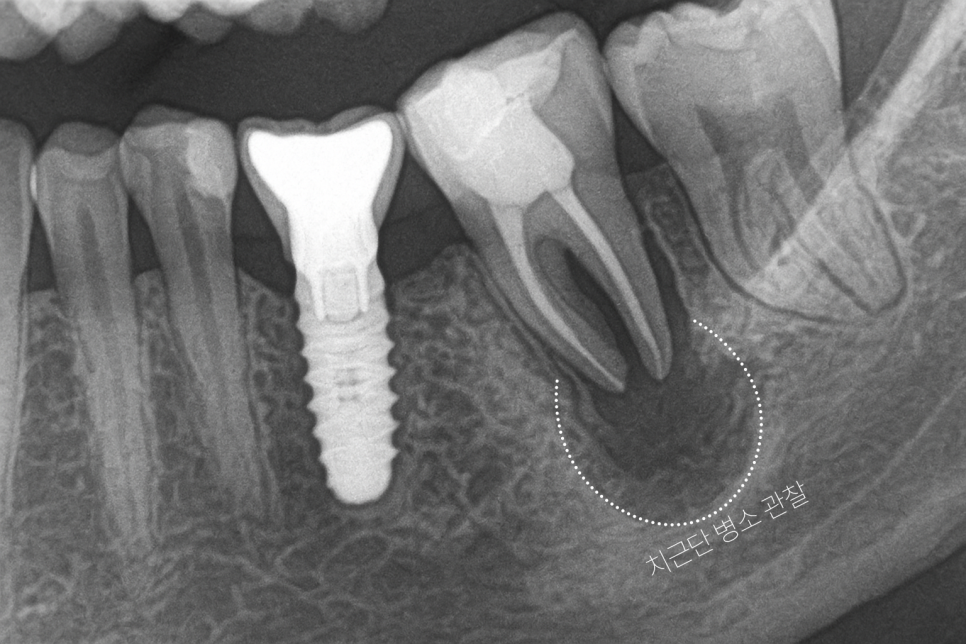
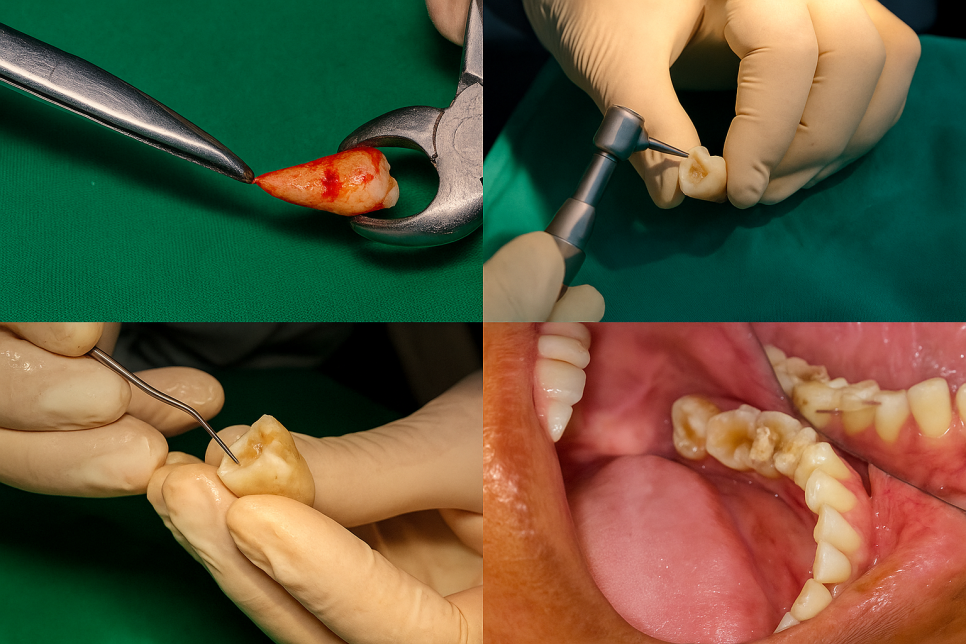
2️⃣ From here, I will explain using one case as an example.
The photo above is of the first lower molar on the left side,
and it shows traces of previous root canal treatment.
Through this, an apical lesion was identified,
and reinfection was finally confirmed.
Fortunately, the periodontal ligament and remaining bone
were in relatively good condition,
so it was decided to proceed with reimplantation.
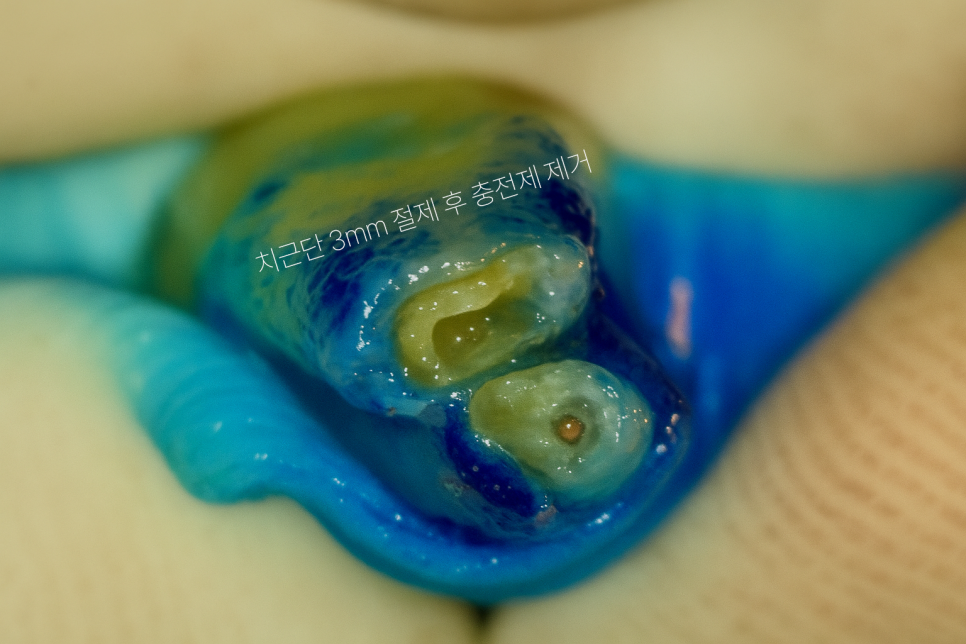
3️⃣ For reference, extraction at this stage
is performed using specially made instruments,
not standard tools.
After extraction, the area where the inflammation is located is cut away,
and some of the previously filled material is scraped out.
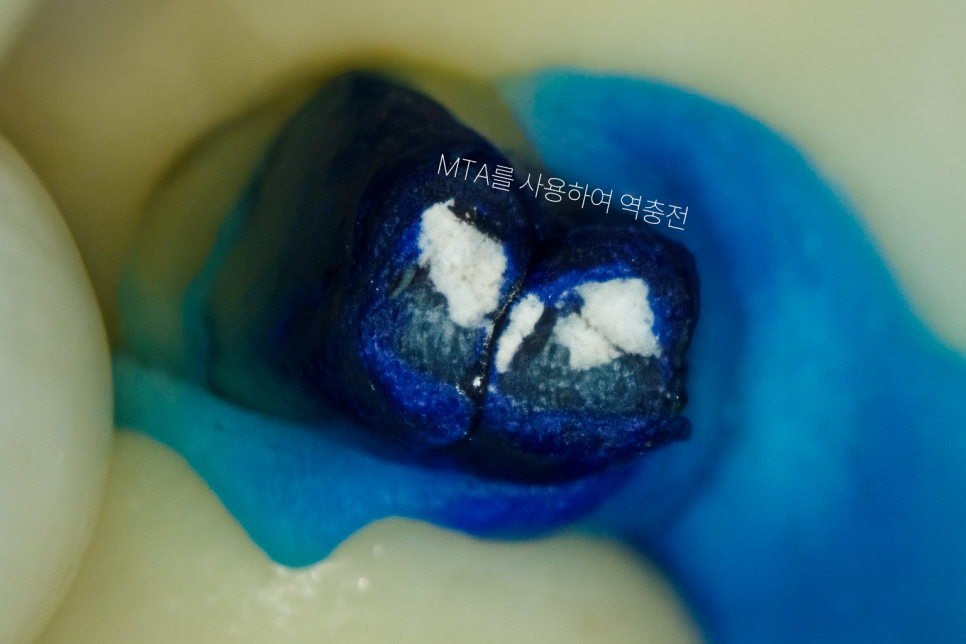
4️⃣ After that, through the resected apical surface of the scraped area,
a biocompatible material called MTA (Mineral Trioxide Aggregate)
is reverse-filled.
This can help tissue regeneration
and increase the success rate of the procedure.
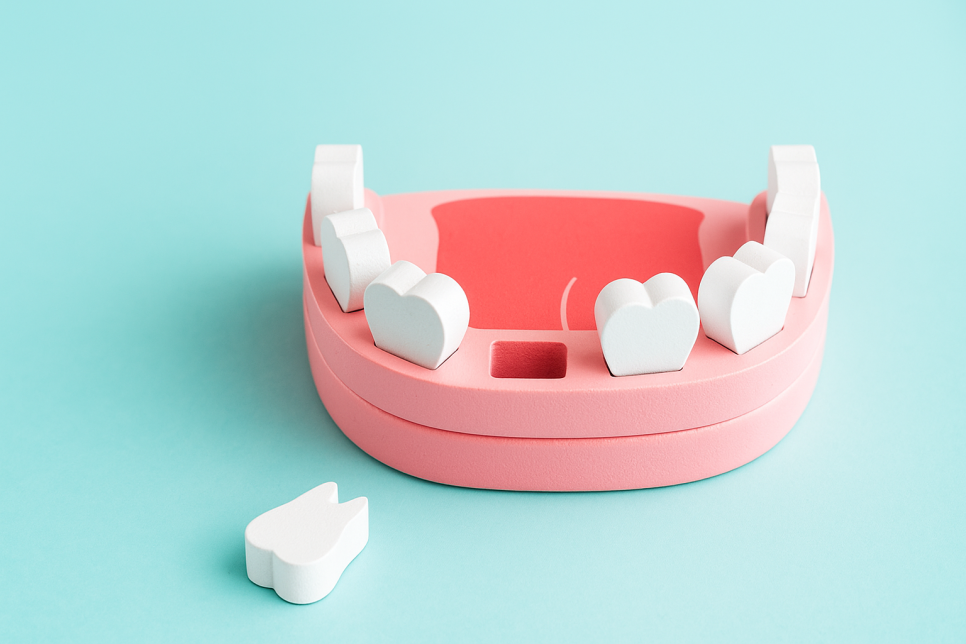
Once the MTA filling is completed,
the tooth is placed back into the original alveolar socket,
which is the socket corresponding to the jawbone.
Then, to ensure it is stably positioned,
it is temporarily fixed to adjacent areas.
All of these steps are carried out carefully
to avoid damage, and quickly within 30 minutes.
That is because this helps improve stability
and the success rate.
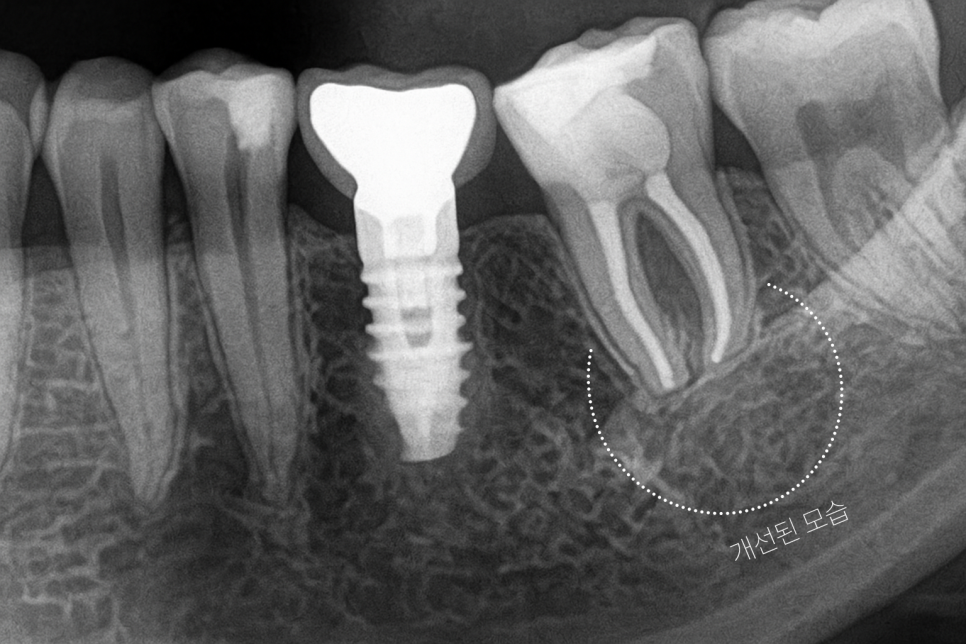
5️⃣ After all procedures are completed,
we carefully monitor the progress for about 2 to 3 months
and observe the prognosis.
In the case above, things fortunately went well,
and the inflammatory issue showed significant improvement.
Important precautions

Next, I will summarize what should be taken care of
at Magok Dental Clinic.
First, immediately after the procedure,
you must not touch the area with your hand or tongue.
Because the reinserted part has not yet firmly bonded
with the gum, even small movements can
cause failure of adhesion.
Therefore, when brushing, avoid that area
and gently clean only the surrounding areas,
and I recommend using chlorhexidine mouthwash
as prescribed.
To reduce swelling and pain,
continue cold compresses,
and avoid hard or chewy foods;
it is better to build your diet around soft liquids
such as porridge, soup, and rice gruel.

Also, absolutely avoid smoking and drinking.
These can interfere with blood flow and increase the infection rate,
which can further raise the chance of failure.
In addition, be sure to return for a follow-up exam within 1 to 2 weeks
to check whether it has been properly placed,
whether it has adhered well, and whether there is any infection.
It is important not to forget to take the antibiotics
and anti-inflammatory pain relievers that were prescribed.
Also, during this period, it is recommended to avoid activities
that can significantly raise body heat,
such as intense sports or hobbies,
going to places like saunas or jjimjilbangs,
or eating very hot soup dishes.
When body heat increases, blood flow increases,
and this raises the possibility of bleeding.
Even after things seem to have stabilized to some extent,
you should continue regular checkups every 3 to 6 months,
which is tighter than usual.
We also advise avoiding hard or chewy foods
with that tooth.
The reason is that its durability is much lower
than that of surrounding natural teeth.
Please maintain good oral hygiene
so that decay does not occur again,
and if you feel tooth sensitivity, pain, or a foreign-body sensation,
please contact us immediately.

I hope you can keep your natural tooth healthy
after it gets another chance through this solution.
And to do that,
please make sure to understand the points mentioned above well
and put them into practice in daily life.
And once again, I would like to emphasize:
This solution is performed with the preservation of the natural tooth
as the top priority,
but it cannot be recommended to everyone,
and depending on the case,
implant treatment may be a better option.
This procedure can be seen as the last card
a person can use before that.
Therefore, I ask you to pay even more attention
to your oral health in everyday life,
and I will conclude today's post prepared by Magok Dental Clinic.
Thank you to everyone who read this long post.
Thank you.