Hello.
This is a dental clinic near Magok Station.
Among those who have undergone root canal treatment,
many may have thought this.
For some people, it ends in just one or two visits,
while in other cases, they come in three or four times.
Why is there such a difference for the same treatment?
Naturally, anxiety can arise,
and you may worry whether
the treatment is being done incorrectly.
To start with the conclusion,
all teeth have different structures,
and molars, in particular, are structurally much more complex
than front teeth.
Today, together with the dental clinic near Magok Station,
we will look at the anatomical characteristics of molars
and explain in detail why they are more challenging.
-
The Number of Root Canals Differs by Tooth
-
The Complexity of Root Canals
-
For More Difficult Treatments,
Accurate Diagnosis Is Essential.
-
Closing Remarks
-
The Number of Root Canals Differs by Tooth
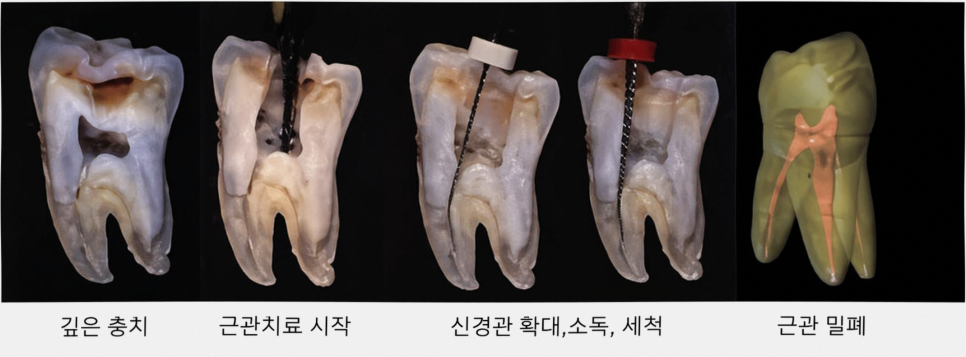
Root canal treatment is the process of finding the nerve canal inside the tooth,
that is, the root canal, removing the nerve and blood vessel tissue,
and filling the empty space.
The key part of this process is to find every root canal without omission
and perform every step accurately.
If even one is missed,
there is a high chance bacteria will grow inside,
which can lead to retreatment.
In front teeth, most teeth have one root canal.
They are relatively easy to locate,
and the instruments are easier to handle.
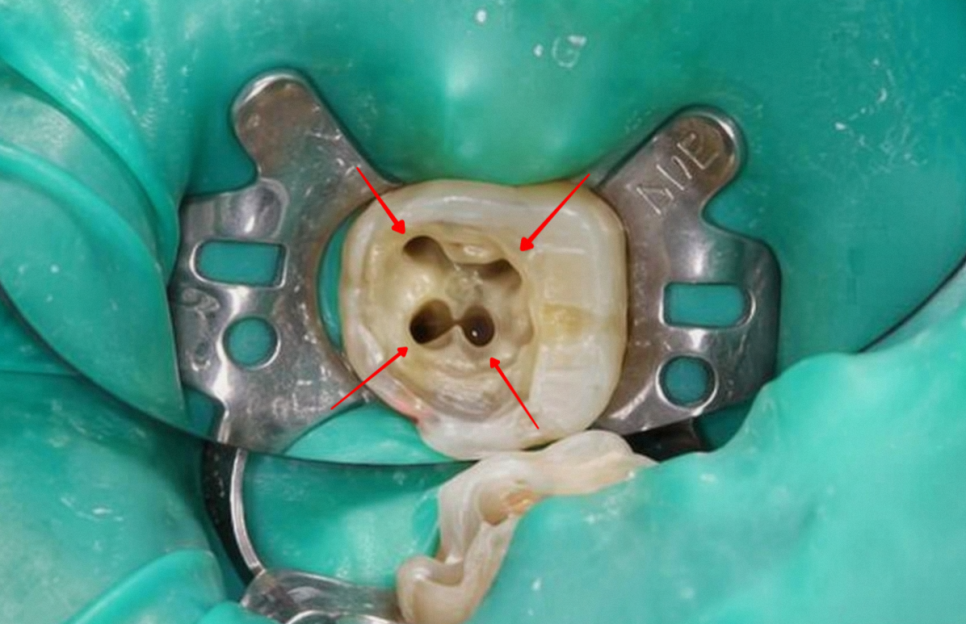
However, maxillary molars have an average of 3 to 4 root canals,
and in some cases, there can be as many as 5.
There are also cases where additional root canals,
which are difficult to confirm with the naked eye,
are hidden inside, so missing them is not uncommon.
Having this many root canals means
there are more passages to find
and more steps to complete as well.
- The Complexity of Root Canals
As the dental clinic near Magok Station explained earlier,
it is not only the number of root canals that matters.
The root canal in a front tooth is relatively straight
and has a simple structure.
By contrast, molar root canals are often narrow,
may have bends in the middle, or become sharply curved
as they approach the end.
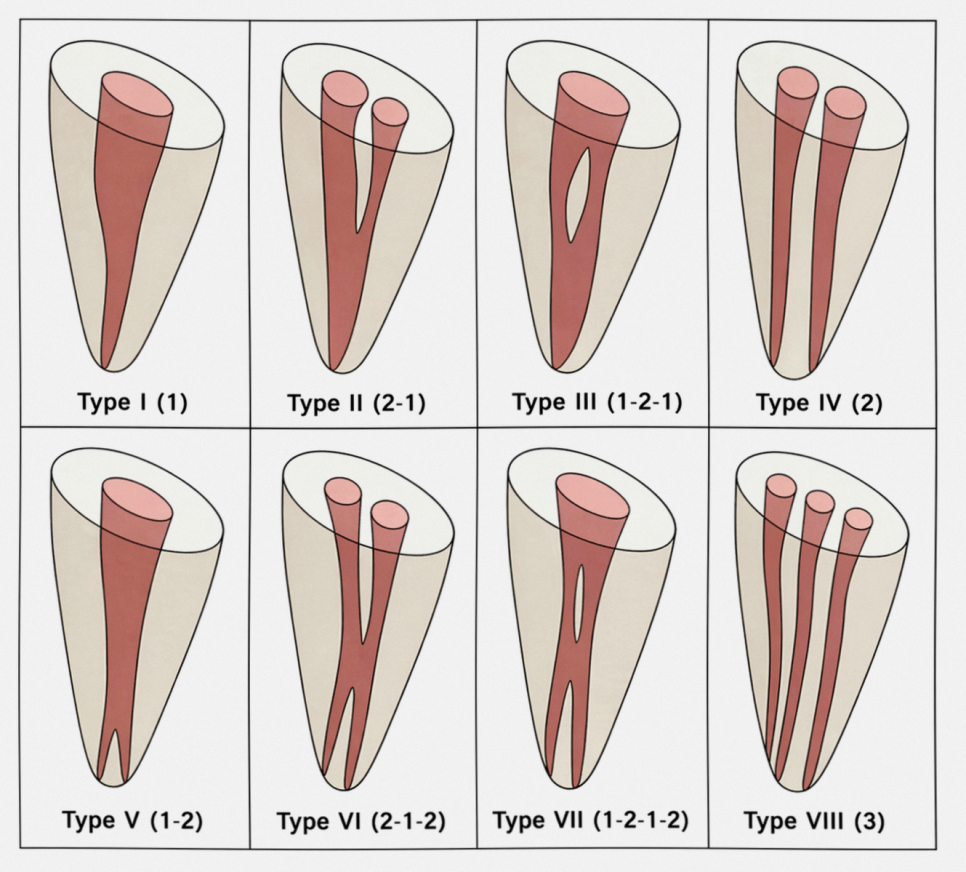
In rare cases, they may bend into an S-shape,
or two root canals may merge in the middle,
forming that kind of structure.
In such cases, it is difficult for the treatment instruments
to reach the end accurately.
If force is applied, the instrument can bend or break,
and the more carefully it is approached,
the longer the treatment time inevitably becomes.
In addition, molars are located deep inside the mouth,
so not only is it difficult to secure a clear field of view,
but there are also limitations in the angles at which instruments can be handled.
Since the procedure is carried out under many unfavorable conditions,
it is only natural that it is difficult to compare with simple front teeth.
- For More Difficult Treatments,
Accurate Diagnosis Is Essential.
Of course, just because it is difficult
does not mean it should be given up on.
Root canal treatment is close to the last resort
for preserving a natural tooth.
The longer the treatment is delayed,
the higher the likelihood that extraction will be necessary,
and that can affect not only chewing function
but also the surrounding tissues.

As mentioned earlier by the dental clinic near Magok Station,
the success of root canal treatment depends on how accurately
the entire root canal system is identified.
To do this, before treatment, a CT scan is taken
to identify the number and shape of the root canals
and the direction of any curvature,
then a treatment plan is established.
Additional root canals or complex branching structures,
which are difficult to identify with a standard panoramic X-ray alone,
can also be checked three-dimensionally.
The more accurately the structure is understood in advance,
the fewer unexpected variables there will be during treatment,
creating a foundation for more thorough care.
- Closing Remarks
If the number of visits feels longer,
that is closer to meaning that the treatment is being carried out accurately
while checking each complex structure one by one.
The longer the treatment process feels,
the more natural it is to feel anxious.
At times like that, it is also a good idea to ask
how far the treatment has progressed and
how many more visits may be needed.
Simply knowing the progress can make vague anxiety
feel much less overwhelming.
Then let us finish by organizing a few questions
frequently asked at the dental clinic near Magok Station.
Q1. Is it okay to have pain after root canal treatment?
A dull ache for a few days right after treatment
is due to irritation of the surrounding tissues,
and it usually subsides within a few days.
However, if it continues for more than a week or gets worse,
you should visit the clinic promptly for an evaluation.
Q2. Is it true that teeth become weaker after root canal treatment?
When the nerve and blood vessels are removed,
the supply of moisture and nutrients is blocked,
so the tooth tends to become drier.
That is why a crown is restored,
and if there is an issue with the prosthesis,
you should have it checked.
Q3. Is retreatment possible?
This is called retreatment of the root canal,
and it is performed to preserve the natural tooth
when there are infectious factors missed during the previous procedure.
In many cases, it is more difficult than the first treatment,
but if there is still a possibility of preservation,
retreatment is generally considered first.
Thank you.
This was the dental clinic near Magok Station.