Hello, I’m Lee Soo-kyung, a specialist in integrated dentistry.
Have you heard of the two major oral diseases?
It refers to two common diseases related to the mouth,
and cavities and gum disease fall into this category.
As teeth decay and inflammation develops in the gums,
if it continues to worsen and spread more widely,
it can eventually threaten the preservation of the natural teeth.
This can lead to a situation where a tooth needs to be extracted,
and in such cases, another alternative is needed to replace the natural tooth.
Implants are the most representative option,
and many people seem to wonder when they should be placed after extraction,
as well as about the placement timing.
So today, I’ve prepared some related information.
Let’s begin this post from a Magok-dong dentist.
Classification by placement timing.
Placement timing can be broadly divided into three categories.
-
immediate immediate implantation
= A method of placing the screw immediately after extraction.
-
delayed immediate implantation
= Surgery is performed after allowing only the gums (soft tissue)
to recover for about 2 to 8 weeks.
- late implantation
= After allowing sufficient time of about 4 to 6 months,
surgery is performed after the surrounding bone tissue has also healed.
An implant places a fixture that serves as the root, like a natural tooth,
into the bone to obtain support.
This is why it can reproduce about 70–80% of the force of a natural tooth.
Because of this, what determines the success and stability of the treatment is
osseointegration.
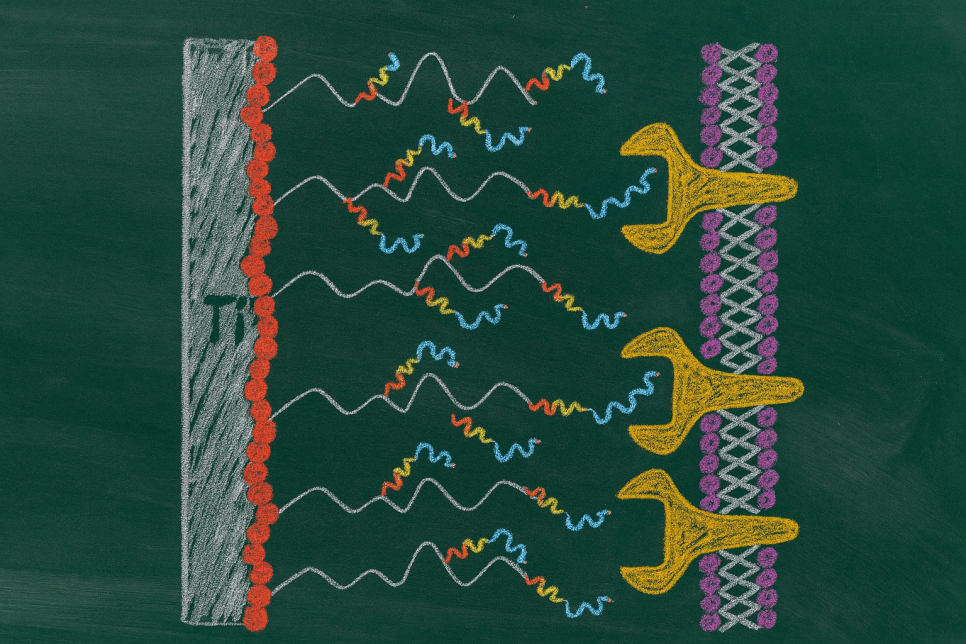
What is osseointegration?
This concept was first discovered by a Swedish researcher named Brånemark.
He conducted an experiment in which titanium was inserted into a rabbit’s leg bone and the microvessels inside the bone were observed.
When the experiment was over and he tried to remove the titanium, it would not come out.
The reason was that the bone and titanium were so firmly attached
that they seemed to have become one.
This is due to the concept of adhesion.
It means the titanium and bone tissue bond together
so firmly that they seem to become one.
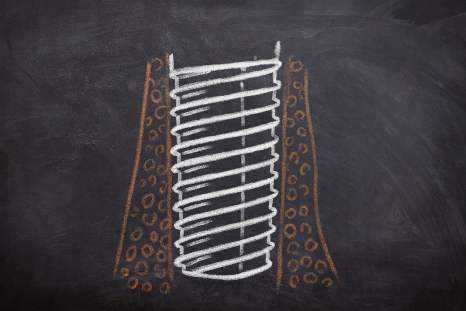
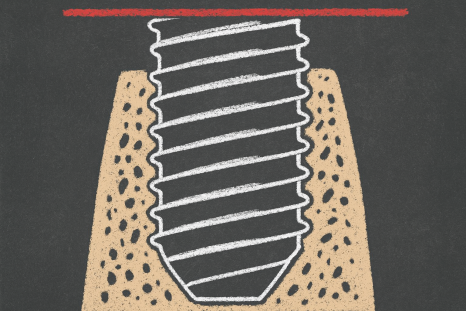
This process must proceed smoothly in order to replace the function of a natural tooth,
and if the osseointegration process does not occur well,
it will be difficult for the implant to perform its role.
So the placement environment is made solid,
to provide a foundation so that healing can proceed smoothly.
Magok-dong dentist Lee Soo-kyung
Then when is immediate placement possible?
If the environment requiring the screw to be placed is poor due to inflammation,
it is better to allow some healing first.
This is because a better oral environment leads to smoother healing
and faster recovery.
On the other hand, if there are no special issues,
you can benefit from immediate placement after extraction.
If extraction and implant surgery are done separately,
a person has to be anesthetized twice.
If both are done at once,
the number of times anesthesia is needed can be reduced.
In addition, as the healing period is shortened,
the overall treatment time also becomes shorter.
Then the function of the lost tooth can be restored more quickly,
reducing the patient’s discomfort.
I think this is why many people prefer immediate placement.
Magok-dong dentist Lee Soo-kyung
Let me explain with an example case.
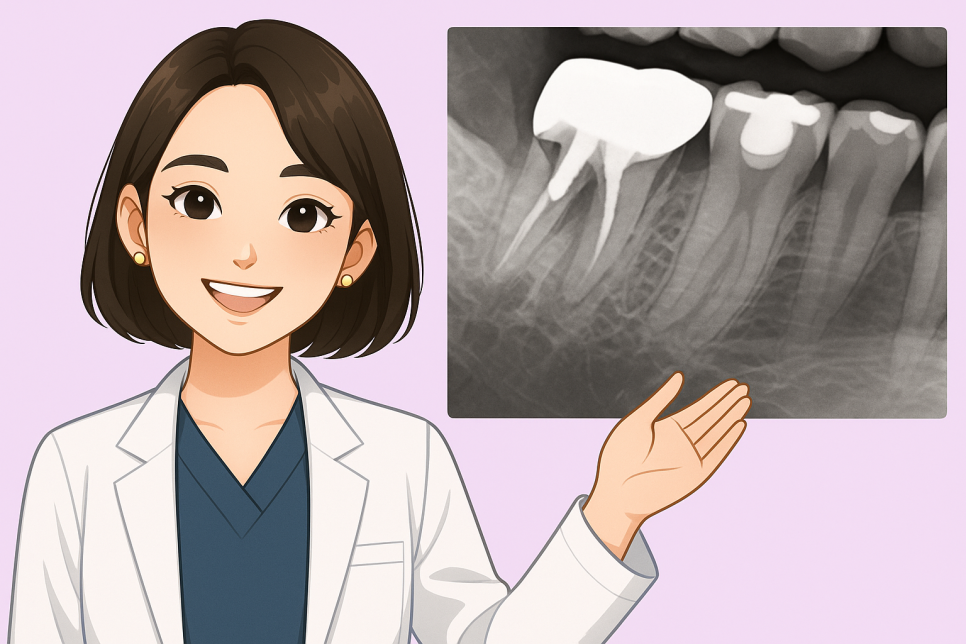
If you look at the photo prepared by the Magok-dong dentist,
after root canal treatment, inflammation has developed and
bone loss extending to the root furcation area is clearly visible.
Although some bone has been lost,
the extent was not severe,
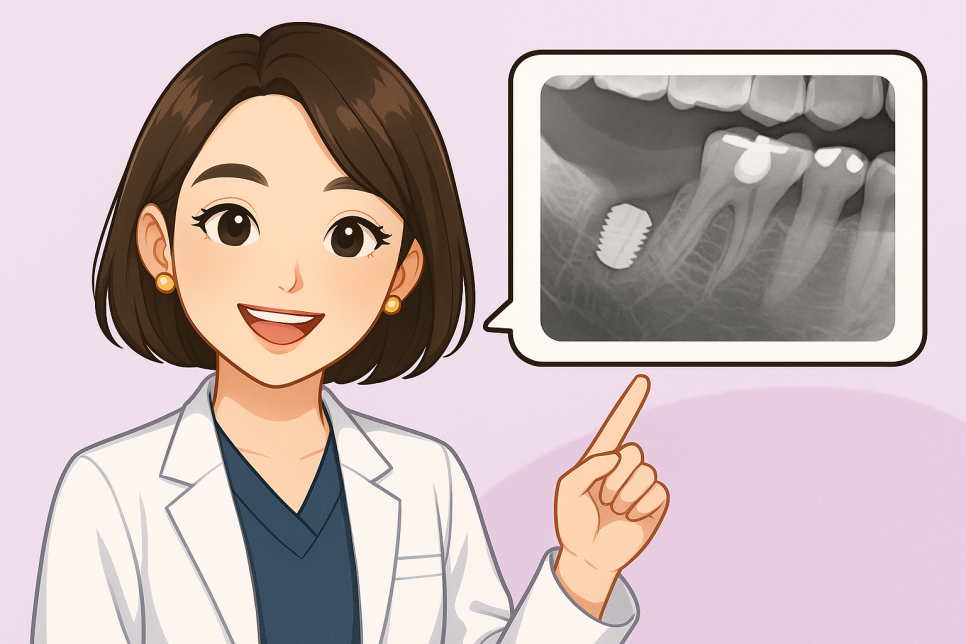
and since enough bone tissue necessary for placement was secured,
immediate placement is judged to be possible.
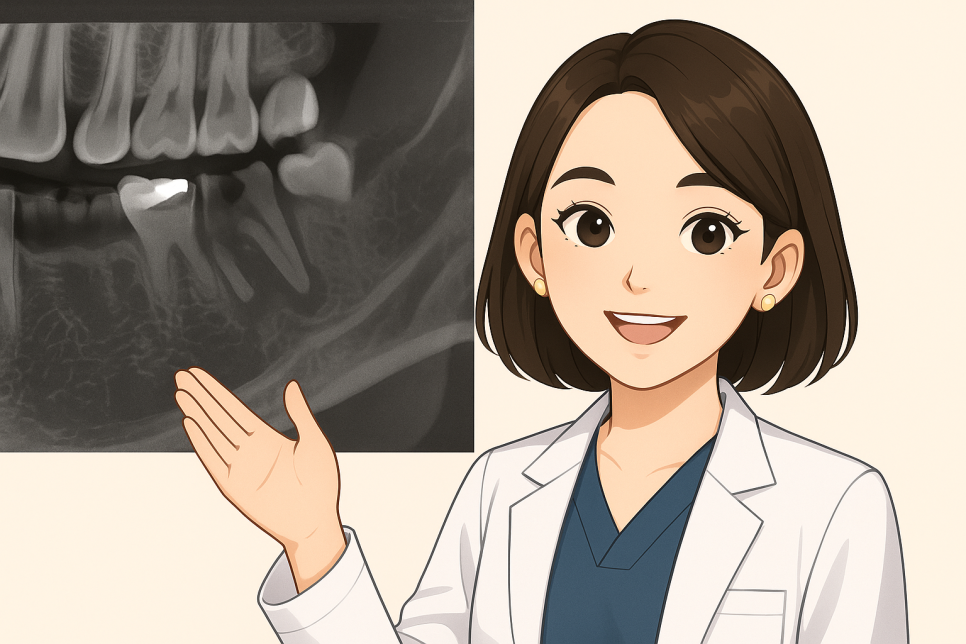
On the other hand, this is a case where the bone tissue is severely destroyed
and a very clear radiolucent pattern is observed.
You can see that the inflammation appears to be surrounding the molar, right?
In such cases, it is close to the inferior alveolar nerve canal below,
so it is difficult to place the screw right away.
Also, because enough bone tissue is not secured,
stable fixation cannot be achieved.
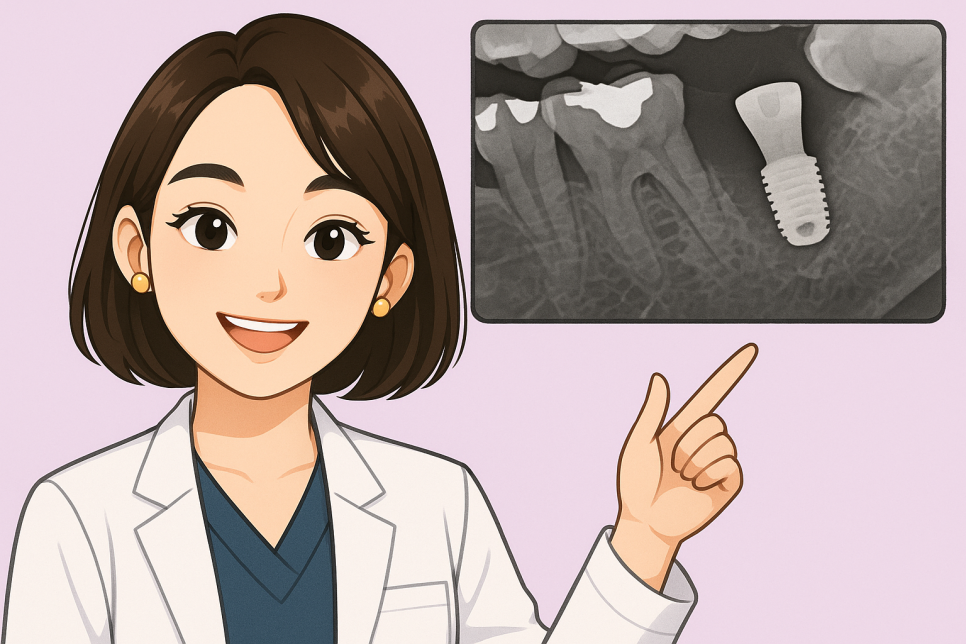
In such cases, placing the screw after a healing period
will lead to much more favorable results.
Magok-dong dentist Lee Soo-kyung
Can I have it placed whenever I want?
If healing is needed,
it is better to go through recovery first, but
if a tooth is simply left untreated for a long period after extraction,
it can lead to various problems.
Due to the loss of the opposing tooth that it bites against,
the tooth may rise upward and become overerupted,
and nearby teeth may tilt into the empty space,
creating an inclined tooth axis.
In addition, as the bone tissue shows signs of resorption,
this may also lead to a situation where additional bone grafting is needed.
Therefore, although going through a healing period is good,
it is important to determine the correct timing for placement
through ongoing consultation with the attending dentist.
How was the information prepared by the Magok-dong dentist?
I hope it was helpful to you, and I’ll wrap up here.
Next time, I’ll be back with information about wisdom tooth extraction.
If you are wondering when it should be extracted,
or if you have been putting it off because you are afraid of the pain when it is removed,
I am preparing a post that may be helpful,
so please look forward to the next one as well.
This has been Lee Soo-kyung, a specialist in integrated dentistry at a Magok-dong dental clinic.
Thank you.