Hello, this is Balsan-dong Dental Clinic.
I am Lee Su-gyeong, a specialist in integrated dentistry.
If you feel a sharp pain when chewing
or react especially sensitively to cold foods,
there is something you should suspect at least once.
That is Cracked Tooth Syndrome
(Cracked Tooth Syndrome, CTS).
Even if a tiny crack has formed,
it often goes unnoticed without any symptoms,
which is why detection itself is often delayed.
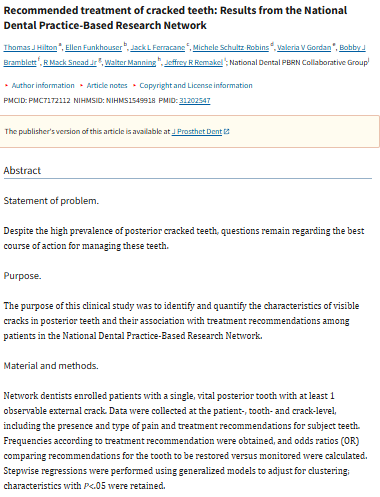
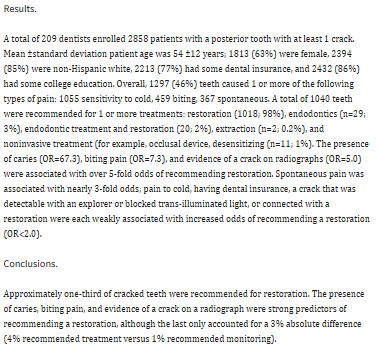
Source: https://pmc.ncbi.nlm.nih.gov/articles/PMC7172112/
In a clinical study that analyzed 2,858 patients with cracked teeth,
the proportion who experienced pain was only 46%.
In other words, more than half of the patients
had cracks but did not feel any particular symptoms.
To put it another way,
there were many cases where people did not know
that a crack existed.
Today, at Balsan-dong Dental Clinic,
we will take a closer look at
cracked tooth syndrome.
Balsan-dong Dental Clinic Oral Information
- Causes of cracks in teeth
Teeth may look hard from the outside,
but when repeated force accumulates,
fine cracks can gradually form.
The most common cause is
repeated chewing of hard foods.
When you frequently chew foods
that place strong impact on the teeth,
stress concentrates on specific areas,
and this becomes the starting point of a crack.
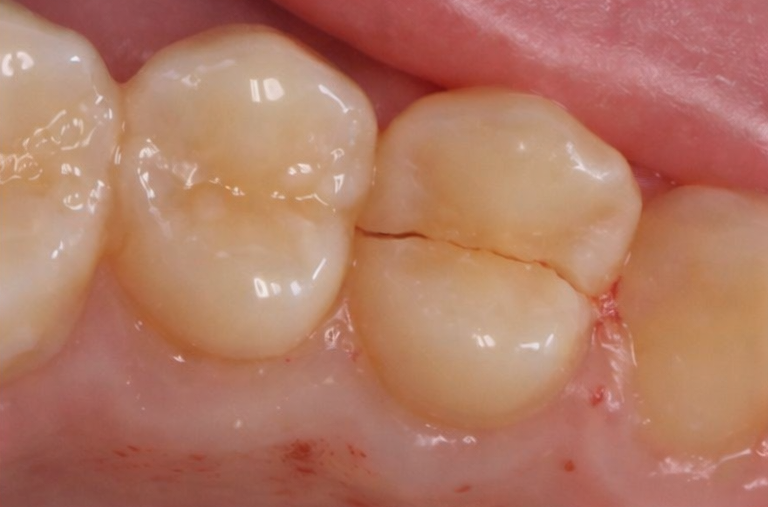
Teeth grinding during sleep (bruxism) and
the habit of clenching the jaw are also major causes.
Because excessive force is repeatedly applied
without the person even realizing it,
a crack may progress
even without obvious symptoms.
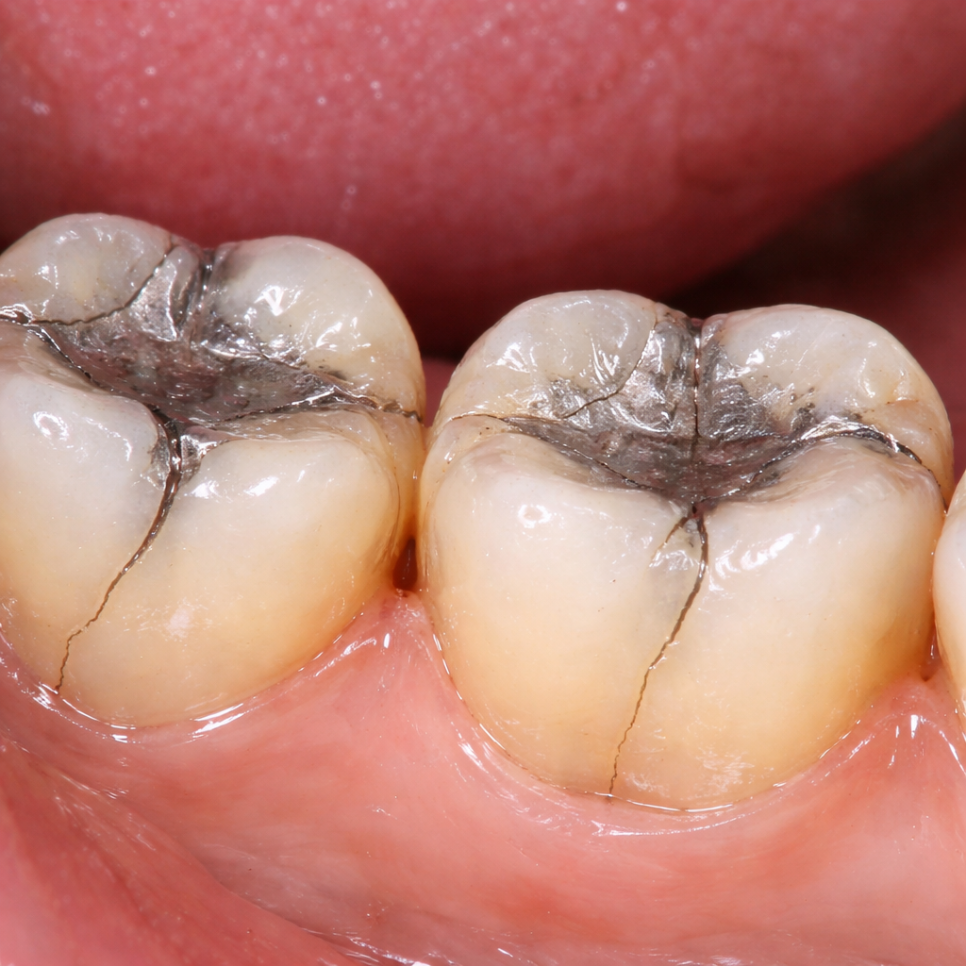
Natural teeth with large or old fillings
can also become more vulnerable to cracking
as they expand and contract slightly with temperature changes.
Balsan-dong Dental Clinic Oral Information
- Why diagnosis is difficult and the main symptoms
The reason CTS is tricky is that
a crack line is rarely captured
on a standard X-ray.
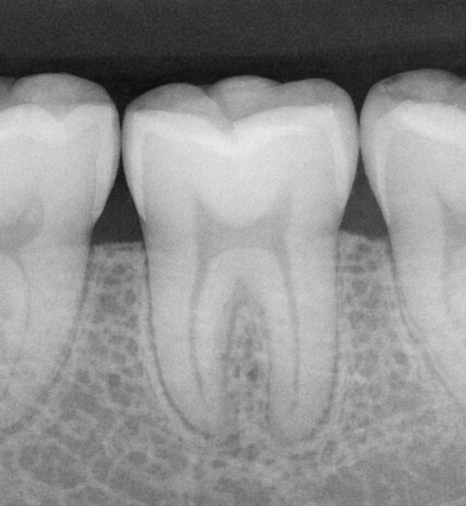
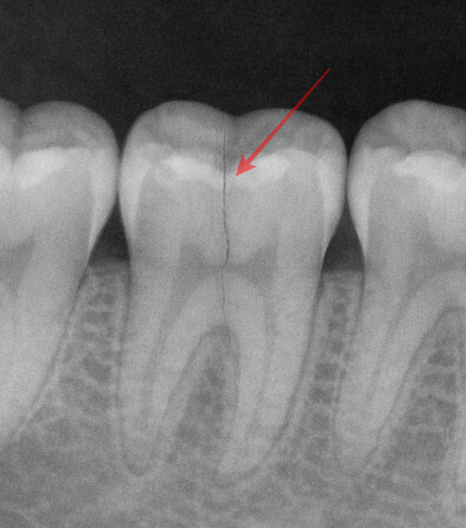
This is an example of a tooth crack for easier understanding.
This is because if the direction of the crack is
parallel to the direction in which the X-rays pass,
it will not appear on the image.
The typical symptom is a sharp pain that appears
momentarily when chewing in a certain direction.
It does not continue,
and it is characterized by appearing only at the moment of chewing
and then disappearing,
so if you repeatedly react sensitively to
cold or sweet foods,
or if it is difficult to pinpoint the location of the pain,
you should keep the possibility of a crack in mind.
Balsan-dong Dental Clinic Oral Information
- Treatment direction depending on the depth of the crack
The treatment method depends on how deep
and how widely the crack has progressed.
If it is an early stage limited
to the outermost layer, the enamel,
the symptoms are often almost absent
or very mild.
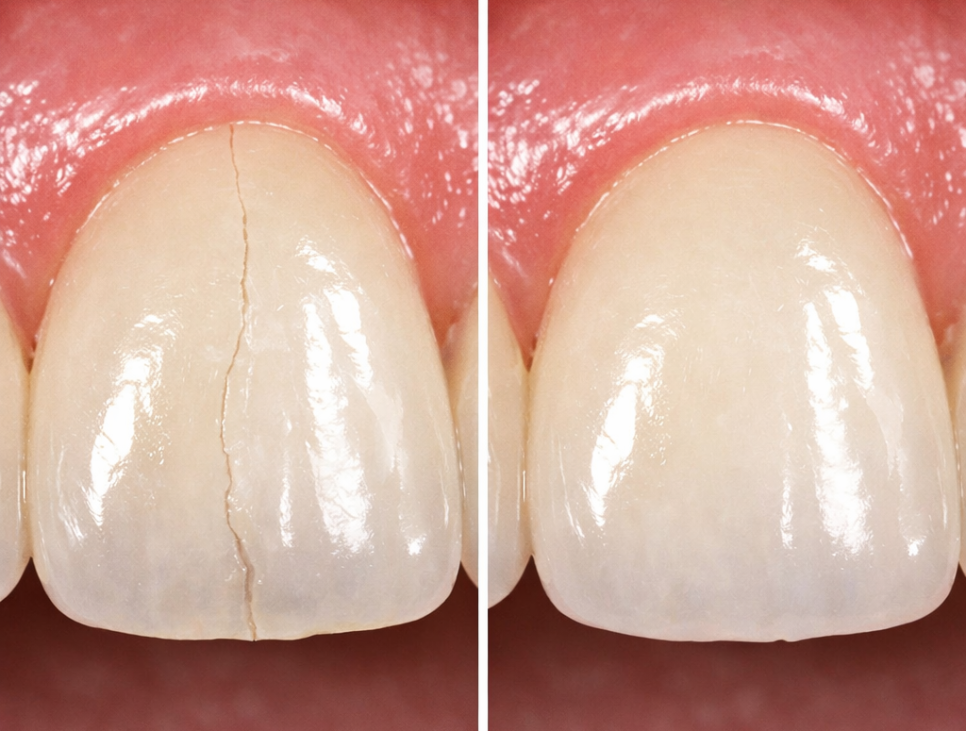
At this stage, monitoring the condition or
reinforcing it with resin
may be enough for proper management.
However, if it progresses to the dentin
and pain repeatedly occurs when chewing,
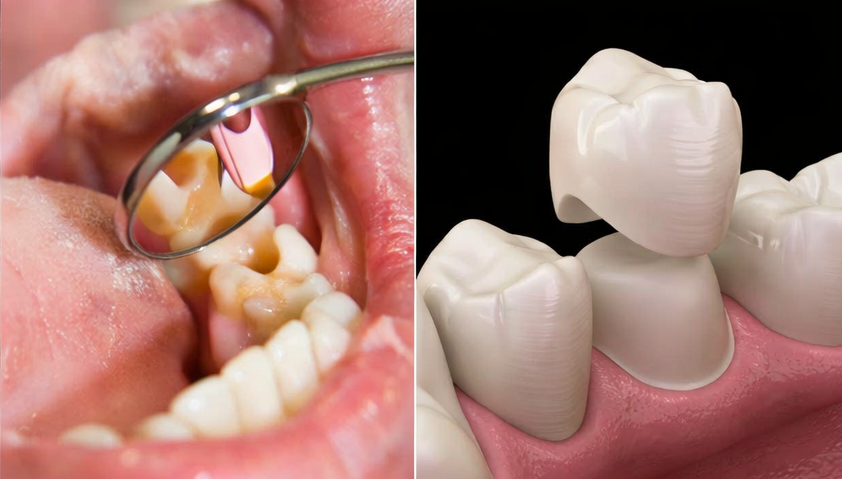
a crown that covers and encases the tooth
to prevent the crack from expanding
is generally recommended.
If the crack goes deeper
and affects the pulp (nerve),
root canal treatment is needed, and
if it extends vertically down to
the root,
it becomes difficult to preserve the tooth,
so extraction may be necessary.
Therefore, checking in advance through regular checkups
is the most practical way to keep your teeth for a long time.
Balsan-dong Dental Clinic Oral Information
- In closing - final thoughts
Because tooth cracks have vague symptoms
and are difficult to diagnose,
if you extract a tooth because the pain seems mild,
the crack may deepen and the scope of treatment
may become wider.
In daily life, reduce habits such as chewing ice
or excessively chewing hard foods,
and if you have a teeth-grinding habit,
it is a good idea to consider wearing
a stabilization appliance (mouth guard).
If a sharp pain repeats every time you chew,
even if there is no cavity,
please visit a nearby clinic and check whether there is a crack.
This was Lee Su-gyeong from Balsan-dong Dental Clinic. Thank you.