Hello, this is Ujangsan Station Dental Clinic.
I’m Lee Su-kyung, a specialist in integrated dentistry.
Have you ever felt that your tooth was loose?
If it wasn’t very severe,
most people tend to just let it go.
However, this signal can be examined carefully
as a problem with the periodontal tissue.
What we commonly call the “gums”
is actually part of a much more complex structure
that surrounds and supports the teeth.
The reason natural teeth can stay firmly
in the mouth is because
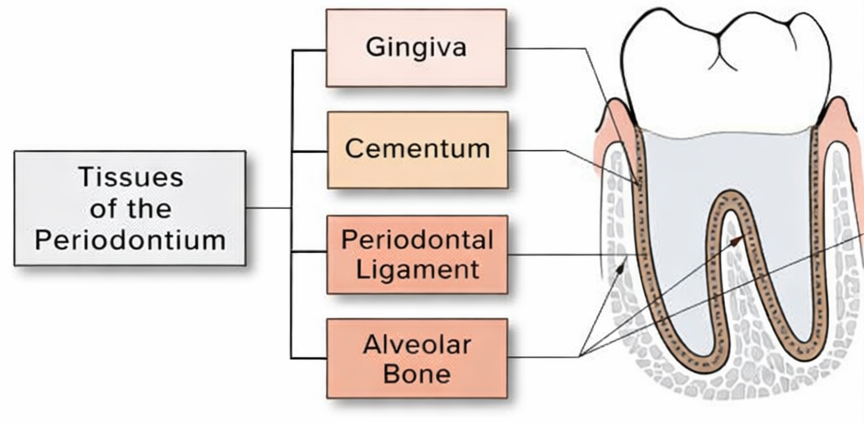
the gingiva, periodontal ligament,
cementum, and alveolar bone
work together organically.
When any one of them begins to fail,
the others are affected in sequence.
Today, let’s take a closer look at
what role these four periodontal tissues each play,
and what happens to the teeth
when this structure breaks down.
Ujangsan Station Dental Clinic Oral Information
- The Four Periodontal Tissues That Support the Teeth
The four tissues surrounding the root—
that is, the gingiva, periodontal ligament, cementum, and alveolar bone—
work together to hold the teeth in place.
The gingiva, visible from the outside,
acts as a first line of defense
that prevents bacteria from invading toward the root.
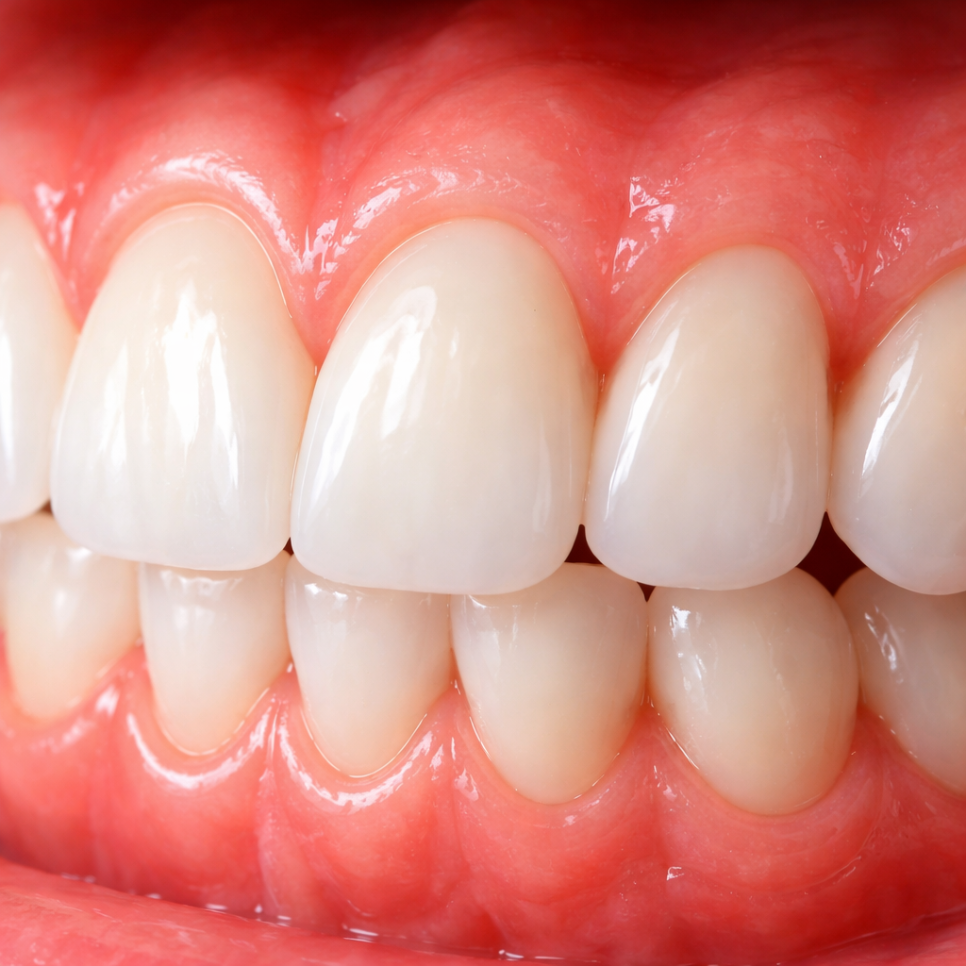
Healthy gingiva has a light pink color,
is firmly attached to the natural tooth,
and the gingival sulcus, the space between the tooth and the gingiva,
normally remains 3 mm or less.
Cementum, which covers the root surface,
is a hard tissue with properties similar to bone,
and provides the foundation for periodontal ligament fibers
to anchor to the tooth.
Beneath that is the jawbone surrounding the root,
which is the alveolar bone.
The alveolar bone disperses the forces placed on the teeth,
and forms the structural foundation
that allows the teeth to maintain a stable position.
Ujangsan Station Dental Clinic Oral Information
- The Periodontal Ligament, a Precise Connecting Structure Between the Tooth and Bone
Among the four tissues, the one most often overlooked
but functionally essential is the periodontal ligament (PDL).
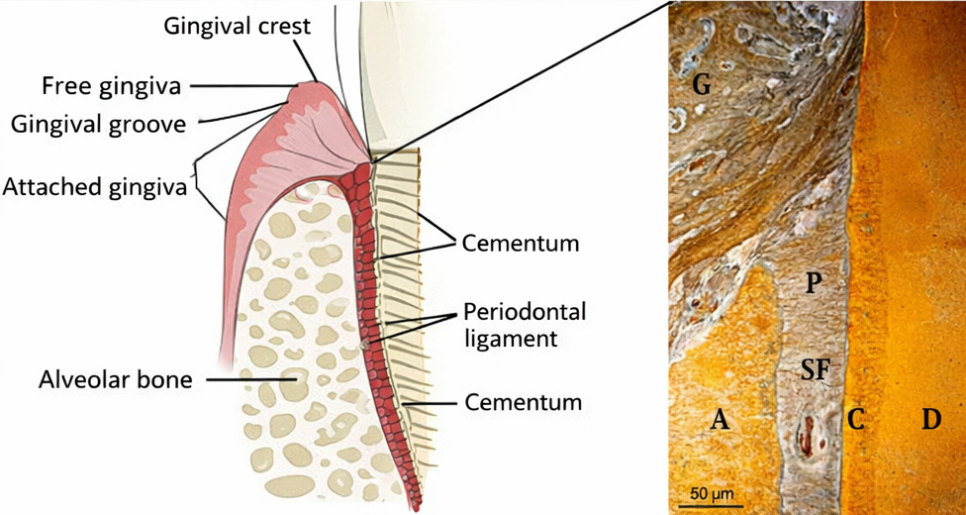
The PDL is a thin fibrous tissue
that exists between the cementum of the root
and the alveolar bone,
and its thickness is only about 0.15 to 0.38 mm.
However, within this thin structure,
numerous bundles of collagen fibers
are arranged in different directions,
so that chewing force, biting force, and horizontal force
are all evenly distributed to the alveolar bone.
Another important function of the periodontal ligament
is sensory transmission.
The periodontal ligament contains abundant
pressure and pain receptors,
which help perceive the texture and hardness of food
and send signals to the brain when excessive force is applied.
This is also why implants
cannot provide the same delicate sense of touch
as natural teeth.
In addition, the periodontal ligament
keeps the tooth from being completely fused to the bone,
maintaining it in a slightly suspended state,
which creates a structure that absorbs impact
from occlusal force like a spring.
Ujangsan Station Dental Clinic Oral Information
- When Periodontal Tissue Breaks Down,
From Inflammation to Tooth Loss?
Destruction of periodontal tissue usually begins
with bacteria in dental plaque.
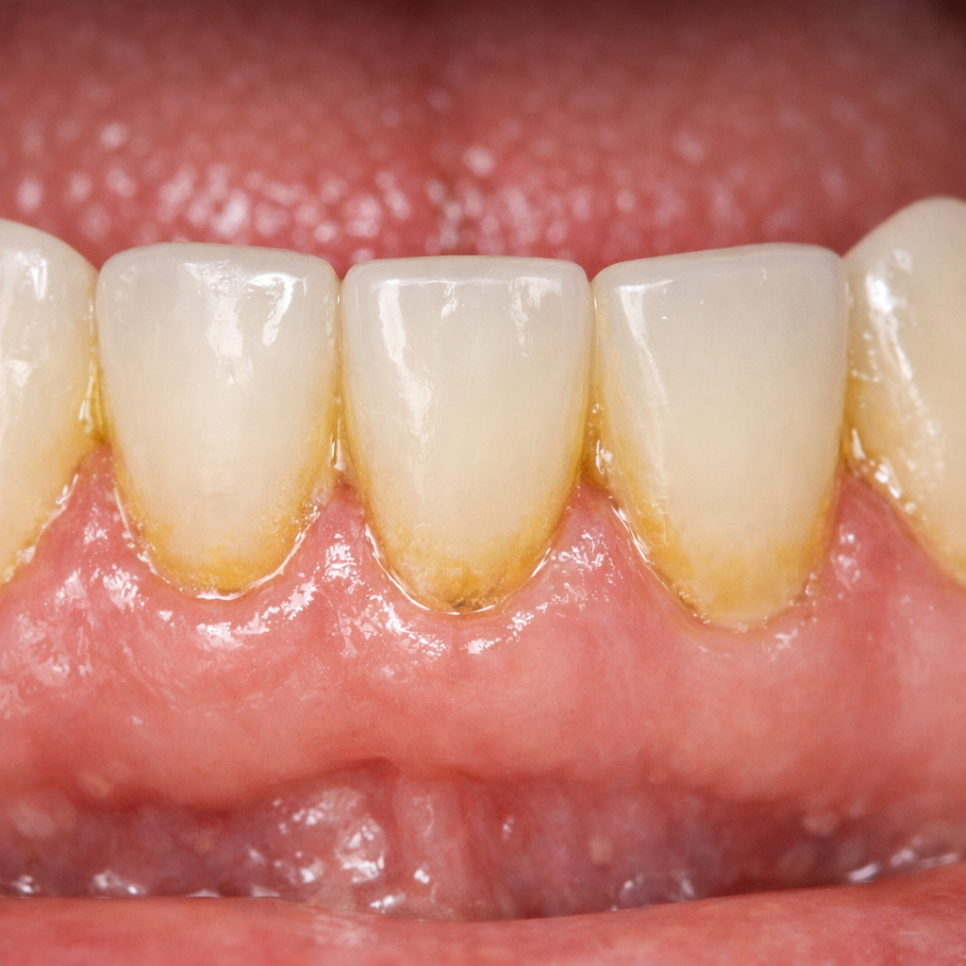
The toxins secreted by bacteria trigger
an inflammatory response in the gingiva,
and if this inflammation is not resolved and becomes chronic,
the cytokines secreted by immune cells
instead act in a way that breaks down
the periodontal ligament and alveolar bone.
During this process, the gingiva separates from the tooth,
forming a periodontal pocket,
and bacteria move deeper,
extending the range of destruction.
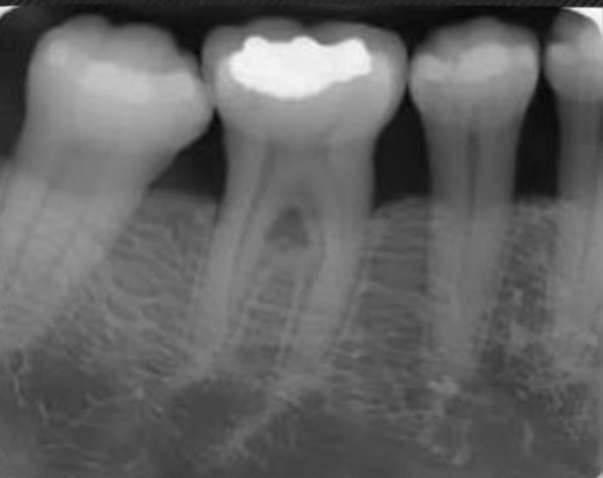
When the alveolar bone begins to dissolve,
the foundation that fixes the tooth in place itself decreases,
so the tooth starts to feel loose.
The problem is that alveolar bone loss often progresses
without pain,
making it difficult for patients to notice on their own.
There are also many cases in which
substantial bone loss has already progressed
by the stage when it can only be confirmed
through an X-ray.
In addition, chronic inflammation of periodontal tissue
does not remain only in the mouth,
and research findings have consistently reported
an association with cardiovascular disease and diabetes complications
through the systemic blood vessels.
Ujangsan Station Dental Clinic Oral Information
- In Summary - Closing Remarks
Preserving natural teeth is not just a matter
of the teeth themselves.
Only when the four tissues—
gingiva, periodontal ligament, cementum, and alveolar bone—
remain balanced can they function properly.
The basics that can be practiced in daily life are
brushing along the boundary between the gingiva and the teeth,
and removing dental plaque with interdental brushes and floss.
Because alveolar bone loss often progresses
without noticeable symptoms,
we recommend early detection through regular checkups.
This has been Lee Su-kyung from Ujangsan Station Dental Clinic. Thank you.