Hello, this is Balsan-dong Dental Clinic.
I’m Lee Su-kyung, a specialist in integrated dentistry.
Before cavity treatment, there is one question that comes up most often in the treatment room.
"Is resin better, or is ceramic better?"
It sounds like a natural question,
but in fact, there is one premise hidden inside it.
The assumption is that one of the two must be the superior material.
However, the answer in clinical practice, including at Balsan-dong Dental Clinic, is a little different.
These are not materials that can be ranked by superiority,
but materials with different uses from the start.
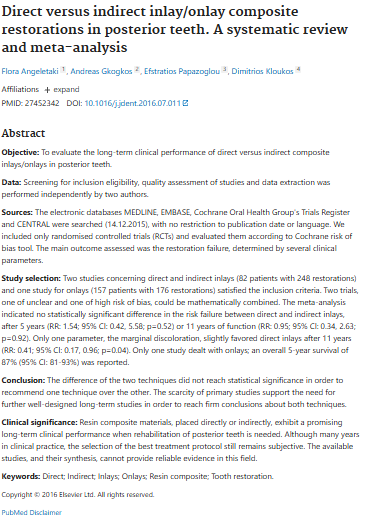
Source: https://pubmed.ncbi.nlm.nih.gov/27452342/
In studies analyzing the long-term clinical outcomes of direct restorations (resin) and indirect restorations (ceramic inlays),
there is a common conclusion:
the key variable that determines the result is not the material itself, but whether it was chosen according to the indication.
In other words,
it is more important whether the material was appropriate for that tooth
than which material was used.
There are things you should know before the material name.
Let’s look at them one by one.
Balsan-dong Dental Clinic Oral Health Information
- Resin: What you have to accept in exchange for finishing in one visit
Resin is a restoration method that is completed on the same day in the treatment room.
Because the material is directly filled into the removed area and hardened with a special light,
it can be finished in a single visit without a separate manufacturing process.
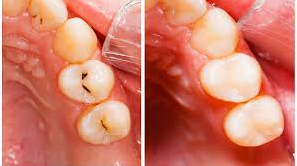
If the damaged area is small,
if it is limited to the edge of the tooth,
resin is a sufficiently appropriate choice.
However, as the damaged area becomes larger,
resin reveals its material limitations.
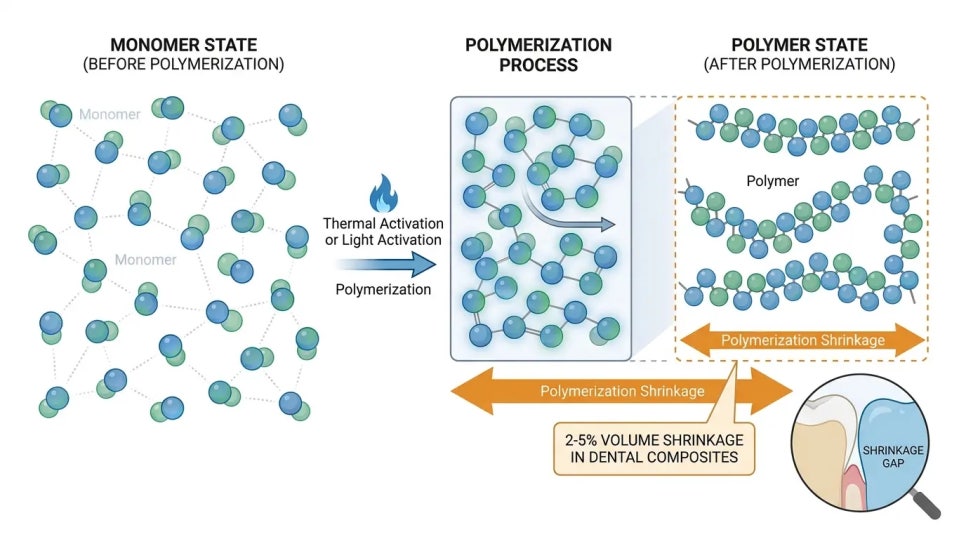
During the process of layering and hardening the material,
"polymerization shrinkage" occurs,
which is the phenomenon in which the material slightly decreases in volume as it hardens.
This shrinkage can create an invisible gap between the tooth and the material,
and if bacteria enter through that gap,
it can lead to secondary caries.
To use an analogy,
it is similar to filling a crack in a wall with putty, where the putty itself shrinks a little as it hardens and the gap reappears.
Balsan-dong Dental Clinic Oral Health Information
- Ceramic: The price of precision is two visits
Ceramic restoration is a method in which a precisely made prosthetic restoration is bonded to the tooth.
Depending on the extent and location of the damage, it is divided into inlay, onlay,
and crown forms,
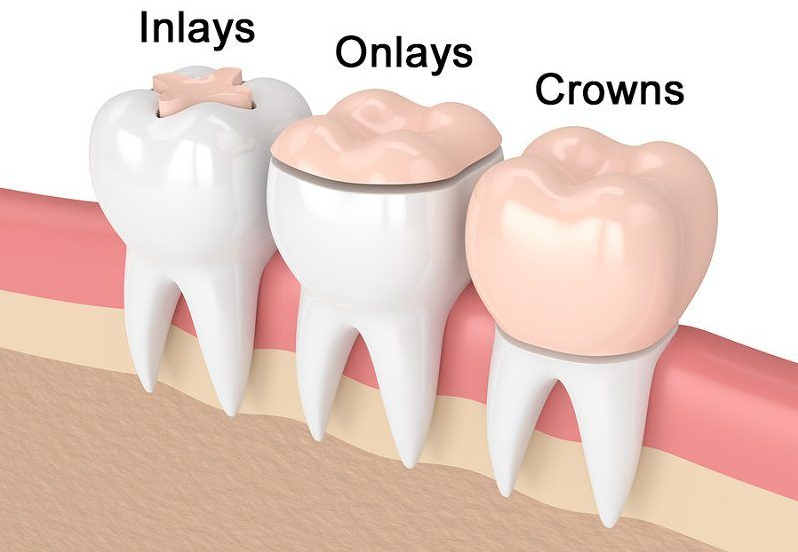
and because a separate manufacturing process is required,
you need to visit the clinic at least twice.
At the first visit,
the tooth is prepared and an impression is taken, and once the prosthetic is completed,
it is bonded at the second visit.
The key strength of ceramic is that it does not undergo polymerization shrinkage.
Because it is bonded after going through a high-temperature sintering process and already completed,
very little deformation of the material itself occurs,
and the fit at the border with the tooth,
that is, the marginal fit, is highly accurate.
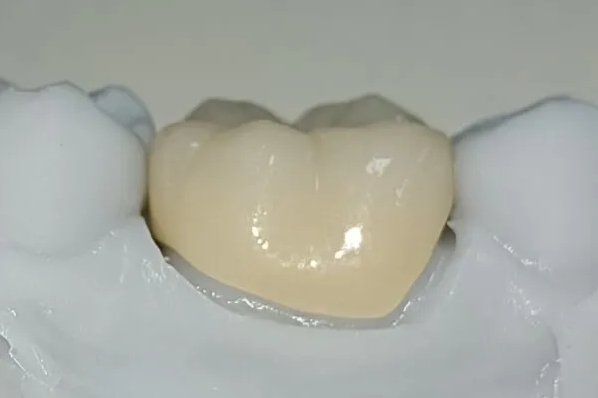
It also has optical properties similar to those of natural teeth,
so a natural-looking aesthetic result can be expected.
However, ceramic can fracture under strong impact,
and it tends to wear down the opposing tooth that bites against it.
For this reason, an occlusion analysis before restoration,
that is, a process to first check how biting force is distributed across the teeth,
must always come first.
Balsan-dong Dental Clinic Oral Health Information
- Things to look at before the material
The choice between resin and ceramic should ultimately be the result of a comprehensive consideration of the size of the damage, its location, occlusal force, and aesthetic needs.
It is not simply a matter of choosing a "better material,"
but a process of first determining which method is right for the current condition of the tooth.
If the area is a narrow early caries lesion,
resin can provide a sufficiently good result.
On the other hand, if the damage extends across multiple surfaces, or if it involves the cusp, the pointed protrusion of a molar,
then securing structural stability with a ceramic onlay or crown is more advantageous in the long term.
Even in areas where aesthetics are important, such as the front teeth,
ceramic with precise shade reproduction is more suitable for producing a natural result.
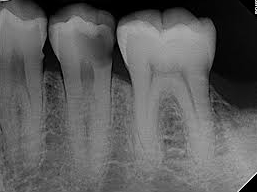
Before deciding on a restorative material,
it is necessary to first assess the size and depth of the caries on an X-ray,
and to review the occlusion and aesthetic conditions together.
That is exactly why diagnosing the condition of the tooth comes before the material.
A restorative material is a means of treatment, not the goal.
Whether it is resin or ceramic,
if it helps preserve the tooth for a long time,
that was the correct choice.
Care after restoration is just as important as the treatment itself.
The marginal area can change little by little over time.
Regular checkups to consistently monitor this area are the most practical way to extend the lifespan of the restoration.
Instead of asking, "Which material is better?"
first think about "What is right for me now."
That is the right starting point for restorative treatment.
This was Lee Su-kyung from Balsan-dong Dental Clinic. Thank you.