Hello, this is Lee Soo-kyung, a specialist in Integrated Dentistry, working in collaboration with an orthodontic specialist at a dental clinic near Wojangsan Station.
Among those who have received orthodontic consultations,
some of you may have heard that roots can become shorter
(Root Resorption)
at some point.
At that moment, most people tend to think,
"That probably doesn’t apply to me," and move on,
but it is a more common phenomenon than you might think.
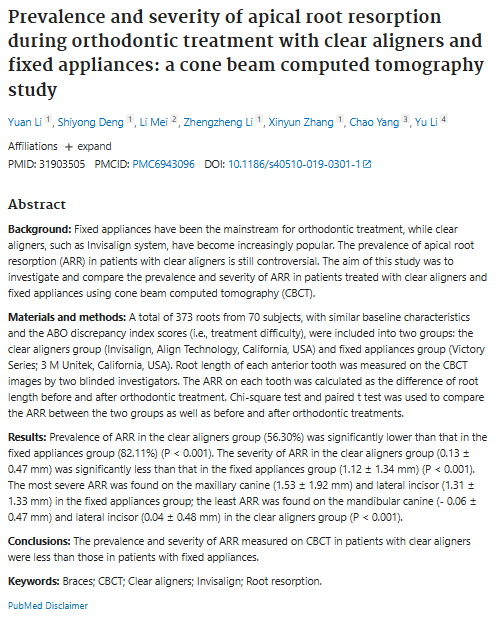
Source: https://pubmed.ncbi.nlm.nih.gov/31903505/
In a study that analyzed the incidence of apical loss through CT scans of patients
who used brackets,
it was found in about 82% of the participants.
Of course, most of these cases were clinically
mild and did not cause problems,
but this figure shows that Root Resorption is
a commonly observed change.
Another point worth noting is that
it can also occur due to various causes such as
trauma, chronic periodontal disease,
and pressure from impacted teeth,
so even those without orthodontic experience
need to pay attention to it.
Wojangsan Station Dental Clinic Oral Information
- What is root resorption?
It refers to a condition in which root tissue breaks down
or becomes shorter,
and depending on where it occurs,
it is classified into external and internal types.
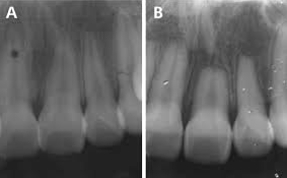
Internal resorption is a rare case in which the tissue inside a natural tooth
breaks down on its own,
and what is more commonly seen in clinical practice is the external type,
which progresses on the outer side, especially
at the root tip.
Not all of these changes are
problematic,
and the process in which the roots of primary teeth
naturally resorb before they fall out
is a normal physiological phenomenon.
What becomes a problem is
pathological resorption that occurs in
permanent teeth,
because if the length or shape changes, it can
affect how long the tooth can be maintained.
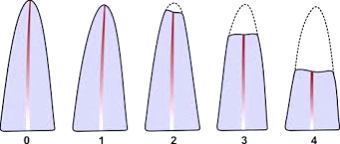
The type that is often identified through orthodontic patients is
external apical root resorption
(EARR, External Apical Root Resorption).
When continuous orthodontic force is applied,
the tissue at the root tip is compressed
and gradually becomes shorter.
Wojangsan Station Dental Clinic Oral Information
- Factors that affect resorption during orthodontic treatment
Orthodontic force works by applying
continuous force to gradually move the teeth.
During this process, the tissue at the root tip is compressed,
and the pattern of resorption varies depending on the extent of that pressure.
The influencing factors can be broadly divided into
the treatment environment and individual
conditions.
The longer the treatment period and the greater the distance the teeth are moved,
the greater the cumulative burden on the roots becomes.
Especially, intrusion, which moves a natural tooth
upward or downward,
is known to apply more direct pressure
to the root tip than movement in other directions.
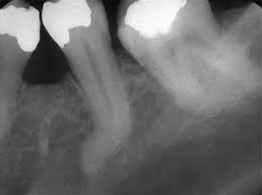
Individual conditions are also important.
If the roots are naturally short or slender,
or if they have a curved shape (dilaceration),
then even with the same treatment, the loss may
appear more pronounced.
In adult patients, resorption tends to appear more clearly than in children and adolescents,
and this is understood to be because the elasticity of the periodontal tissues
decreases with age.
Wojangsan Station Dental Clinic Oral Information
- Causes other than orthodontics and how it is detected
Root Resorption can also occur
for other reasons.
If an impacted tooth presses on the root of an adjacent tooth
for a long period of time,
that adjacent tooth’s root may
gradually become shorter.
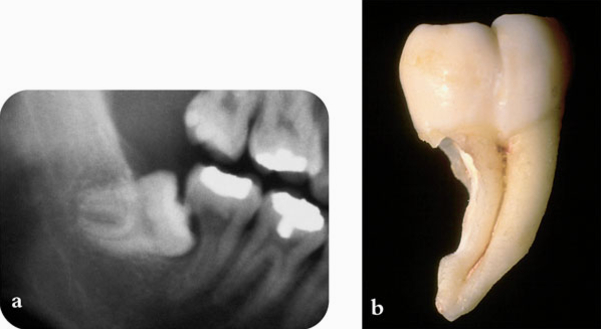
Even after trauma caused by a strong impact,
the tissue may be damaged and lead to resorption, and chronically progressing periodontal disease
is also one of the causes.
The problem is that in all of these cases,
there are no symptoms in the early stages.
Because there is no pain and nothing visible on the outside,
it is difficult to identify the progression without radiographic imaging.
Changes in length and shape can be confirmed through periapical radiographs or CBCT,
and during orthodontic treatment,
periodic imaging is recommended for monitoring.
Depending on the degree of resorption,
the direction or strength of the orthodontic force may be adjusted, or in some cases,
the entire treatment plan may need to be reconsidered.
Wojangsan Station Dental Clinic Oral Information
- In conclusion
Root resorption is not something that applies only to people who have had orthodontic treatment.
Those who have experienced trauma, have impacted teeth,
or have had poor gum health for a long time may also have root changes in progress.
The absence of symptoms does not necessarily mean that there is no problem.
Regular radiographic imaging to consistently check the length and shape,
and if you are undergoing orthodontic treatment, not missing mid-treatment checkups,
can be of practical help in keeping teeth healthy for a long time.
Having a place nearby where you can comfortably ask questions when something about your teeth comes up,
Everi Dental Clinic hopes to be such a place.
This has been Lee Soo-kyung from the dental clinic near Wojangsan Station.
Thank you.