Hello,
I am Lee Su-gyeong, a dental specialist at Every Dental Clinic.
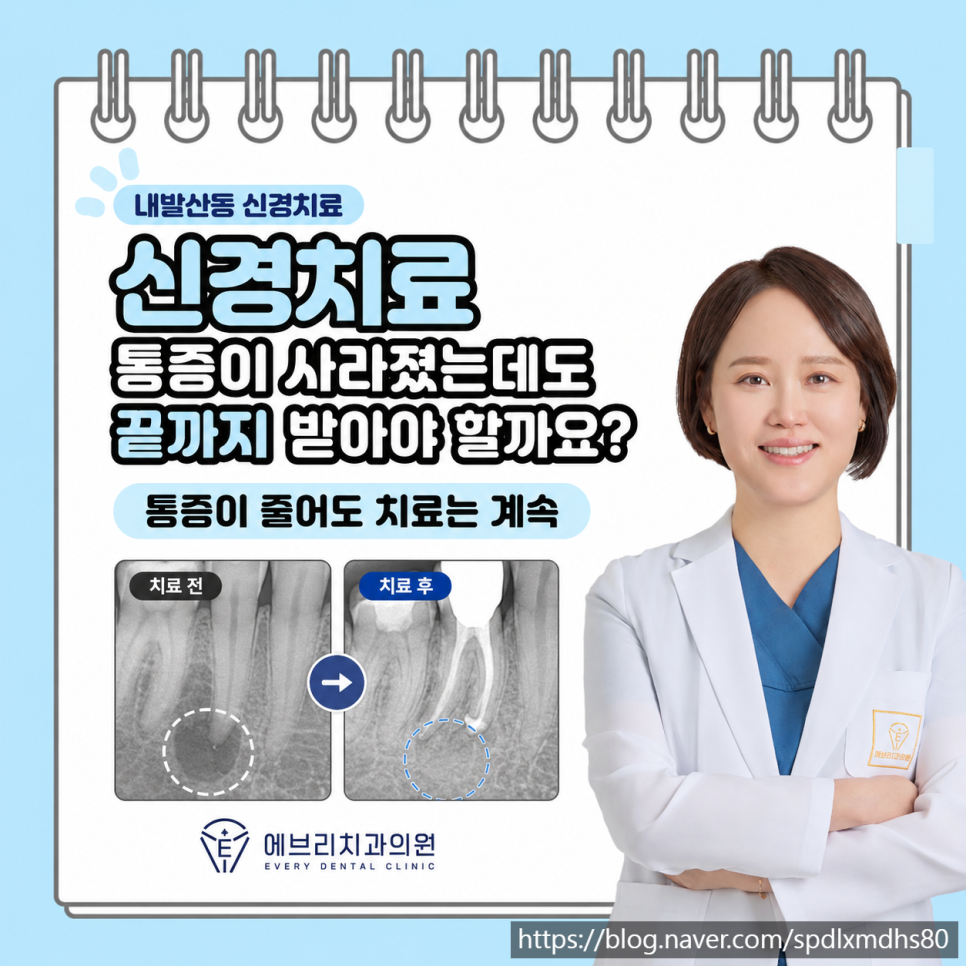
The pain is gone. Does that mean the treatment is over?
To give you the conclusion first,
root canal treatment is not finished simply because the pain has decreased.

Patients often visit us because the pain is severe enough to keep them awake at night.
Their teeth may be sensitive even to cold water, and they may throb when they chew.
In some cases, the gums swell or discomfort extends to the face.
However, after receiving root canal treatment once or twice,
the pain often decreases significantly.
“Since it doesn’t hurt anymore, do I still need further treatment?”
“If the pain is gone, doesn’t that mean it has healed?”
“Could I postpone my next appointment for a little while?”
It is completely understandable to think that way.
When a painful tooth becomes comfortable, it can feel as though the treatment is finished.
However,
root canal treatment is not simply a procedure to eliminate pain.
A reduction in pain is a positive sign.
But it does not necessarily mean that the infection has been completely cleared.
That is why today I would like to explain this from the perspective of a dental specialist.

Why root canal treatment may require multiple visits.
Why treatment must be completed even after the pain disappears.
Whether recovery is possible when bone has been lost because of inflammation at the root tip.
And how to protect a tooth after root canal treatment.
I will explain these points simply, based on what we frequently discuss at Every Dental Clinic in Naebalsan-dong.
The goal is not merely to reduce pain.
It is to preserve the natural tooth for as long as possible.
- Even if the pain decreases, root canal treatment is not finished.
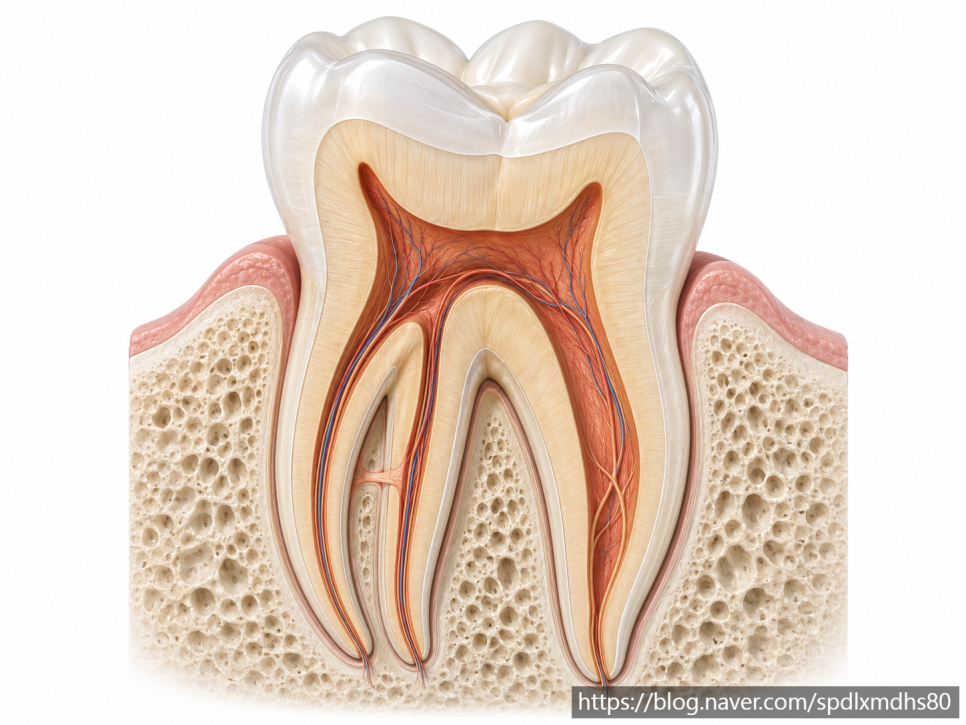
Inside a tooth is a narrow space containing nerves and blood vessels.
This space is called the root canal.
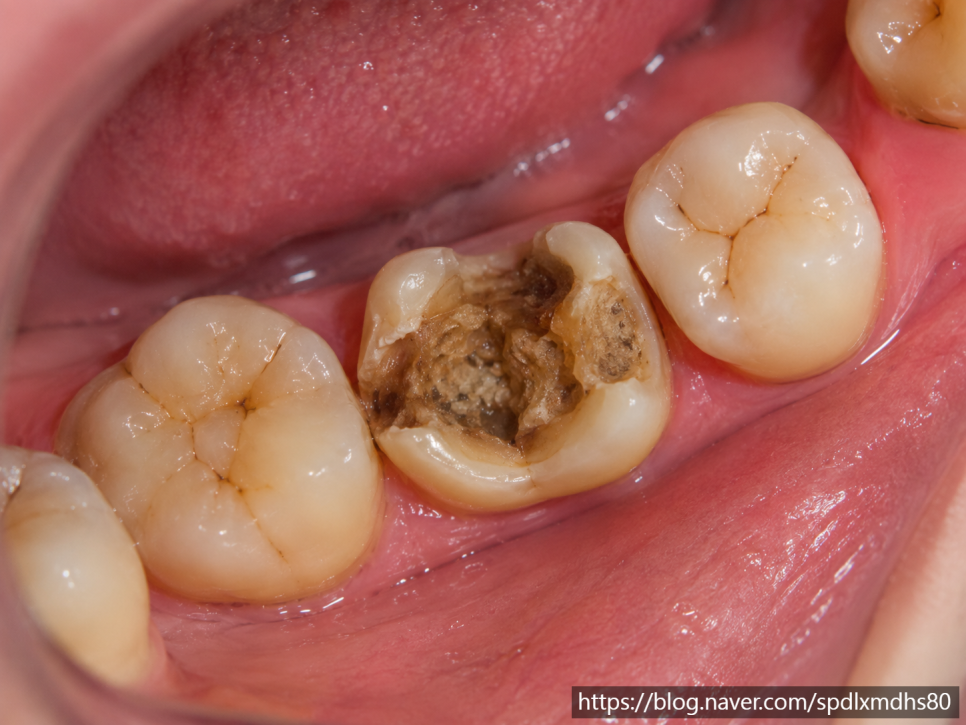
When tooth decay becomes deep, bacteria enter the root canal and cause inflammation in the surrounding tissues.
This is what leads to severe pain.
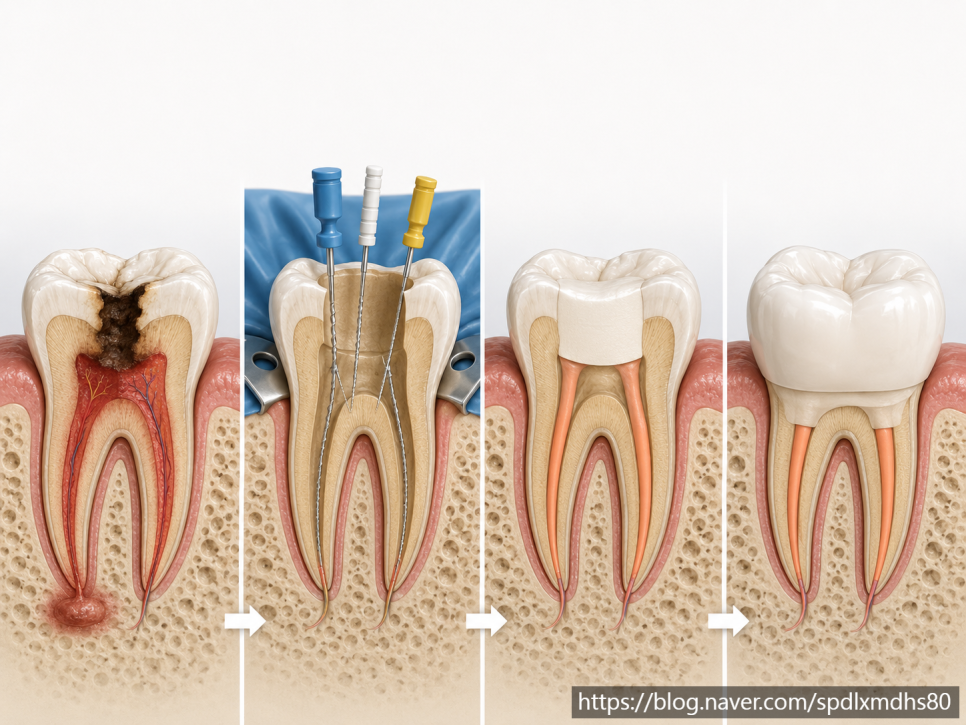
Root canal treatment involves removing infected nerve tissue,
disinfecting the inside of the root canal,
and then sealing it to prevent bacteria from entering again.
It is a process of cleaning the narrow, complex pathways inside the tooth’s roots.
Molars, in particular, have multiple root canals.
The canals are often curved or extremely narrow.
For this reason, it is common for treatment not to be completed in a single visit.
A reduction in pain is a positive change. However, it does not mean that treatment is complete.
At Every Dental Clinic, we review radiographs and examine the shape of the tooth roots and the extent of inflammation before proceeding with treatment.
During treatment, we continually check the level of anesthesia and the patient’s discomfort.
If you feel uncomfortable, we do not simply ask you to endure it.
Additional anesthesia is provided when necessary, and the pace of treatment is adjusted.
With root canal treatment, it is more important to carefully clean the infected spaces without overlooking them than to finish quickly.
- What happens if treatment is stopped?
“Since it doesn’t hurt anymore, it should be fine.”
However, if treatment is stopped at this point,
bacteria remaining inside the tooth can cause problems again.
A tooth undergoing root canal treatment is usually sealed with a temporary material.
The temporary material gradually breaks away with chewing.
Eventually, the empty root canal may become exposed to the oral cavity,
allowing food to enter the canal.
Inflammation may develop again,
and the pain may return.
The tooth may swell and hurt, leading you to visit the dentist again.
In fact, some patients stop treatment because the pain has decreased, only to return several months later with swelling and pain.
In such cases, treatment may be more complicated than it was initially.
Retreatment may be necessary, and depending on the condition of the tooth, extraction may need to be considered.
This is why root canal treatment must be completed.
- Properly completed root canal treatment can allow the surrounding bone to grow back.
Some teeth requiring root canal treatment show a dark shadow at the root tip on radiographs.
We often describe this as inflammation at the root tip, or an apex lesion.
This means that the surrounding bone has been lost due to inflammation at the root tip.
In some cases, the tooth may also become loose.
“Has the bone been lost?”
“Does that mean this tooth cannot be saved?”
“Do I need an implant?”
Patients are often very surprised when they see the images.
Of course, not every tooth can be saved with root canal treatment.
However, if the cause of the inflammation is an infection inside the tooth’s root canals,
recovery may be possible after root canal treatment.
After the infected root canals are cleaned and disinfected all the way to the root tips,
properly sealing the canals may allow the inflammation to gradually subside.
Over time, the bone around the root tip may grow back.
I see these changes in actual clinical practice as well.
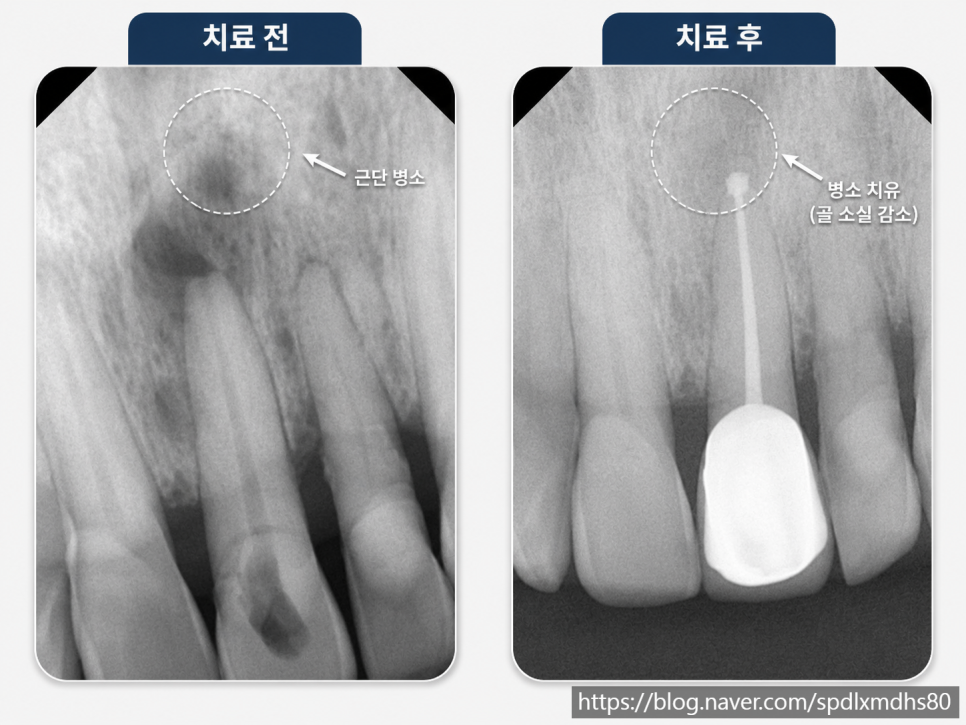
There was a tooth whose initial radiograph showed significant bone loss at the root tip, making it appear dark.
The tooth had even become loose,
so the patient was concerned that it might need to be extracted.
We proceeded carefully with root canal treatment.
After the root canal treatment was completed,
the inflammation gradually subsided and the surrounding bone recovered.
The tooth was stabilized as its mobility disappeared, and treatment was completed.
- A tooth that has undergone root canal treatment should be protected with a crown.
Most teeth that receive root canal treatment either had deep decay or were already significantly weakened.
During treatment, weakened portions also need to be removed.
As a result, the amount of remaining tooth structure is often reduced.
Molars, in particular, are subjected to considerable chewing forces.
Although the pain improves after root canal treatment,
some patients return several months later because the tooth has fractured.
That is why, after root canal treatment,
it is necessary to determine whether a crown is needed.
A crown is not simply a treatment that covers the tooth.
It is more like a protective device that surrounds the weakened tooth and distributes chewing forces.
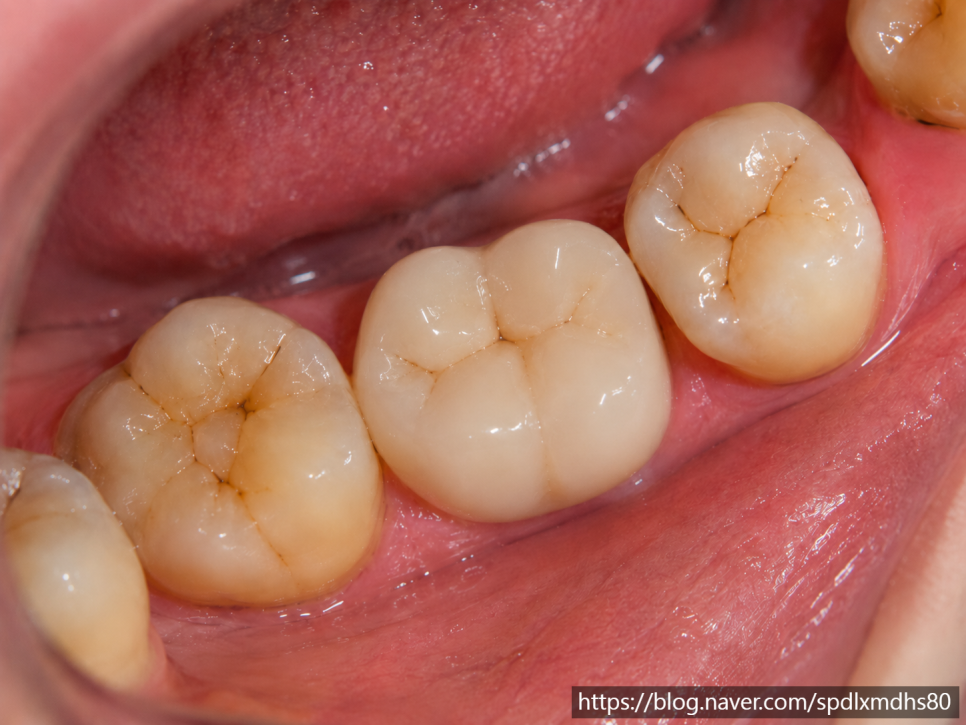
Of course, not every tooth that has undergone root canal treatment automatically needs a crown.
For areas such as the front teeth, which receive less force,
or when there is sufficient tooth structure remaining,
other options may be considered.
However, teeth that receive significant force, such as molars,
often require crowns.
At Every Dental Clinic, we check how much tooth structure remains after root canal treatment.
We also assess the risk of cracks.
In addition, we examine the direction in which chewing forces are applied.
The goal of root canal treatment
does not end with reducing pain.
The goal is to help you use your natural tooth for as long as possible.
Conclusion. Just because the pain is gone,
it does not mean that the tooth has completely healed.
Root canal treatment requires the infection inside the tooth to be thoroughly cleared.
At the same time, a decision must be made about how to protect the weakened tooth.
When bone around the root tip has been lost because of inflammation,
it is also necessary to check whether the bone is recovering properly.
After an accurate diagnosis,
if the source of the infection is properly removed through root canal treatment,
the lesion may decrease and the bone may recover over time.

I consider root canal treatment an important tooth-preserving procedure that can be attempted as a final option before extracting a tooth.
Of course, not every tooth can be saved.
However, when a tooth has a possibility of being preserved,
it is important not to give up too quickly and to obtain an accurate diagnosis.
At Every Dental Clinic,
we will take the necessary measures
and provide attentive care so that you can receive treatment as comfortably as possible.
At Every Dental Clinic in Naebalsan-dong,
we will do our best to preserve a natural tooth to the very end whenever it can be saved.