Hello, this is Ribbon Plastic Surgery near Sinsa Station.

When people talk about “skin aging,” they usually mean a loss of elasticity and a drooping feeling downward.
You may think, “In the end, shouldn’t we just pull the skin upward?”
That may sound reasonable as common sense, but if you look deeper into the skin layers, it is not entirely correct.
Our skin has the skin layer on top (epidermis and dermis), and beneath it are the subcutaneous fat layer and the fascia layer.
What is commonly called “pulling the skin” refers only to pulling the epidermis and dermis.
Because of that, whether it is effective can vary depending on the degree of aging.
If the sagging is not too severe and the condition can improve to some extent with collagen regeneration alone, laser, ultrasound, or radiofrequency lifting may help.
If you want to lift specific points more efficiently, such as the nasolabial folds or the jowls, thread lifting may be suitable.
However, the story changes when the skin has sagged severely overall.
In that case, it is difficult to expect noticeable change just by repeating non-surgical treatments, and because it also takes a lot of time and cost, surgical treatment may be more appropriate.
A representative method is the “facelift.”
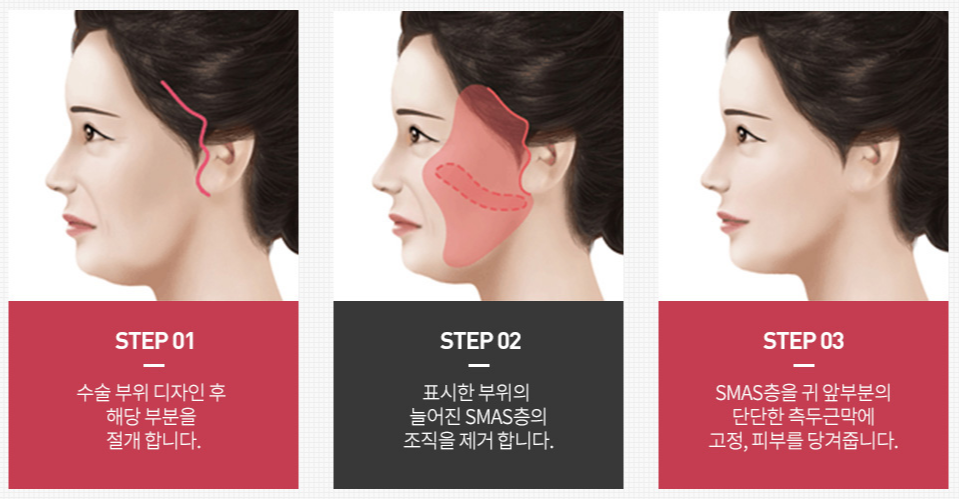
A facelift is a surgery that superficially pulls the skin, but in more detail, it is closer to a procedure that lifts the SMAS layer.
In the following article, I will explain in an easy-to-understand way why the SMAS layer needs to be lifted and how a facelift is performed, so please read comfortably and take away useful information.
─
Why does a facelift need to lift the SMAS layer?
To understand this, we first need to identify what role the SMAS layer plays deep within our skin.
The SMAS layer is the layer just beneath the skin, referring to a very thin subcutaneous fat and muscle layer.

It lies between the skin and the facial muscles and plays a very important role in transmitting the movement of facial muscles to the skin.
However, because it covers almost the entire face and is tightly attached to the skin, it is highly vulnerable to gravity.
Skin aging does not occur only in the epidermis and dermis; it occurs throughout the entire skin layer, so the SMAS layer naturally loosens over time as well.
In particular, when the SMAS layer sags, it causes cheek drooping, one of the signs of aging. So if you often say things like “the jowls have become prominent” or “the nasolabial folds are deep,” there is a high chance that this SMAS layer has become significantly loosened.
Therefore, if cheek sagging is severe, correcting this SMAS layer is very important.
Simply put, pulling only the outer part does not help at all; you need to lift it from very deep within to expect long-term results.

─
How is a facelift performed?
A facelift is performed by designing the surgical area, partially excising the area near the hairline, removing the loosened SMAS tissue, and then fixing the remaining tissue to the temporalis fascia.
Compared with non-surgical lifting, it has the advantage of producing a noticeable effect right after surgery because it physically pulls the tissue upward and removes unnecessary tissue.
However, there is one thing to be careful about here as well.
No matter how much the skin sags in the direction of gravity, the direction of wrinkles can differ from person to person, so the pulling direction must be determined with that in mind.
If the wrinkles are closer to vertical or diagonal lines, simply pulling upward can actually make the wrinkles appear more prominent.
That is why detailed planning before a facelift is so important, and it is important to judge the post-surgery result through sufficient simulation.
Another thing that must never be overlooked during a facelift is the “release of the retaining ligaments.”
Retaining ligaments are structures firmly attached from the bone to the skin.
They support the facial tissues, but as we age, these retaining ligaments can pull down the tissues they are holding together, worsening sagging.
Therefore, during a facelift, it is advisable to release these retaining ligaments so that the skin can no longer be pulled downward.
Only by releasing the retaining ligaments can the facial tissues move freely, so if you want a sufficient lifting effect, please be sure to check how much dissection will be performed and whether the retaining ligaments will be released.

A facelift can be expected to have positive results only when the nerves beneath the skin are preserved and the SMAS layer is lifted safely.
That is why the skill of the medical team performing the surgery is essential, and before surgery, it is important to first create a design that is suitable for the patient’s skin through sufficient consultation.
At Ribbon Plastic Surgery, we take responsibility for everything from design and surgery to aftercare through one-on-one consultations with the head surgeon.
Thank you for reading this long post.