Small, cramped eyes
What type of plastic surgery is needed?
I will explain the effects of improving small eyes through canthoplasty.
How can improve small cramped eyes?
Explaining the principle of
lateral and lower canthal plasty!
This is Dr. Junhyun Kim of Midline Plastic Surgery.
●What Are Cramped Eyes?!●
"Cramped eyes" is a compound word made from "clam" and "eyes," and refers to eyes with a narrow horizontal width, making them look small, with the inner and outer corners not open and appearing closed off.
If the eyeball is deeply set, it may also be called a sunken eye.
As an example of a celebrity with cramped eyes, upturned eye corners, or small, tight-looking eyes,
one of the singers I like
is Kim Bum-soo.
(My top pick is Park Hyo-shin^^)
Fans apparently gave him the nickname "10:10."^^


Source: Knowing Bros / Happy Together
The reason is that his eye corners are raised, making them look like the hands of a clock pointing to 10:10, which is how he got this amusing nickname.
Many people are concerned about having small, cramped eyes with raised outer corners.
If your eyes look cramped, they can seem small and tight, so wanting bigger eyes is natural. And because the outer corners are raised, it is also understandable to want to change an impression that looks sharp or strong into something softer.
How can you escape cramped eyes
and get bigger eyes
with a gentler eye shape??

Lateral canthoplasty? Lower canthoplasty? Combined lateral-lower canthoplasty?
These are terms you may have heard at least once.
If you understand what each surgery does,
you can figure out which surgery is needed for which type of eye.
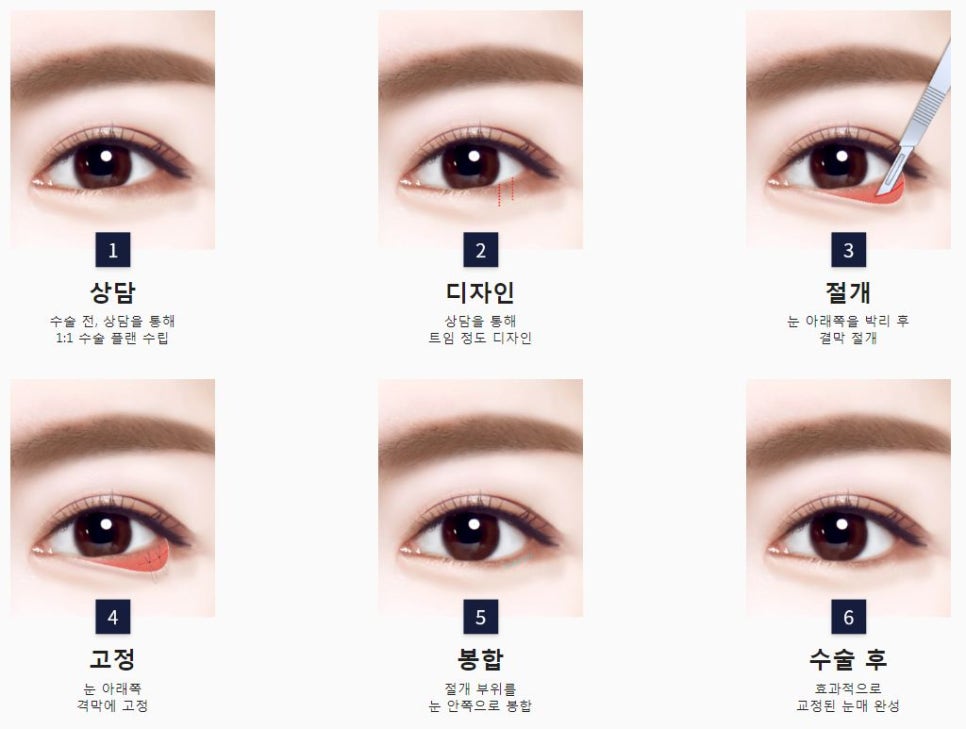
Lower canthoplasty method (Dr. Junhyun Kim)
<Lower canthoplasty>
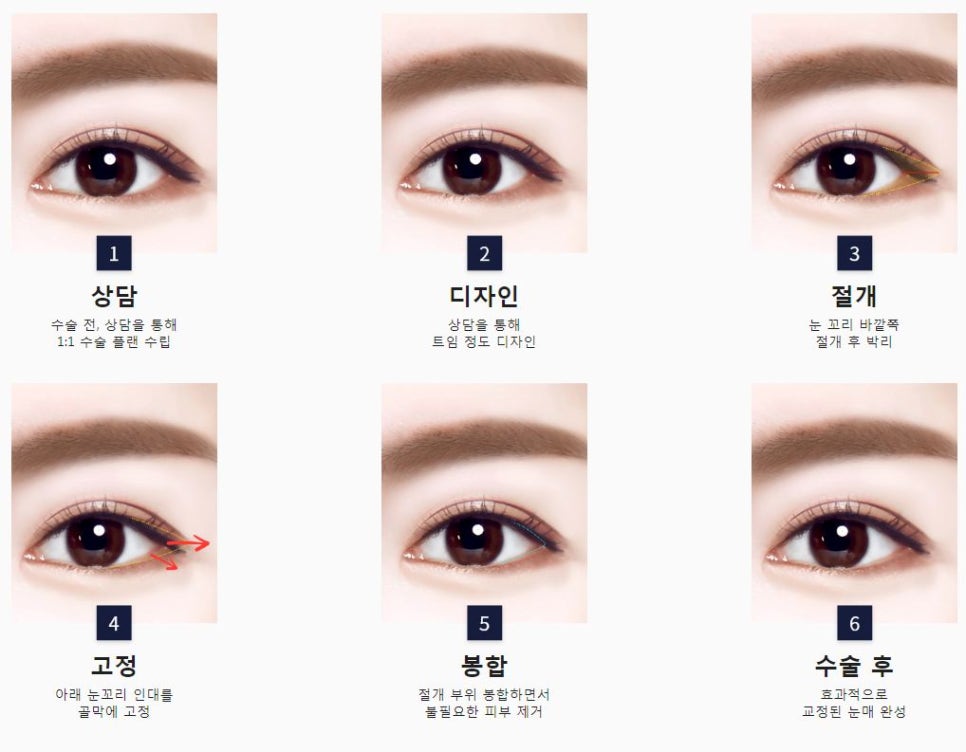
Lower canthoplasty is a surgery that enlarges the space on the outer lower side of the eye while keeping the horizontal length of the eye and the position of the outer corner unchanged.
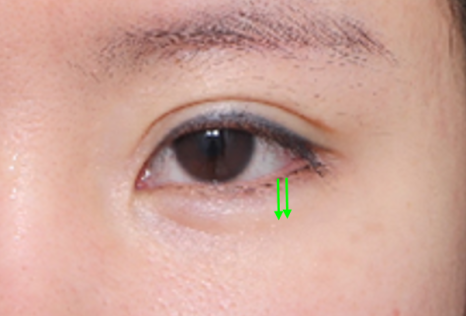
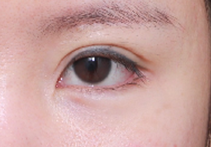
Before lower canthoplasty / After lower canthoplasty
Here, if the outer corner is left as it is and the space is enlarged in the direction of the fluorescent green arrow, it becomes like the eye on the right.
In other words, lower canthoplasty is performed when:
- The horizontal length of the eye is not short, and
- Based on the pupil, the white area on the outer side is not narrower than the white area on the inner side,
and you only want to lower the raised outer corner.
In such cases, lower canthoplasty alone can be effective.
< Lateral canthoplasty >
Then when is lateral canthoplasty needed?
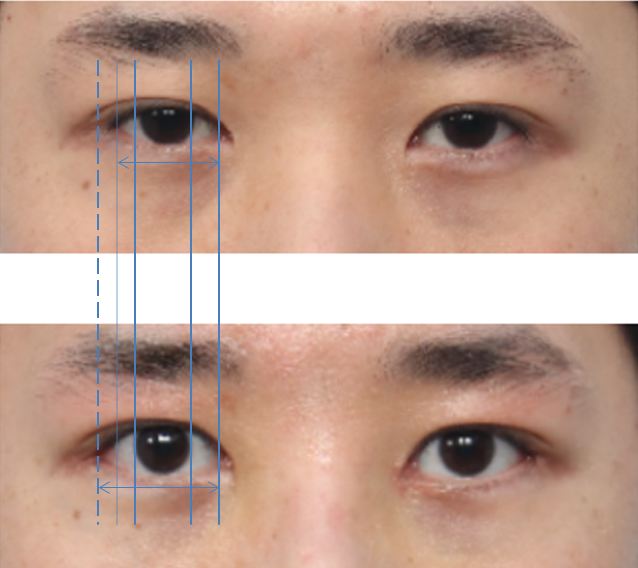
Let’s compare the right and left eyes.
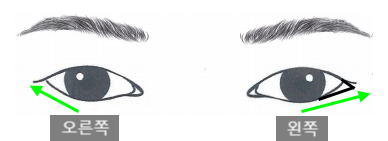
Midline Plastic Surgery eye consultation chart
The right eye has a raised outer corner, and based on the pupil, the inner side shows more sclera than the outer side.
The left eye is an example of having had lateral canthoplasty. The horizontal length of the eye becomes longer, and the outer corner has also come down.
Lateral canthoplasty method (Dr. Junhyun Kim)
Through lateral canthoplasty,
based on the pupil,
the proportions of the inner and outer sides became more balanced,
creating a more stable eye shape.
Correction of scleral asymmetry / uneven eyes (Dr. Junhyun Kim)
This patient had a wider scleral area in front of the pupil and a narrower scleral area behind it, making the pupil appear to be looking slightly outward. Through lateral canthoplasty, we increased the visibility of the sclera on the rear side so that the dark pupil would be positioned more toward the center, correcting it to the midline.
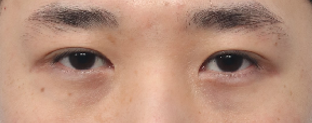
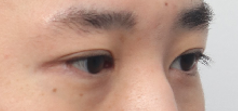
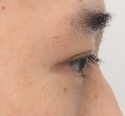
Before midline lateral canthoplasty
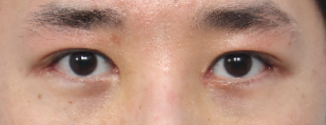
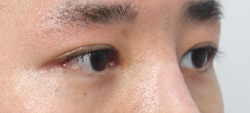
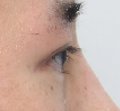
After midline lateral canthoplasty
<Combined lateral-lower canthoplasty>
If lateral canthoplasty and lower canthoplasty are performed together, it becomes combined lateral-lower canthoplasty.
If you have cramped eyes, combined lateral-lower canthoplasty is the most effective.
I will explain the principle of each procedure.
The tissue fixed during lower canthoplasty is the Capsulopalpebral fascia.
The principle of lower canthoplasty is to hook this together with the tarsal plate and pull it downward (marked with a purple line).
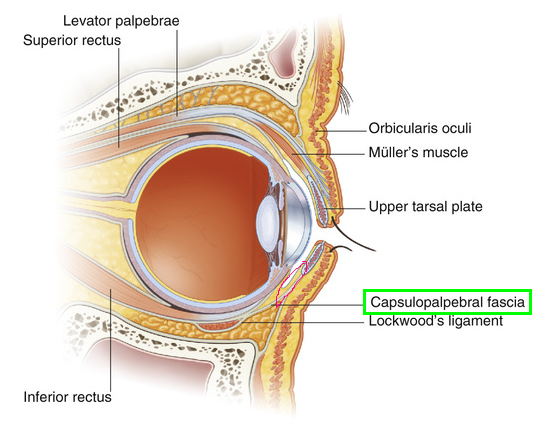
Figure 26.1 Eyelid anatomy. Each eyelid consists of an anterior lamella of skin and orbicularis muscle and a posterior lamella of tarsus and conjunctiva. The orbital septum forms the anterior border of the orbital fat. (Reprinted from Neligan, P.C., Buck, D.W. [Eds.], 2013. Core Procedures in Plastic Surgery. Elsevier, 1–22.)
Then how is lateral canthoplasty done?
Lateral canthoplasty separates the lateral canthal tendon (marked with a purple dashed line)
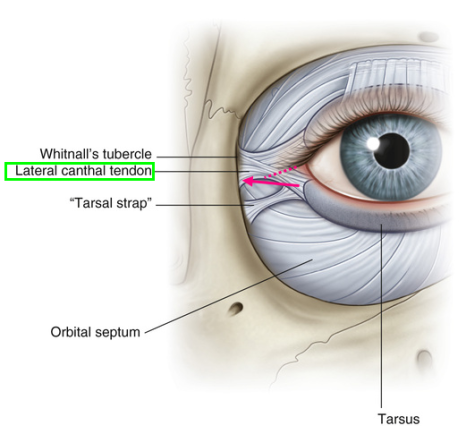
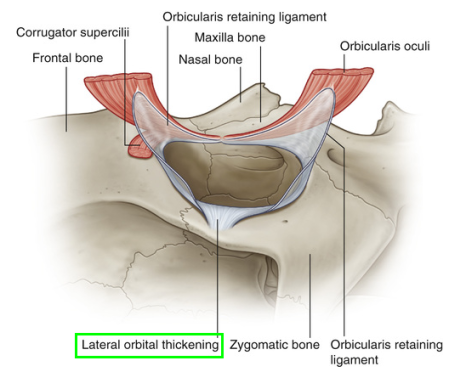
Figure 26.6 The lateral canthal tendon inserts securely into the thickened periosteum overlying Whitnall’s tubercle. The tarsal strap is a distinct anatomic structure that suspends the tarsus medial and inferior to the lateral canthal tendon to the lateral orbital wall, approximately 4 to 5 mm from the orbital rim. (Reprinted from Neligan, P.C., Buck, D.W. [Eds.], 2013. Core Procedures in Plastic Surgery. Elsevier, 1–22.) //Figure 26.5 The orbicularis muscle fascia attaches to the skeleton along the orbital rim by the lateral orbital thickening (LOT) in continuity with the orbicularis retaining ligament (ORL). (Adapted from Ghavami, A., Pessa, J.E., Janis, J., et al., 2008. The orbicularis retaining ligament of the medial orbit: closing the circle. Plast. Reconstr. Surg. 121 [3], 994–1001.)
and then secures it to a thick, tough tissue called lateral orbital thickening.
Because this tissue is attached to the periosteum, we explain to patients that it is fixed to the periosteum.
Even when actually fixing it, we hook the tissue while scraping the bone with a needle.
And the force is stronger than the fixation strength of lower canthoplasty.
So if you want the effect of lower canthoplasty to stand out more,
lateral canthoplasty should be pulled only slightly.
And although the place where it is secured with sutures is a firm tissue, actions such as pulling the eyelids up and down like when inserting contact lenses can loosen the fixation of the outer corner. So you should avoid doing that as much as possible so that the effect of lateral canthoplasty does not diminish and can last longer.
Let’s look at a combined lateral-lower canthoplasty case.
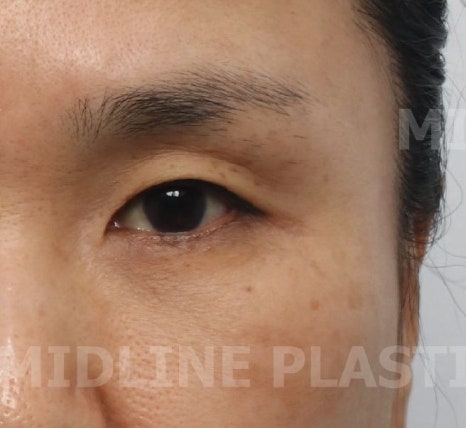
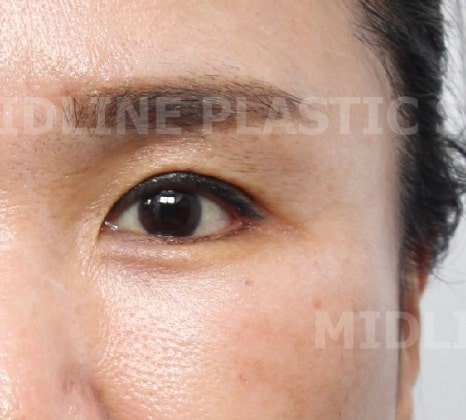
Before combined lateral-lower canthoplasty / After combined lateral-lower canthoplasty
The patient above was concerned about cramped eyes,
was unhappy with the strong impression caused by raised outer corners,
and wanted double eyelids to look natural, so we improved the eyes with natural adhesion eye correction and combined lateral-lower canthoplasty.
They are very satisfied.
They also referred others, thank you.^^
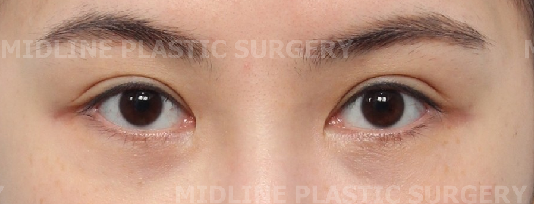
Before revision combined lateral-lower canthoplasty
The second patient is a revision case for combined lateral-lower canthoplasty.
They had combined lateral-lower canthoplasty several years ago.
It returned to the original state, so they came in for revision surgery.
If you look at the right eye among both eyes,
you can see a little sclera below the pupil, making the pupil look exposed,
which indicates a three-white-eye appearance.
In such cases, if lower canthoplasty is done together,
the three-white-eye appearance may become more noticeable,
which can make the impression look colder.
So, for uneven-eye correction,
we decided to perform lower canthoplasty only on the left eye,
and additionally performed lateral canthoplasty on both eyes.
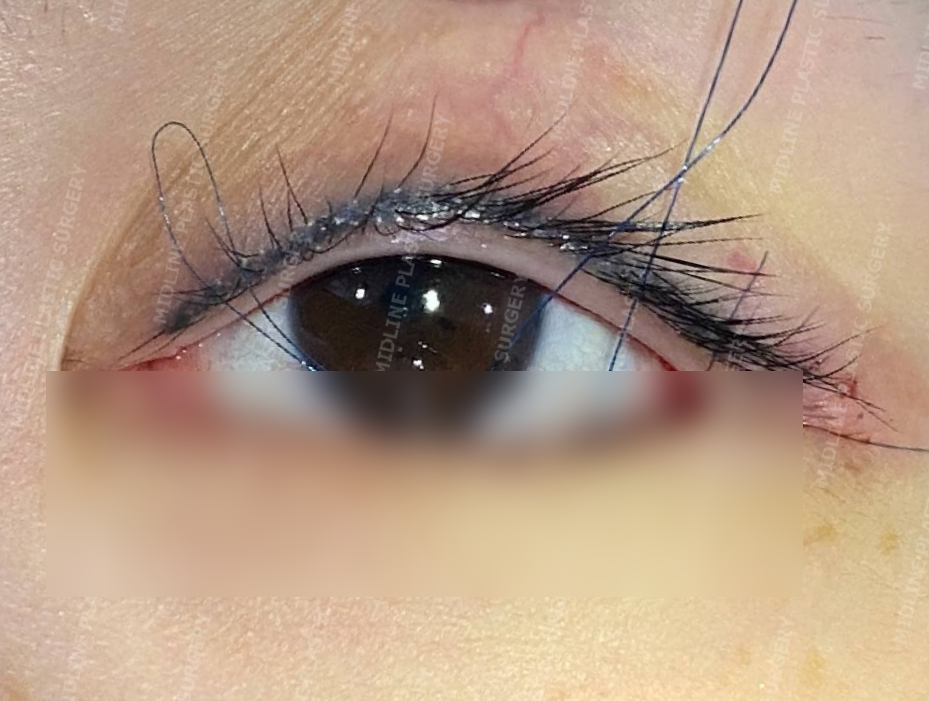
During lower canthoplasty
Before lateral canthoplasty, lower canthoplasty was performed on the left eye.
The surgical photos can be checked if you visit the clinic.
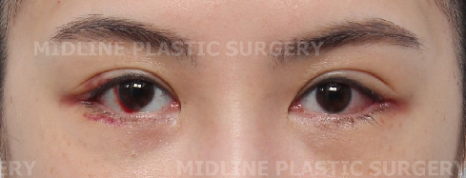
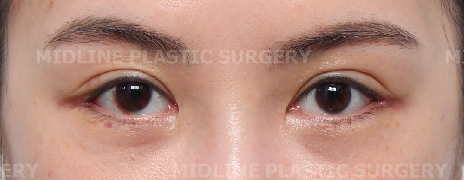
Left: the day sutures were removed / Right: 15 days after surgery
This is a photo from the day the sutures after lateral canthoplasty were removed.
As mentioned above,
after lateral canthoplasty, you should avoid pulling the lower eyelid downward as much as possible so that the effect can last longer.
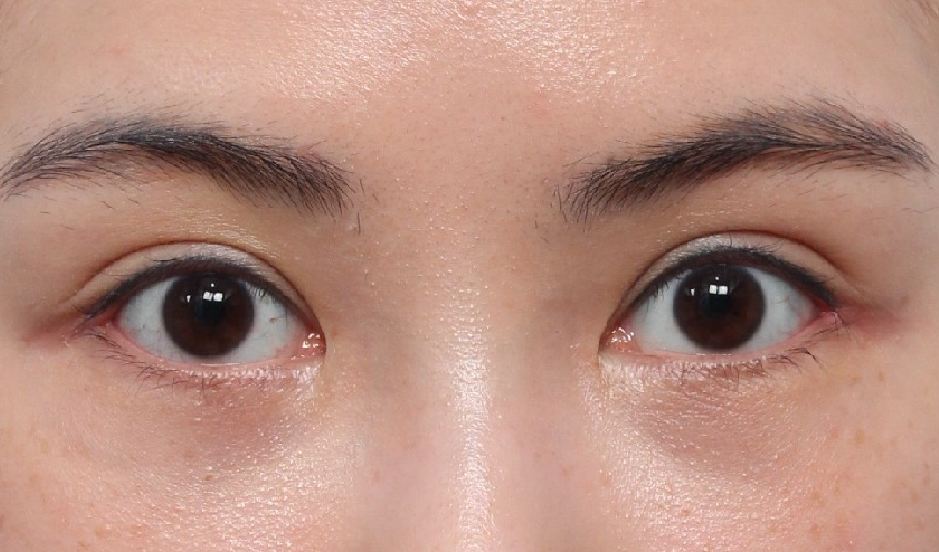
This is a photo taken two months after the uneven-eye canthoplasty.
If you have procedures such as lateral canthoplasty, lower canthoplasty, or combined lateral-lower canthoplasty tailored to your eye shape,
you can lower the outer corner to create a gentler impression while also lengthening the eye toward the back for a clearer, more open look.^^
<If you have additional questions, please leave a private comment,
and I will kindly answer them. Thank you.>

.
.
.
.
.
.
.

It has already been one year since Midline Plastic Surgery opened.
We lit a single candle on a small cake and blew it out together with the staff.
^^
We always do our best in surgery.
We will put safety first and repay you with satisfying results.
Thank you.
-From Representative Director Dr. Junhyun Kim-