People with a hump nose often have a relatively large nose, and because the bones and cartilage of the nose have often overgrown during the growth period, a crooked nose commonly occurs along with it.
The easiest way to correct a crooked hump nose is to surgically shave down the bone and cartilage that form the hump, then cover it with a thin silicone implant.
However, while this method is surgically easy and convenient, it makes an already large hump nose even higher, which increases the likelihood that it will look unnatural.
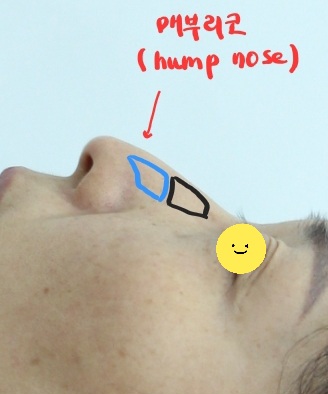
Side view of a hump nose
Because the bridge of the nose is already high overall, adding a silicone implant here can only make the nose bigger and higher.
And when viewed from the front, the nose appears crooked, mainly due to a difference in collapse between the left and right upper lateral cartilages. As a result, the left-right width of the middle part of the nose differs, making the deviation more noticeable.
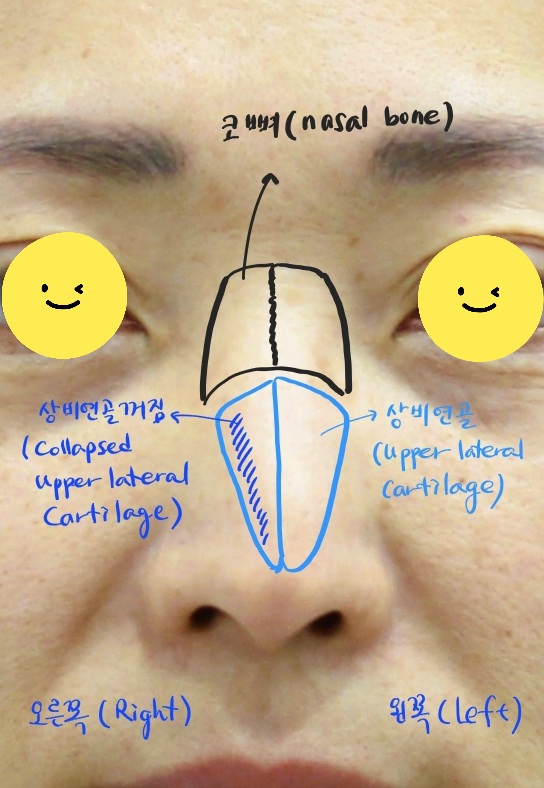
Cartilage structure of a crooked nose
From below, asymmetry of the nostrils is seen, and the columella (the nasal pillar) is often bent to one side.
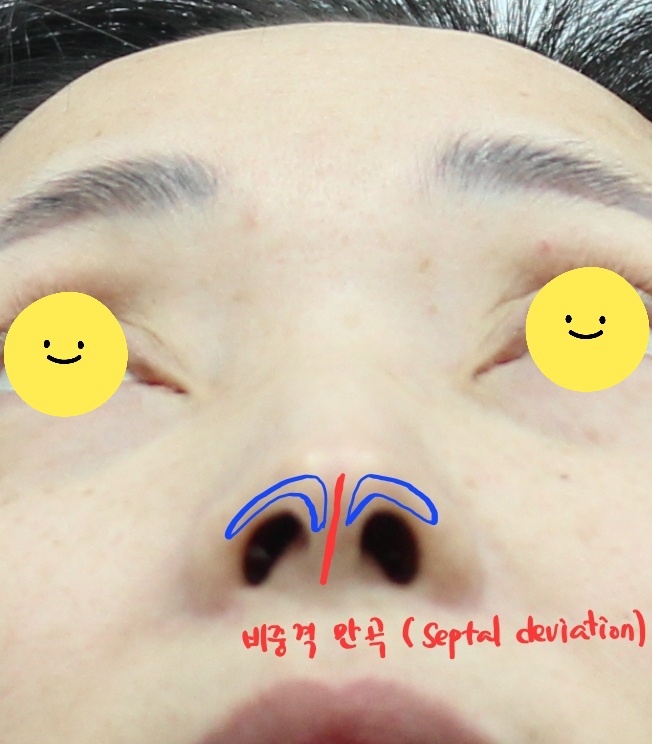
Asymmetry of the nostrils seen from below
To find the cause of this nostril asymmetry and the bent columella, a CT scan was performed.
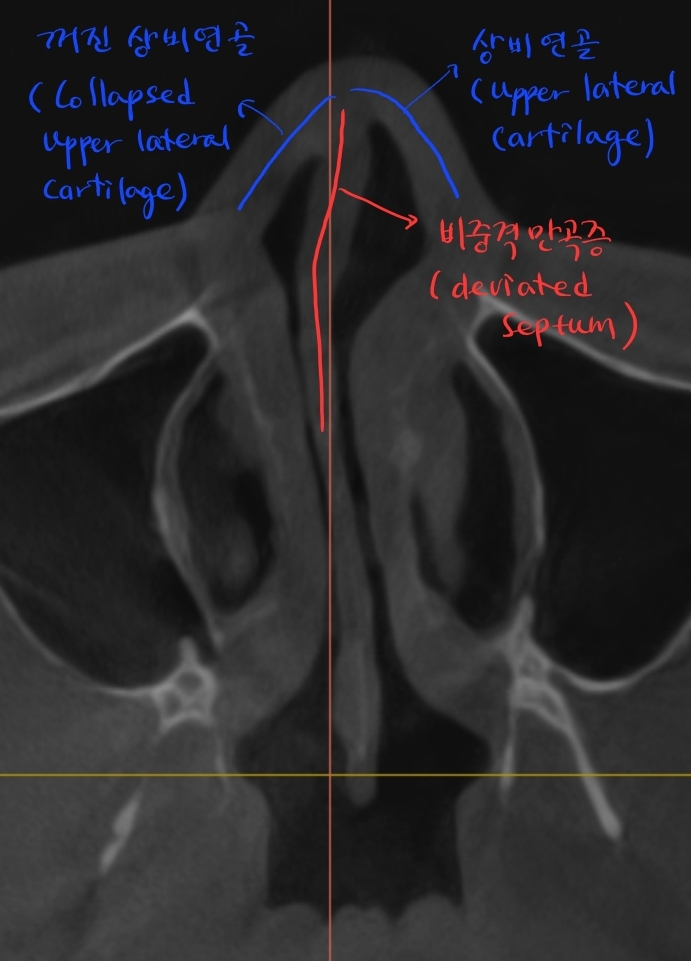
CT scan of septal deviation in a crooked nose
The CT scan showed that the size and shape of the upper lateral cartilages on the left and right are different, and one side of the upper lateral cartilage has collapsed.
The septum inside the nose is also deviated, which causes the nostril asymmetry and the bending of the columella.
Of course, this type of nose not only appears crooked, but also causes functional discomfort. Due to the deviated septum and collapsed upper lateral cartilage, one nasal valve becomes narrow and sinks, which can cause nasal congestion in one nostril.
For surgery, cartilage materials are needed, so septal cartilage, ear cartilage, and mastoid fascia were harvested.
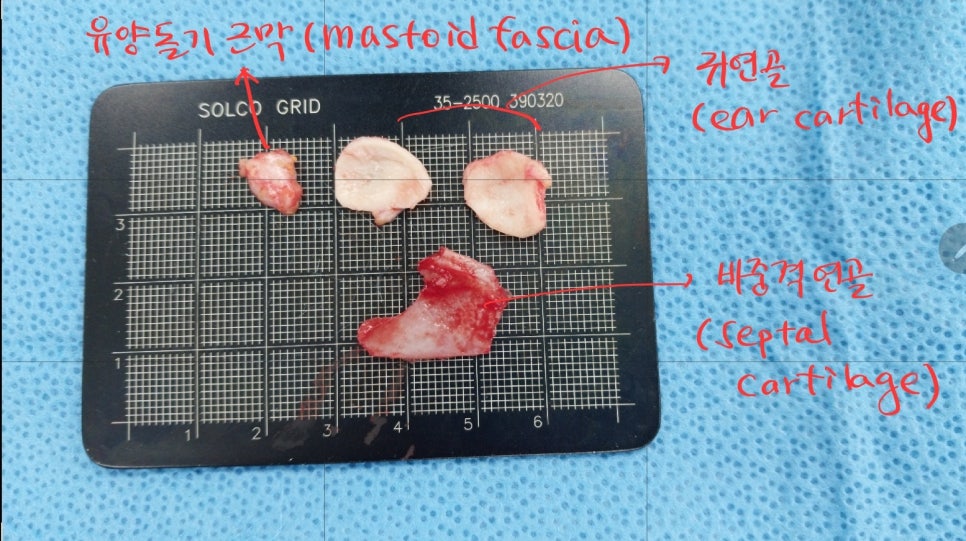
Harvested cartilage and fascia
Cartilage materials are needed to straighten and align a crooked nose, and cartilage materials are also needed to shape the nasal tip.
And for people with a hump nose, if the nasal skin is thin, it is advisable to reinforce the thin skin at the nasal tip.
Usually, nearby fascia or dermis is harvested together with ear cartilage to provide reinforcement.
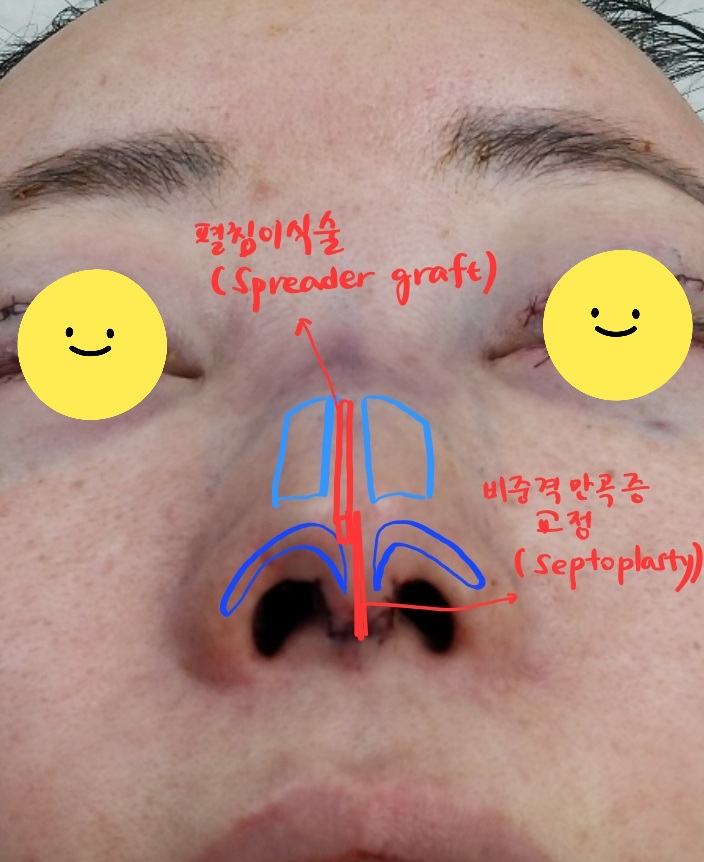
Correction of septal deviation and spreader grafting
First, the deviated septum is straightened to align the nasal tip properly. Through this process, the columella stands upright, improving nostril asymmetry.
Then, spreader grafting is performed using cartilage on the collapsed area of the upper lateral cartilage. This improves the symmetry of the upper lateral cartilage and relieves narrowing of the nasal valve, making breathing more comfortable functionally.
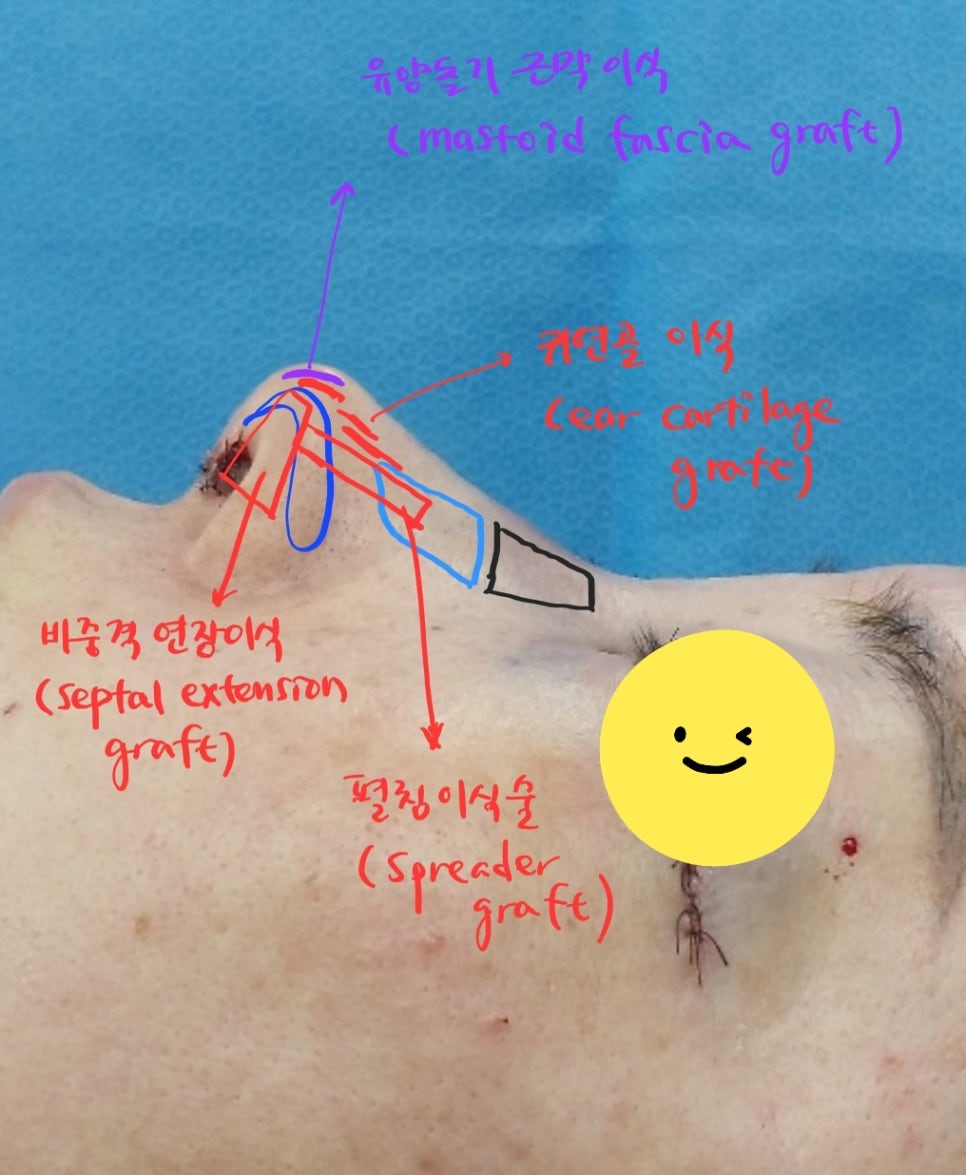
Surgical diagram for hump nose correction
The nasal tip is supported with septal extension grafting to lift the drooping tip, and cartilage grafts are used to refine the transition between the nasal tip and the bridge.
Finally, the thin skin at the nasal tip is reinforced with fascia. This process helps prevent cartilage from showing through the skin at the tip and reduces the chance of revision surgery.
Let's compare the before and after results.
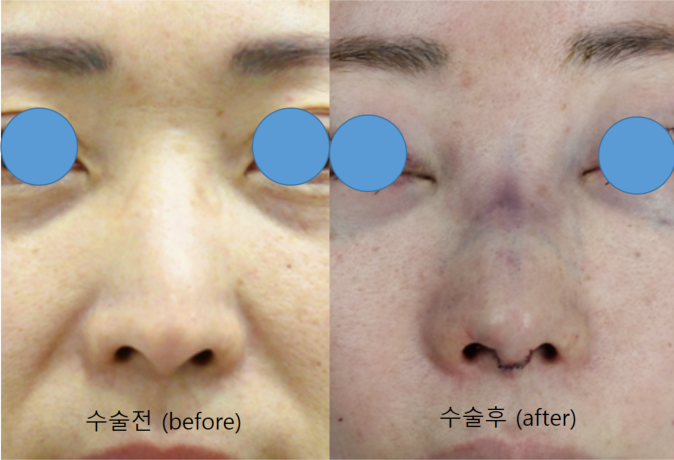
Before-and-after comparison, front view
The nose, which was curved in a C shape before surgery, has been changed to a straighter appearance.
Nostril asymmetry has also improved significantly.
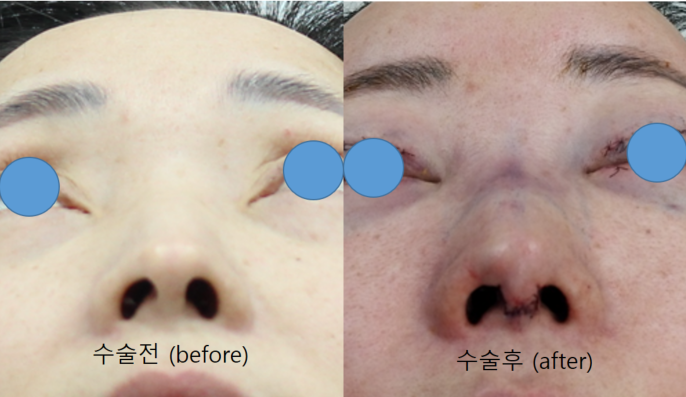
Before-and-after comparison, bottom view
The nostril asymmetry and bent columella seen before surgery have been well corrected.
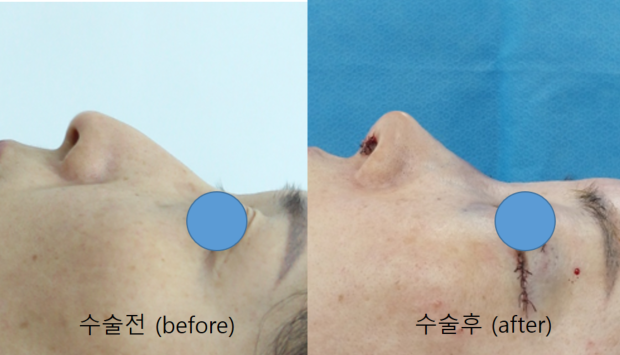
Before-and-after comparison, side view
The dropped hump at the nasal tip before surgery has been well corrected, creating a more feminine side profile.
A hump nose gives a strong impression and is one of the reasons a person may look older after middle age.
Some people think that using a silicone implant is absolutely necessary for hump nose surgery, but if a silicone implant is used, the already large and high nose may stand out even more, so caution is needed.
And when there are structural problems in the nose, correcting them together can be said to be a rhinoplasty that is good both functionally and aesthetically.