Sometimes, among people who had nose surgery long ago, there are cases where the bridge of the nose looks uneven and has a reddish tint.
Silicone implants used in the nose are the safest among the artificial implants available so far, but after a long period in the body, the capsule that forms around the silicone implant can become calcified.
Of course, capsule formation or calcification around a silicone implant does not necessarily cause major problems. However, if the unevenness is noticeable for cosmetic reasons or if the skin is too thin and the implant shows through, revision surgery may be performed.
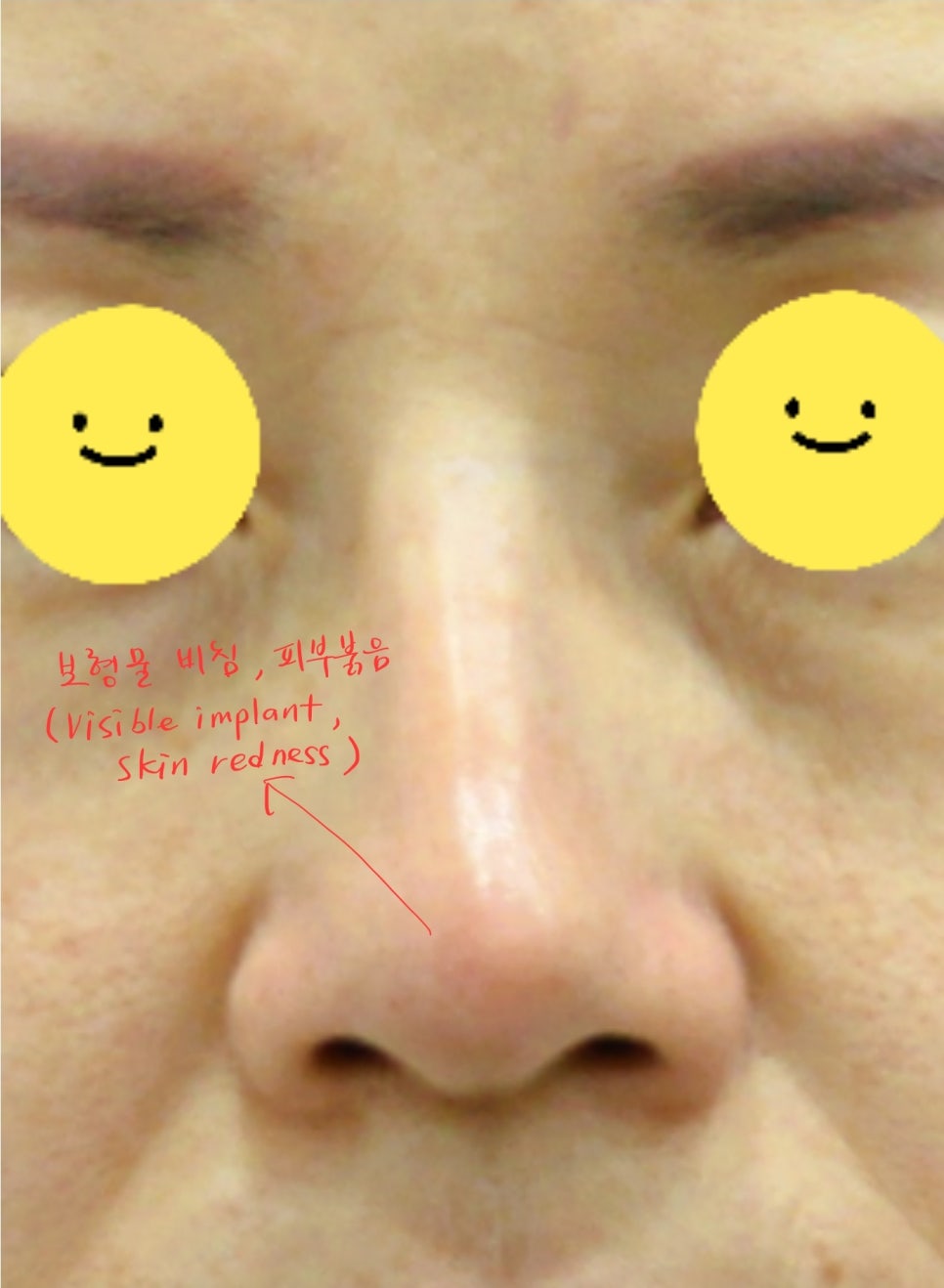
Implant visibility and skin irritation caused by the silicone implant
The reason calcification occurs around a silicone implant is that a thin capsule normally forms around the silicone implant inserted into the body, and calcium in the body gradually accumulates in this capsule.
'Information obtainable through CT scanning in rhinoplasty revision'
If unevenness is felt on the bridge of the nose due to calcification in the silicone implant capsule, a low-dose CT scan can be performed for diagnosis.
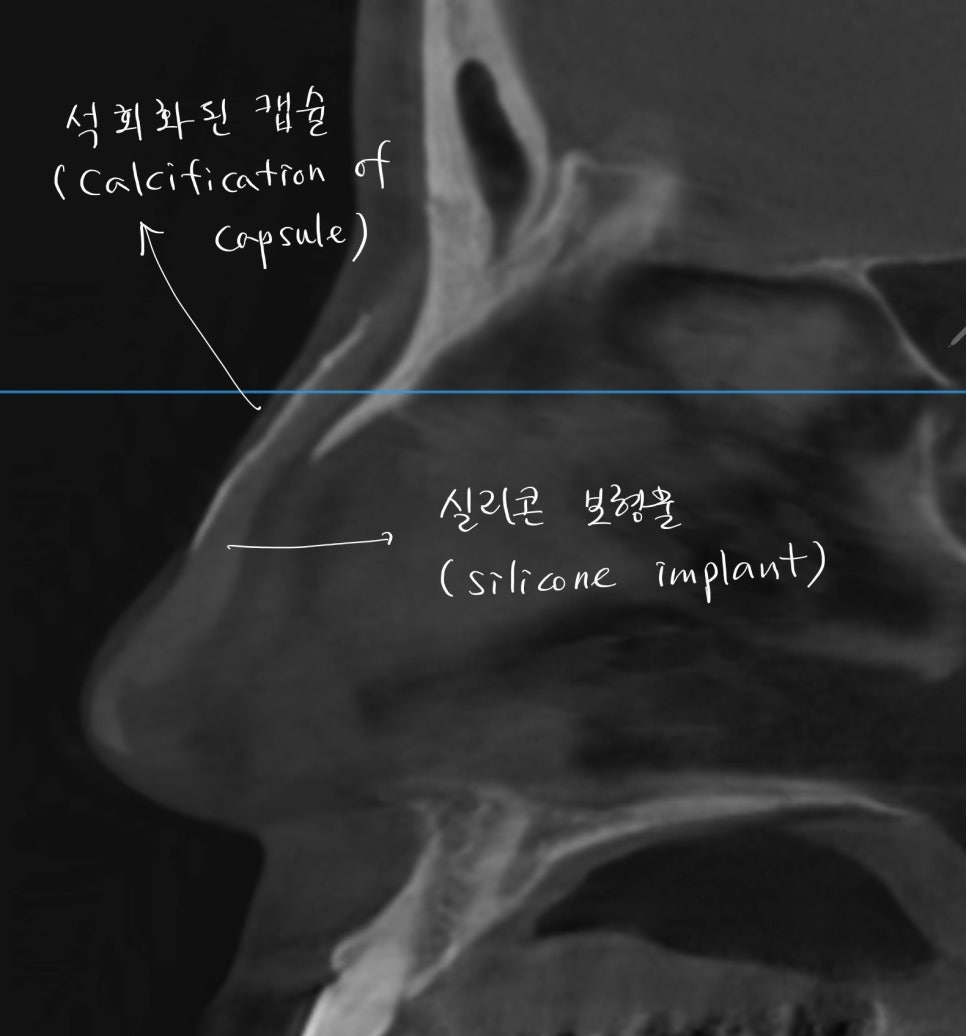
Silicone implant and capsule calcification confirmed through preoperative CT scanning
During a rhinoplasty revision consultation, CT scanning can be used to check the height and shape of the implant, and calcification of the silicone implant capsule can also be confirmed.
Among people with thin skin, there are cases where the skin on the bridge and tip of the nose becomes irritated and turns red because of a silicone implant placed in the past. In some cases, the shape of the implant can also show through the thin skin.
In the past, it was common to perform rhinoplasty by inserting a silicone implant all the way to the tip of the nose, and over the long term, this kind of rhinoplasty can thin the nasal skin and make revision surgery necessary.
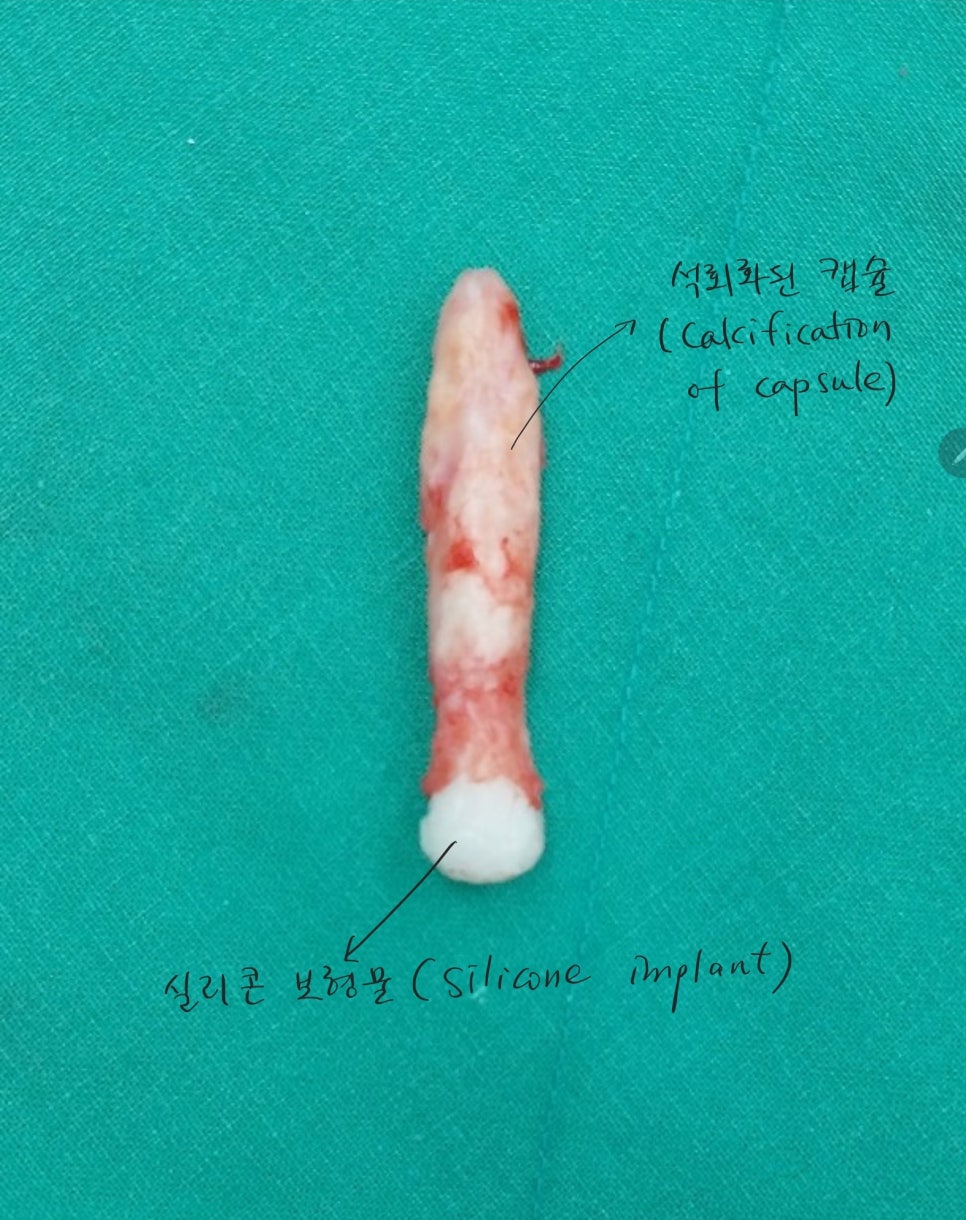
Capsule and calcified lesion around the removed silicone implant
Today, when performing rhinoplasty, silicone implants are no longer inserted all the way to the tip of the nose or used in an L-shape. Instead, an I-shaped silicone implant is inserted only into the bridge, and the tip is lifted using autologous cartilage such as septal cartilage or ear cartilage.
'Rhinoplasty materials used to reinforce thinned skin'
To lift the tip of the nose with autologous cartilage and reinforce thinned skin, several materials are needed.
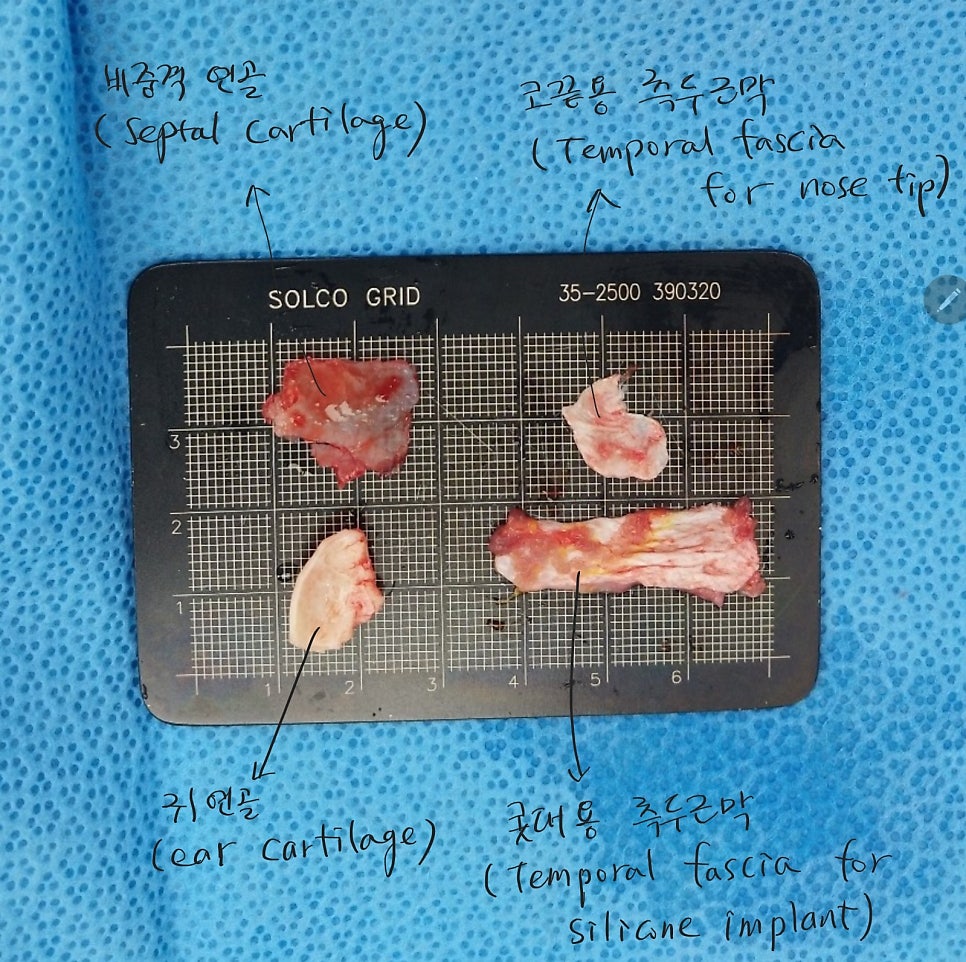
Various autologous tissue materials harvested for rhinoplasty revision
Septal cartilage and ear cartilage are harvested to raise the nasal tip, and temporal fascia is harvested from beneath the scalp to reinforce the thinned skin.
Sometimes, because temporal fascia is harvested from beneath the scalp without leaving a scar, some people refer to temporal fascia as scalp fascia.
Even in a standard first-time rhinoplasty, harvesting septal cartilage and ear cartilage is very common. In addition, temporal fascia or dermis is needed to reinforce the thinned skin of the nose.
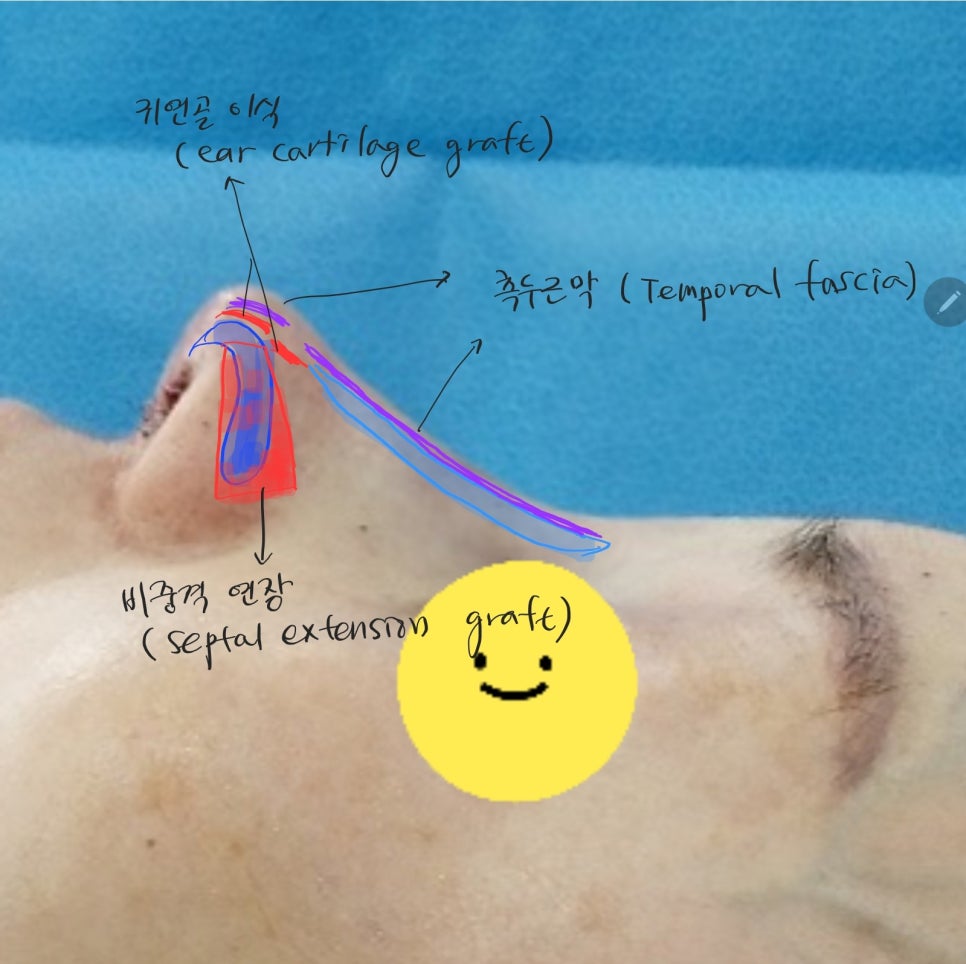
Diagram of rhinoplasty revision to reinforce thinned skin
The harvested septal cartilage is used to create support for the nasal tip through septal extension grafting, and the harvested ear cartilage is placed on the nasal tip using an onlay graft technique.
To reinforce the areas where the skin has become thin due to the silicone implant, fragments of ear cartilage are grafted into partially sunken areas, and temporal fascia is placed over the nasal tip to reinforce the thinned skin.
Then an I-shaped silicone implant is carved and inserted into the bridge of the nose. Since the skin has become very thin and the existing calcified silicone capsule has also been removed, the silicone implant must be covered using temporal fascia.
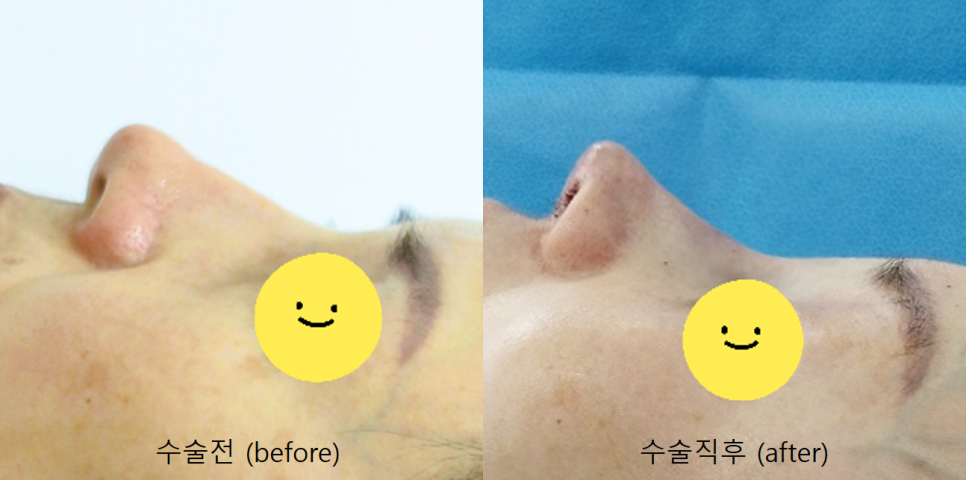
Before-and-after comparison immediately after surgery
Through rhinoplasty revision, it is important not only to remove the calcified silicone implant and capsule and improve the unevenness of the bridge, but also to create a more feminine line for the nose aesthetically.
And the most important point is that once the skin of the nose has become thin, it does not become thick again, so the thinned skin of the bridge and tip must be reinforced with an appropriate method.