In rhinoplasty for Asian noses, the septal cartilage is often small, so ear cartilage is frequently harvested additionally.
And sometimes, if septal cartilage is used for rhinoplasty, the tip of the nose may become a little stiff after surgery, so some people prefer the softer feel of ear cartilage when choosing rhinoplasty.
Both septal cartilage and ear cartilage are good cartilage materials for rhinoplasty, and each type has its own advantages and disadvantages depending on the characteristics of the cartilage.
'Harvest site for ear cartilage'
The important point in harvesting ear cartilage is to collect the cartilage while preserving the shape and structure of the ear.
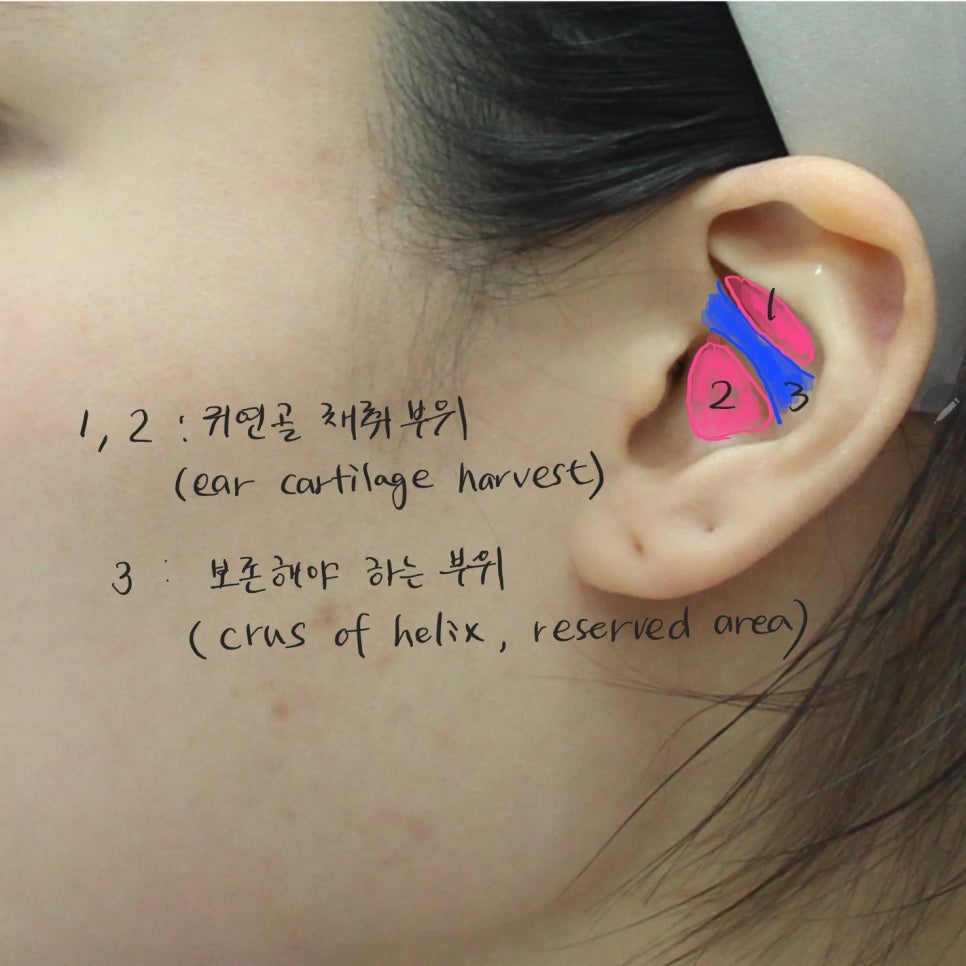 Harvest site for ear cartilage
The incision site for harvesting ear cartilage is usually made behind the ear, where the scar is less visible.
Harvest site for ear cartilage
The incision site for harvesting ear cartilage is usually made behind the ear, where the scar is less visible.
However, in some cases, ear cartilage must be harvested while preserving both perichondrial layers as much as possible, and in those cases, an incision in front of the ear may also be used.
In all cases of incisions behind or in front of the ear, it is best to use a harvesting method that does not destroy the skeletal structure of the ear if possible.
The area labeled 1 in the figure is called the symba concha, and the area labeled 2 is called the cavum concha.
The cartilage structure between 1 and 2 is called the crus of helix, and this cartilage must be preserved to maintain the shape of the ear.
'Processing harvested ear cartilage'
The harvested ear cartilage is processed into a suitable shape for use in raising the nasal tip.
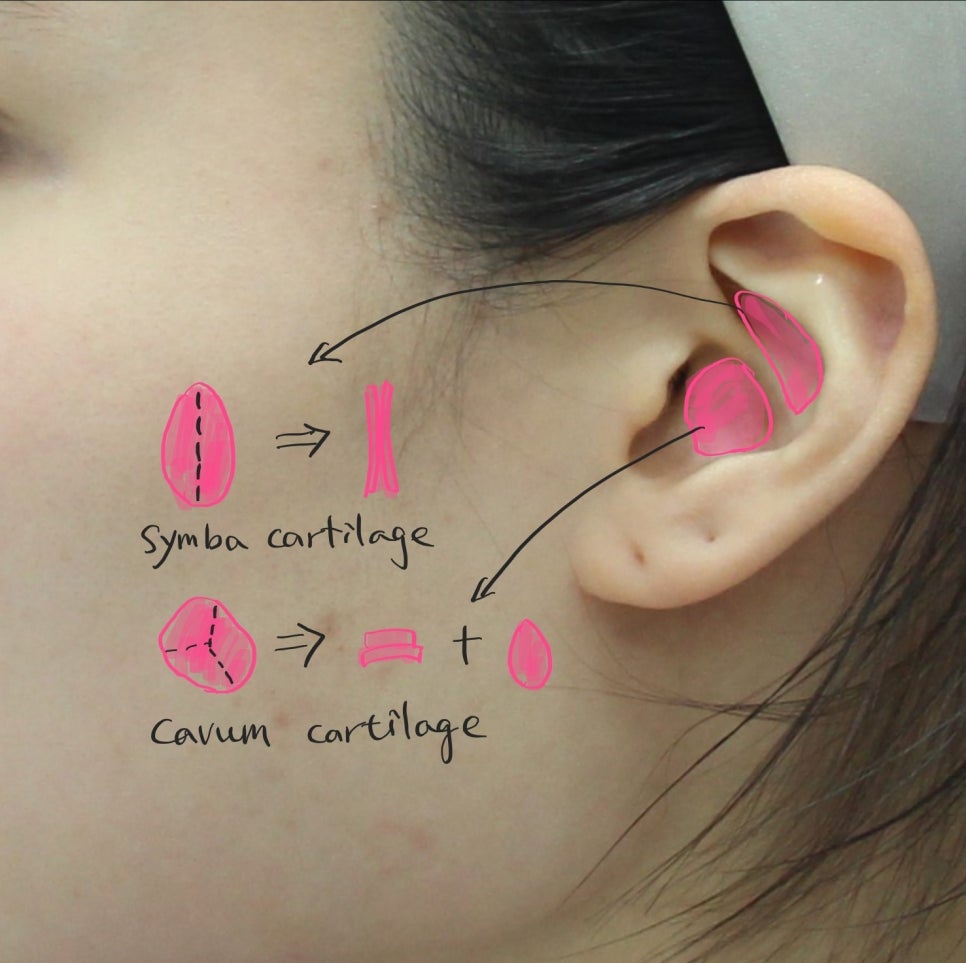 How ear cartilage is processed to raise the nasal tip
The symba cartilage, which corresponds to the upper part of the ear cartilage, is mainly folded in half and used to create support for the nasal tip.
How ear cartilage is processed to raise the nasal tip
The symba cartilage, which corresponds to the upper part of the ear cartilage, is mainly folded in half and used to create support for the nasal tip.
Because ear cartilage has a curved structure, both sides must be folded into the same shape to create a straight support structure.
The cartilage harvested from the lower part of the ear is called the cavum concha, and this cartilage is divided into 2 to 3 pieces and placed on top of the nasal tip to raise it; this method is called an onlay graft.
And sometimes, when support at the nasal tip is insufficient or when a projected nasal tip needs to be lowered, it may also be used as a cartilage piece for a derotation graft.
'Aftercare after harvesting ear cartilage'
After ear cartilage is harvested, the incision area must be carefully sutured.
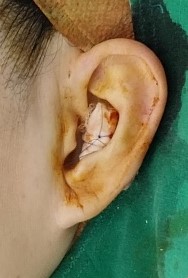 Aftercare to prevent hematoma after ear cartilage harvesting
Sometimes blood may collect in the empty space at the site where ear cartilage was harvested, so after surgery the harvest site is compressed with packing cotton.
Usually, the packing cotton can be removed after about 3 days, which helps prevent hematoma and preserve the shape of the ear.
'Rhinoplasty using ear cartilage'
Usually, in the first rhinoplasty, ear cartilage is often used together with septal cartilage.
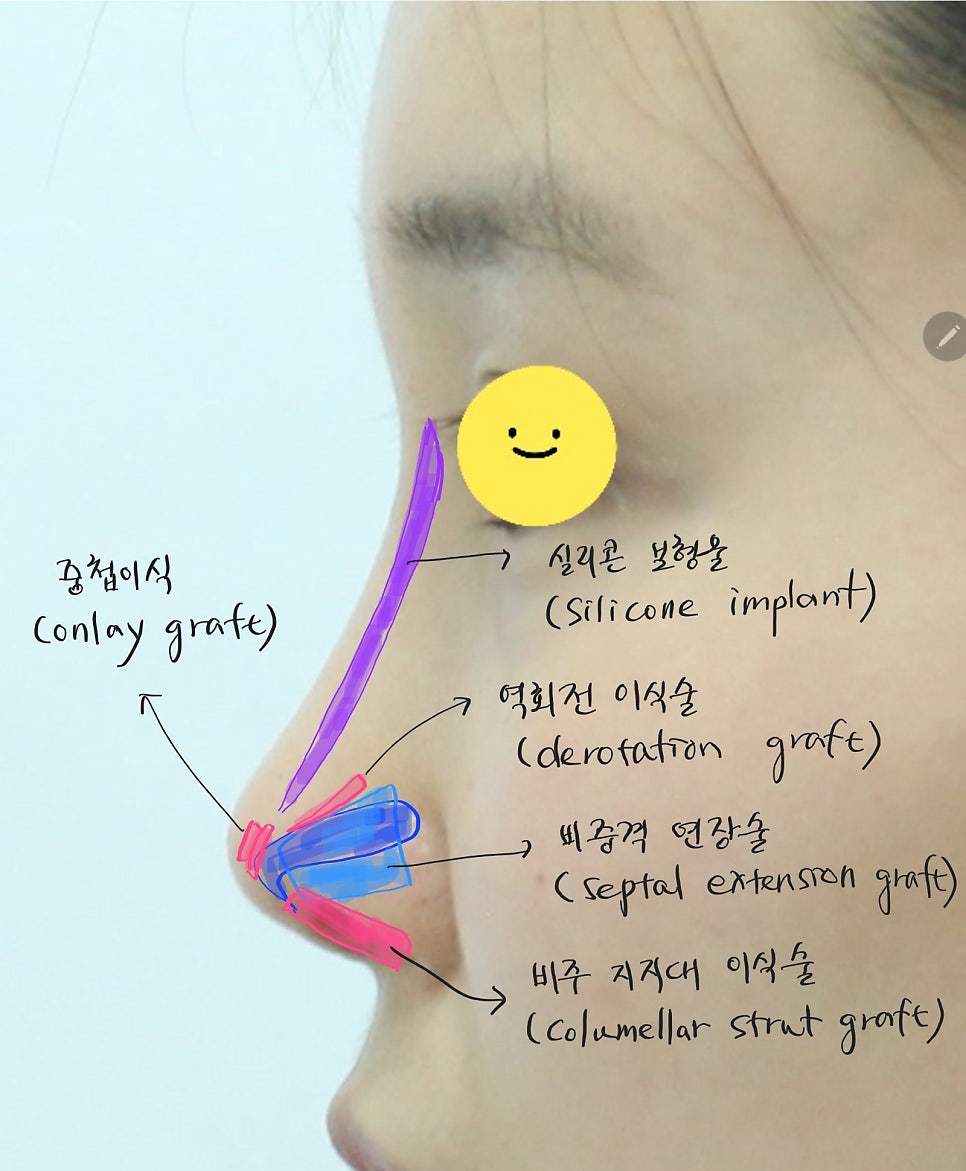 Diagram of rhinoplasty using septal cartilage and ear cartilage
Septal cartilage is the flat cartilage inside the nose that separates the nostrils in the mucosal area, and by partially harvesting this cartilage, it can be used as support for the nasal tip to raise it.
Diagram of rhinoplasty using septal cartilage and ear cartilage
Septal cartilage is the flat cartilage inside the nose that separates the nostrils in the mucosal area, and by partially harvesting this cartilage, it can be used as support for the nasal tip to raise it.
In the case of ear cartilage, it can be used as a columellar strut for the nasal tip, or the nasal tip can be raised by using an onlay graft method in which cartilage is placed on top of the tip.
And sometimes, if the nasal tip is short, it can be used as material for a derotation graft to lower the tip.
'Before and after rhinoplasty using septal cartilage and ear cartilage'
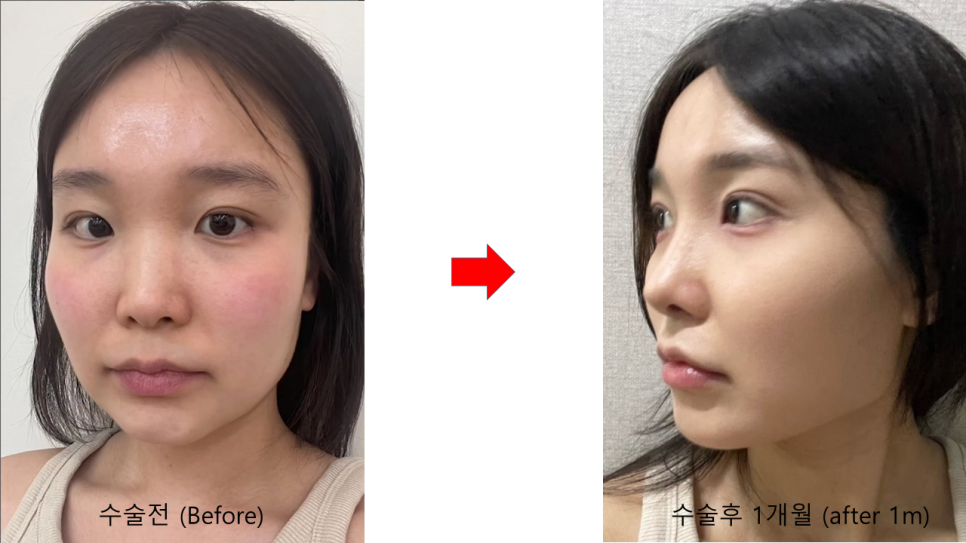 One-month rhinoplasty review. This is a real model whose release has been consented to.
Some people with a small nose think about raising both the bridge and the tip a lot, while many others want rhinoplasty done naturally and in moderation so that their own image is well preserved.
Because of its soft characteristics and unique elasticity, ear cartilage can become a very good material for nasal tip surgery when used appropriately.
And when septal cartilage is insufficient, using ear cartilage as an auxiliary material often produces better results than using septal cartilage alone.
 This is a real model whose release has been consented to.