People often ask about the results or how long a facelift or deep mini facelift lasts, but many also ask about the incision line.
While less attention may be paid to the parts placed inside the hairline or the incision behind the ear, the incision area in front of the ear inevitably draws more attention.
Before looking at the incision areas for a facelift or deep mini facelift, let’s first look at the shape and names of the ear.
'Structure and Names of the Ear'
The ear visible from the outside is called the 'outer ear' and has a very complex structure, with separate names for each part.
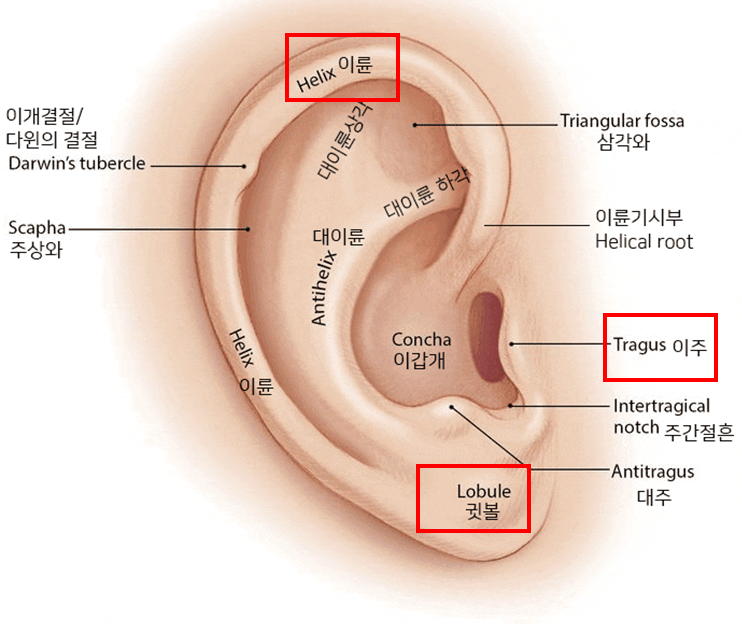
The important parts of the ear in a facelift or deep mini facelift are, from the top, the helix, tragus, and lobule.
'Incision Areas of the Deep Mini Facelift'
A deep mini facelift is a mini facelift method that uses part of the incision line from a facelift. The incision length is shorter than that of a facelift, but the SMAS dissection is performed using the same surgical approach as a facelift.
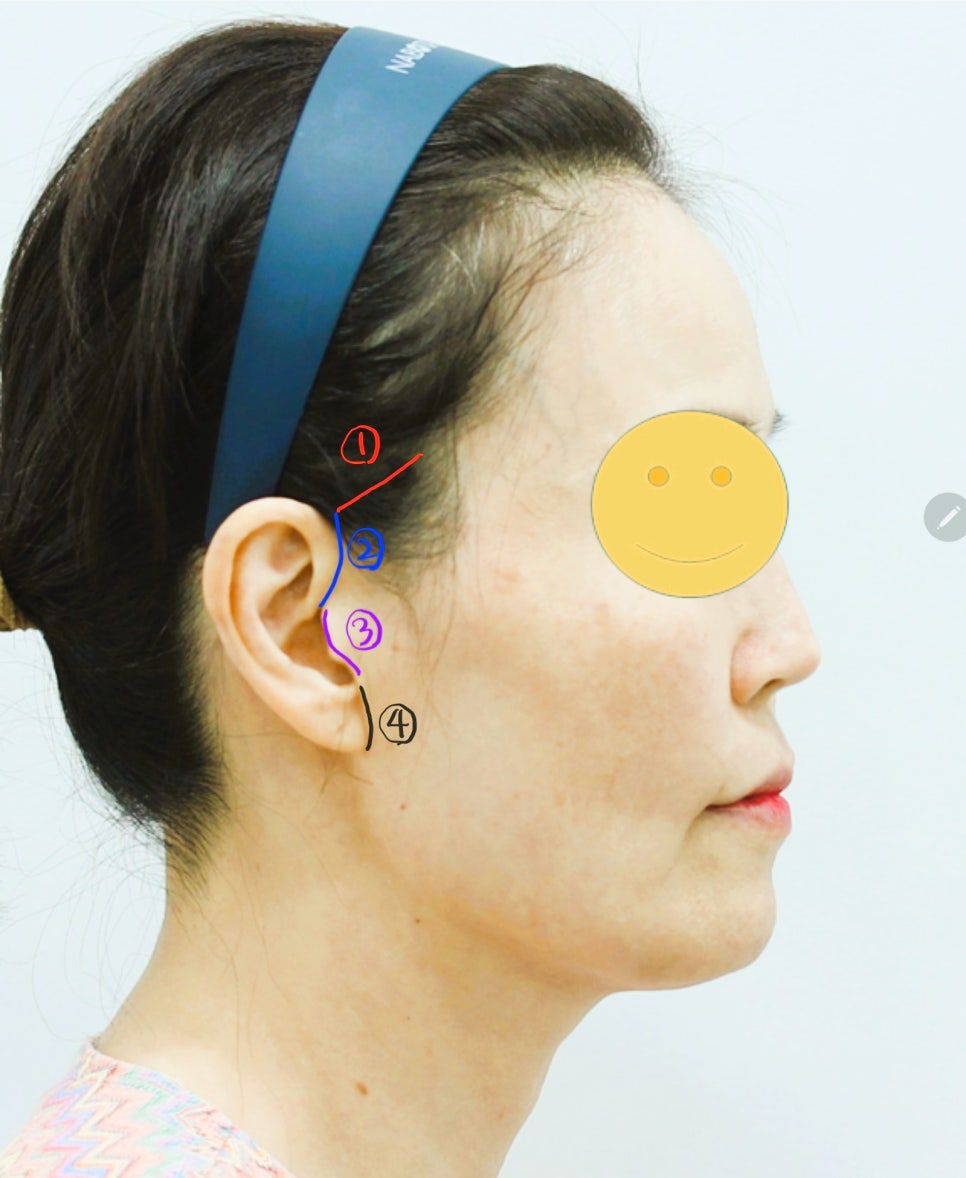 The incision line of a deep mini facelift. This is a real model with consent for public release.
The incision line of a deep mini facelift can be broadly divided into four areas.
-
Temple incision
-
Helix incision
-
Tragus incision
-
Lobule incision
Among these, 1. the temple incision goes inside the scalp, so the scar is not visible, but 2, 3, and 4 are located in front of the ear, so they need to be made as inconspicuous as possible.
'Extent of Dissection and Surgical Method for a Deep Mini Facelift'
A deep mini facelift can be applied when skin sagging is not severe, but because the surgery is performed in a manner very similar to a deep-plane facelift, it has the advantage of producing good results and a long-lasting effect.
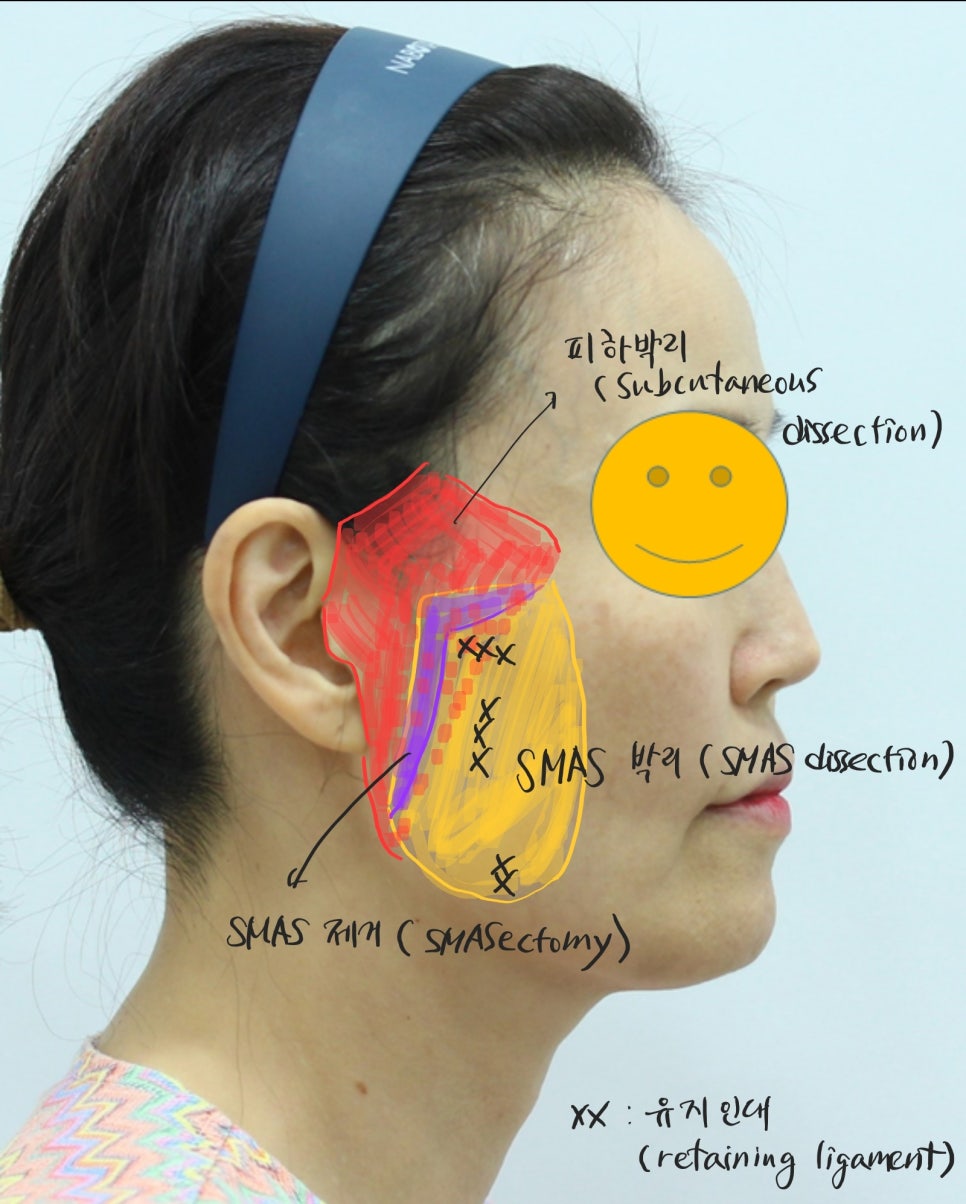 Deep-plane mini facelift, surgical method of deep mini facelift
A deep mini facelift performs subcutaneous dissection in the same way as a deep-plane facelift, and dissection of the SMAS layer and retaining ligaments can also be done to a similar extent.
In a facelift, the important retaining ligaments—the zygomatic retaining ligament, parotid masseteric retaining ligament, and mandibular retaining ligament—must be dissected at the appropriate layers for a good lifting effect and long-lasting results.
And only when the SMAS layer is sufficiently dissected and the retaining ligaments are properly released can the incision scars become less noticeable and ear shape distortion be prevented.
'Third-Week Progress of the Deep Mini Facelift Incision Area'
Scars in the incision area of a facelift or deep mini facelift are usually a little darker than the skin color for about 1 to 2 months after surgery, but as more time passes, they become the same color as the skin and the scar becomes almost unnoticeable.
And most importantly, the original shape of the ear must be preserved.
The incision divisions of a deep mini facelift
In particular, when suturing the incision area, tension should be applied to the lifted SMAS layer. If too much tension is applied to the skin, ear deformation can occur.
If there is excessive skin tension in area 3, tragal deformity can occur, and if too much tension is placed on the skin at the incision area in area 4, pixie ear deformity can occur.
Therefore, the important point in a facelift or deep mini facelift is to secure the tension of the lifted soft tissue to the SMAS layer through proper dissection and fixation of the SMAS layer, and to close the skin with almost no tension (tension free) for good results.
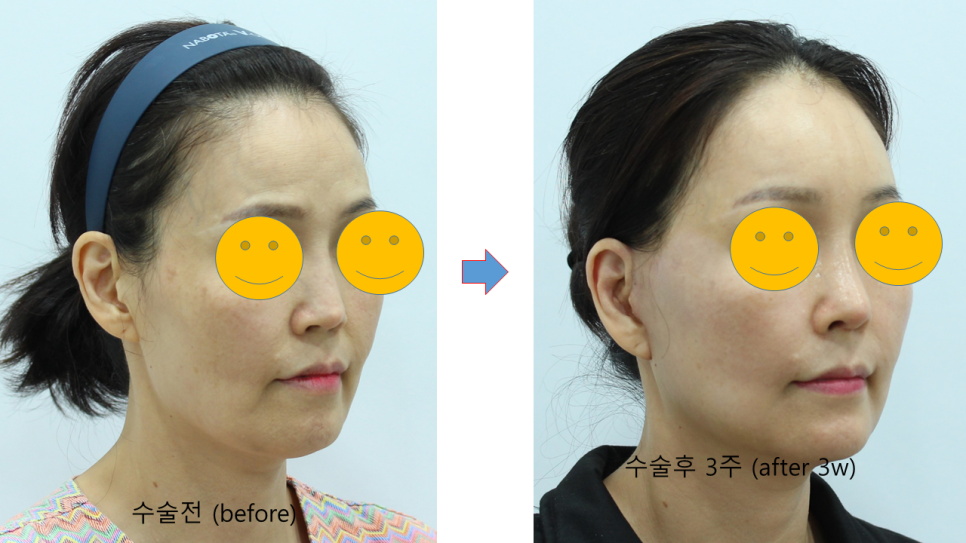 Third-week follow-up of the deep mini facelift
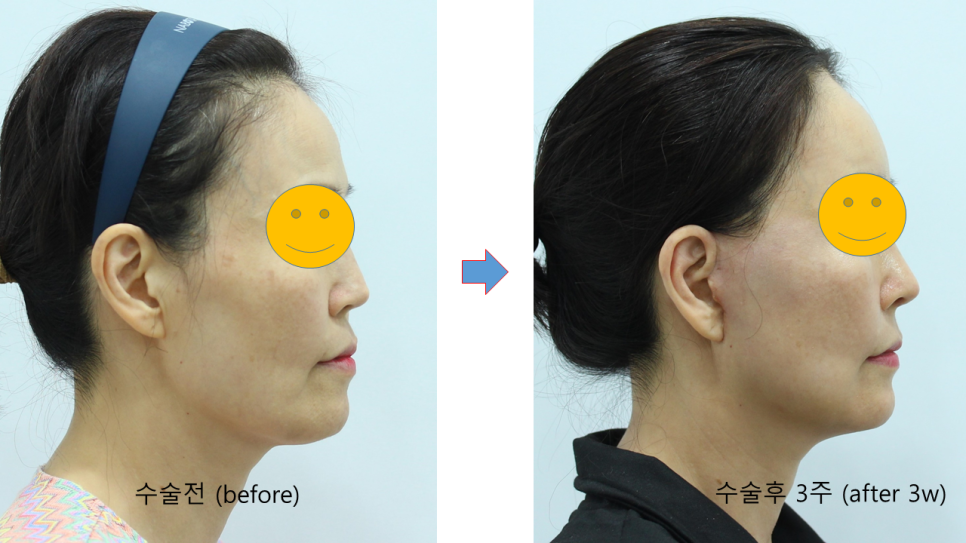 Third-week follow-up after deep mini facelift surgery