When consulting about incision-based double eyelid surgery, many people are concerned about postoperative scar issues.
Because incision-based double eyelid surgery creates a double eyelid by making an incision in the skin above the eyelid, it is not possible to have no scar at all after surgery.
However, in some cases, very severe sunken scars can occur, and in such cases, revision surgery is needed to correct the scar so that a natural double eyelid can be created.
'Causes of Sunken Scars After Double Eyelid Surgery'
A woman in her late 20s visited the clinic with a sunken scar that developed after a previous double eyelid surgery.
After the double eyelid surgery, the fold was created, but the scar was severe, and she said it was stressful that the surgical traces were too visible when her eyes were closed.
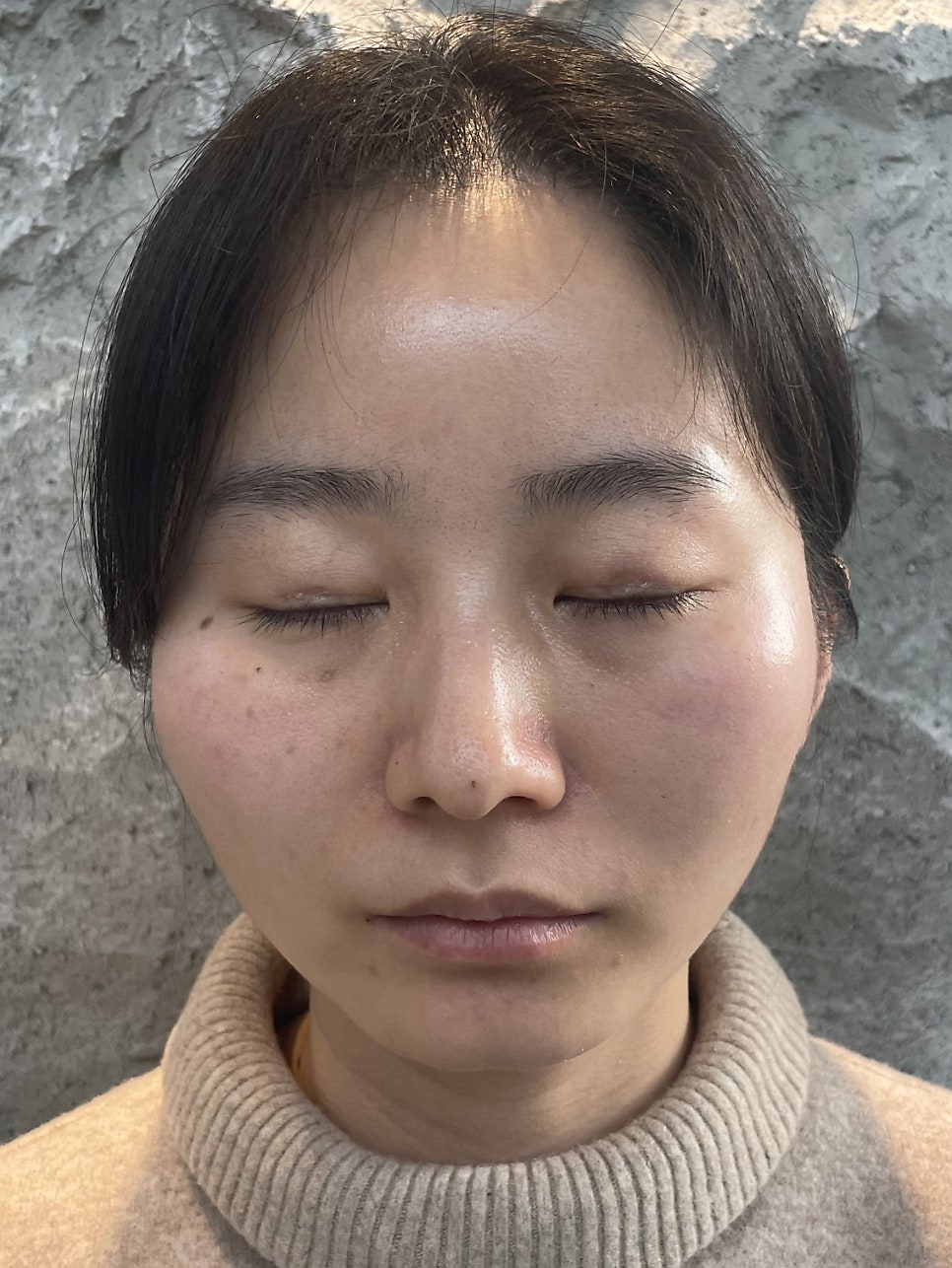
Sunken scar that developed after double eyelid surgery. This is a real model with consent for disclosure.
The double eyelid was created slightly lower than the usual position for surgically made double eyelids, and when the eyes were closed, the surgical scar was very noticeable.
In incision-based double eyelid surgery, there are cases where a large amount of pre-tarsal tissue below the incision line is removed in order to create strong adhesions so that the double eyelid does not loosen. In such cases, a sunken scar can occur after surgery.
In particular, if a large amount of orbicularis oculi muscle is removed, the sunken scar tends to become even more severe.
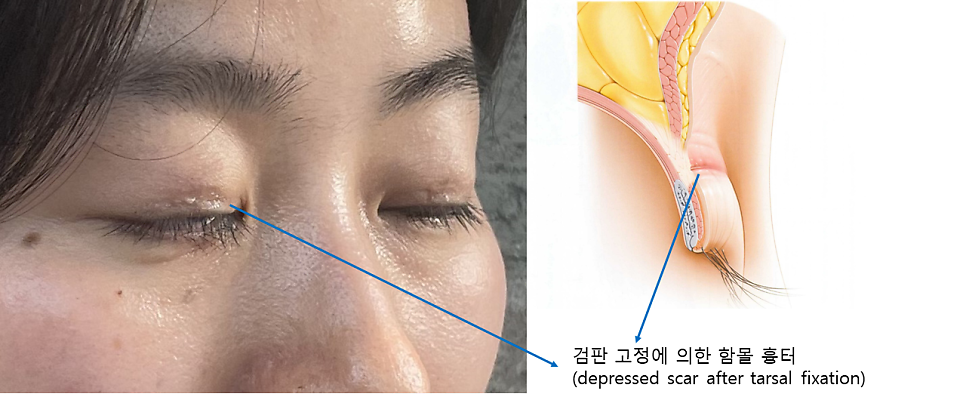
Sunken scar caused by removed orbicularis oculi muscle and firm tarsal fixation.
Also, a fixation procedure is performed to create the double eyelid at the incision line, and if the skin is strongly fixed to the tarsal plate, which is the firm tissue in the eyelid, the sunken scar becomes even more severe after surgery.
In the end, sunken scars after double eyelid surgery can occur when soft tissue, including the orbicularis oculi muscle, is excessively removed, or when strong fixation is made to the firm tissue called the tarsal plate while creating the double eyelid.
'Revision Surgery to Correct Sunken Double Eyelid Scars'
In cases of double eyelid revision surgery with severe sunken scars, incision-based double eyelid revision surgery is necessary.
A non-incisional method cannot remove sunken scars, and because the scar tissue must be properly removed and the scar tissue loosened, the surgery is performed as incision-based double eyelid surgery.
There are also several methods for fixing the double eyelid, but as mentioned earlier, tarsal fixation involves fixing to firm tissue, so it can look unnatural and may cause sunken scars.
In addition, because the fixation method is static, an artificial feeling can also occur during the process of opening the eyes.
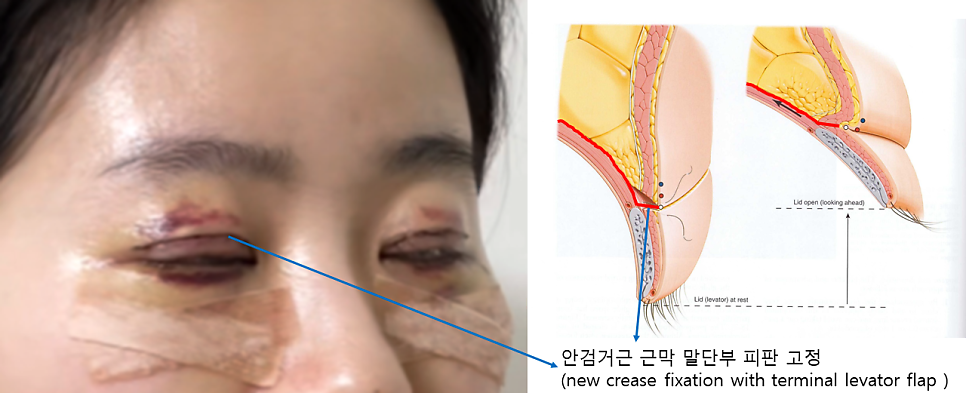
The fixation method used in double eyelid revision surgery to correct sunken scars. A double eyelid fixation method that attaches to the terminal flap of the levator aponeurosis, which is soft tissue.
During the dissection process of double eyelid surgery, the muscle that opens the eyes, called the levator muscle, can be found. This tissue is mainly used for ptosis correction, but it is also an important tissue for creating a natural double eyelid.
Unlike the tarsal plate, this tissue is soft, and if the length of the terminal part of this tissue is adjusted to form a flap, it becomes a good tissue for creating a soft double eyelid.
If the levator aponeurosis is made into a foldable flap and the end of that flap is connected to the skin, a double eyelid that does not sink in can be created.
Also, when a double eyelid is created using this soft tissue, it moves in a way that is more similar to a natural double eyelid during the process of opening the eyes, and this is called a dynamic double eyelid.
'Before and After Double Eyelid Revision Surgery to Correct Sunken Scars'
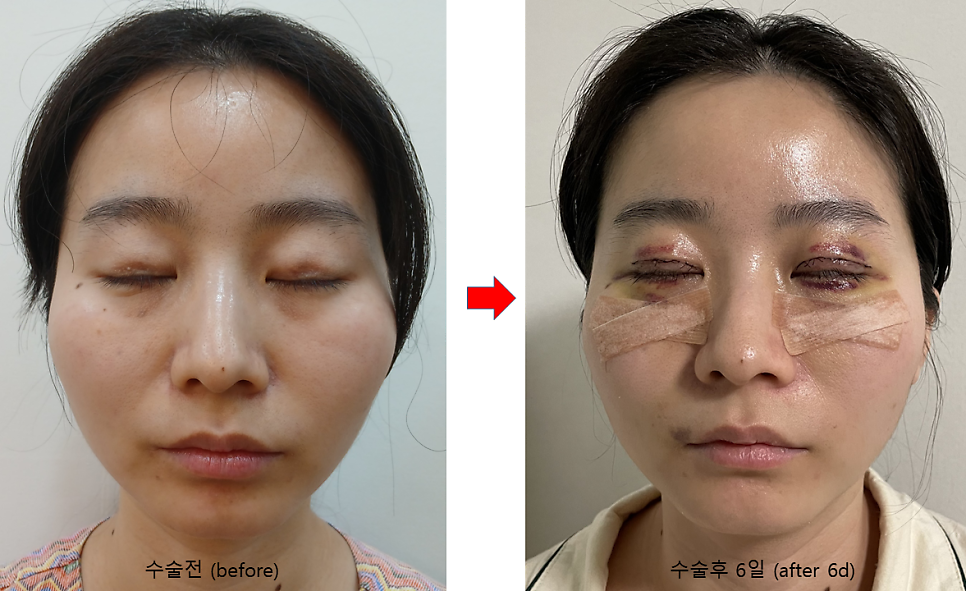
Before and after surgery for a sunken double eyelid scar. This is a real model with consent for disclosure.
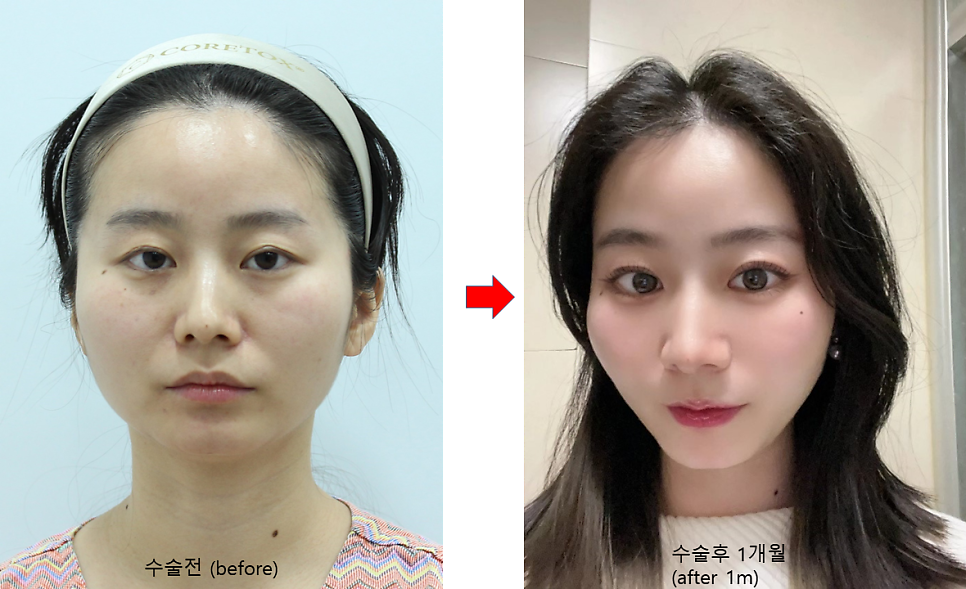
Before and after correction of double eyelid scars. This is a real model with consent for disclosure.
In the case of incision-based double eyelid surgery, sunken scars can occur if the orbicularis oculi muscle or pre-tarsal soft tissue is excessively removed.
And in terms of the double eyelid fixation method, tarsal fixation is a firm fixation, so if it is fixed too tightly, sunken scars can occur, and caution is needed.
Therefore, in double eyelid surgery, the orbicularis oculi muscle and soft tissue should not be excessively removed, and soft tissue such as the terminal part of the levator muscle should be used to create the double eyelid so that a natural fold can be made without the scar sinking in even when the eyes are closed.

Double eyelid revision surgery review. This is a real model with consent for disclosure.