The most commonly used implant in rhinoplasty is a silicone implant, but 15 to 20 years ago, GORE-TEX implants were also widely used.
Silicone and GORE-TEX implants each have their own advantages and disadvantages, but in the case of GORE-TEX, removal is not easy and it often makes the skin thinner, so it is rarely used these days.
However, in consultations, it is not uncommon to meet patients who previously had surgery using a GORE-TEX implant, and many of these cases require revision surgery.
'Diagnosis when the nasal tip drops after rhinoplasty'
After rhinoplasty in the past, it was common for the height of the nasal tip to decrease, but in most cases, revision surgery is not required.
However, if the nasal tip becomes too low, it may deform into a beak-like shape and the cosmetic result may be unsatisfactory, making revision surgery necessary.
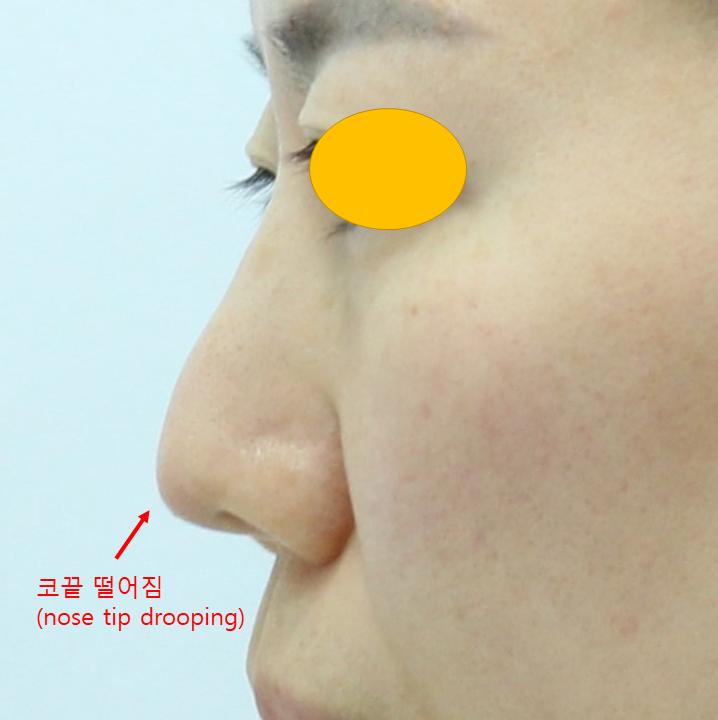
Drooping nasal tip. Revision rhinoplasty in a patient in their 40s. This is a partially modeled image with consent for disclosure.
In consultations for revision rhinoplasty, an in-person examination is important, but a preoperative CT scan is essential to accurately assess the condition inside the nose.
Through CT imaging, the type, position, and height of the implant used in the past can be identified, and the condition or deviation of the septal cartilage can be checked.
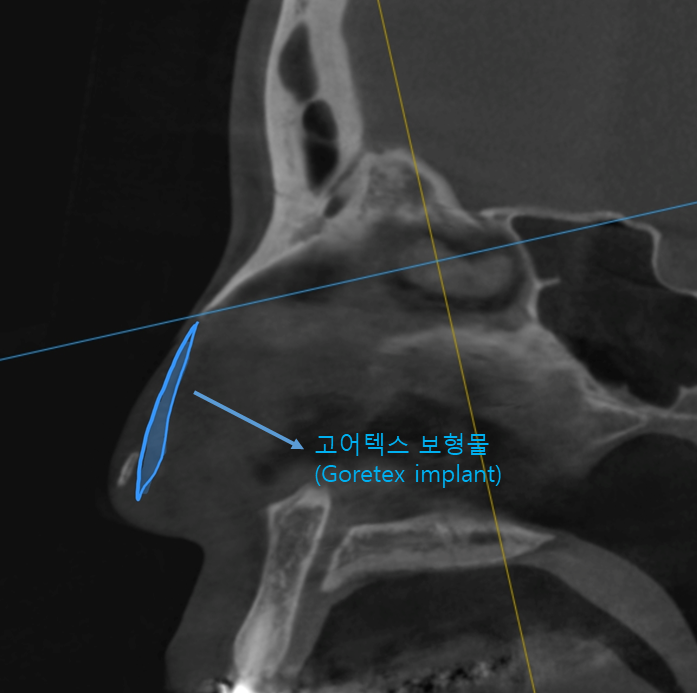
Revision rhinoplasty CT. GORE-TEX implant. The GORE-TEX implant observed on CT imaging.
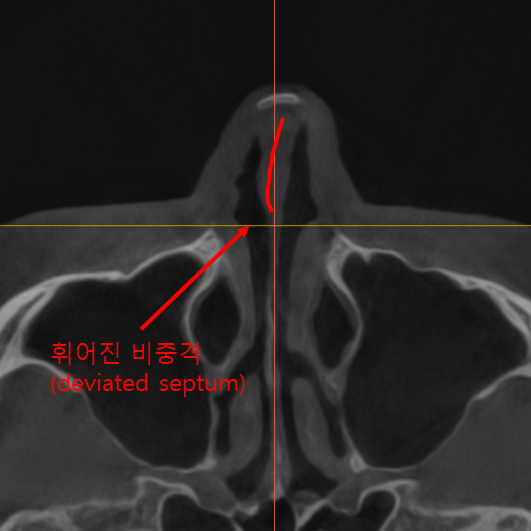
Septal deviation. Crooked nose after rhinoplasty. Deviation of the septum seen on CT imaging.
In many cases where the nasal tip drops after rhinoplasty, the reason is insufficient support at the tip.
However, this does not simply mean that the cartilage is too weak; if the septum is deviated, the pressure from the implant and the skin often causes the nasal tip to gradually drop.
'Revision rhinoplasty replacing the implant with autologous tissue'
Although there may be differences in personal preference, the recent trend in rhinoplasty is toward more natural-looking results.
Because of this, many people choose implant-free rhinoplasty for their first surgery, and in revision rhinoplasty, more people are choosing to replace implants with autologous tissue.
Reusing an implant in revision rhinoplasty is also common, but if you are uncomfortable with implants or concerned about implant-related side effects, it may be worth considering rhinoplasty using autologous tissue.
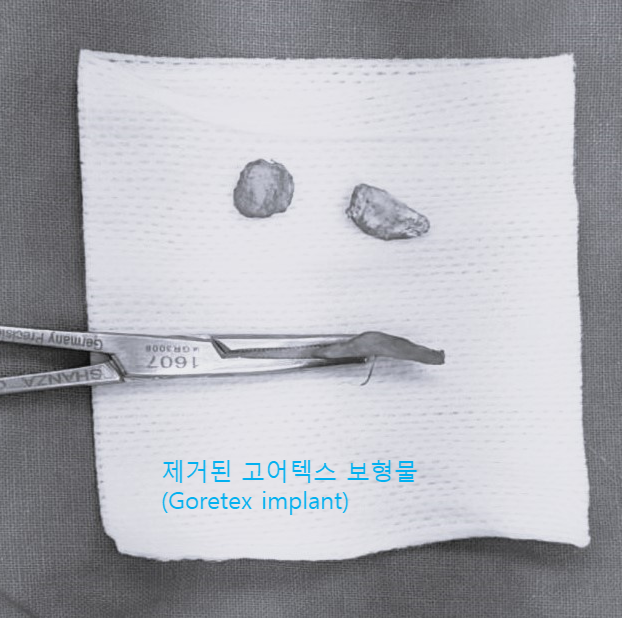
Removed GORE-TEX implant. GORE-TEX removal. Removal of a GORE-TEX implant.
After removing the implant used in the previous surgery, autologous tissue of a similar volume is needed to maintain the same nasal bridge height, and through the consultation process, the appropriate material for rhinoplasty is recommended.
In autologous tissue rhinoplasty, the materials used for the nasal bridge can vary, but if minimal absorption and a high, refined shape are desired, the results are excellent when using a dorsal onlay graft of carved rib cartilage.
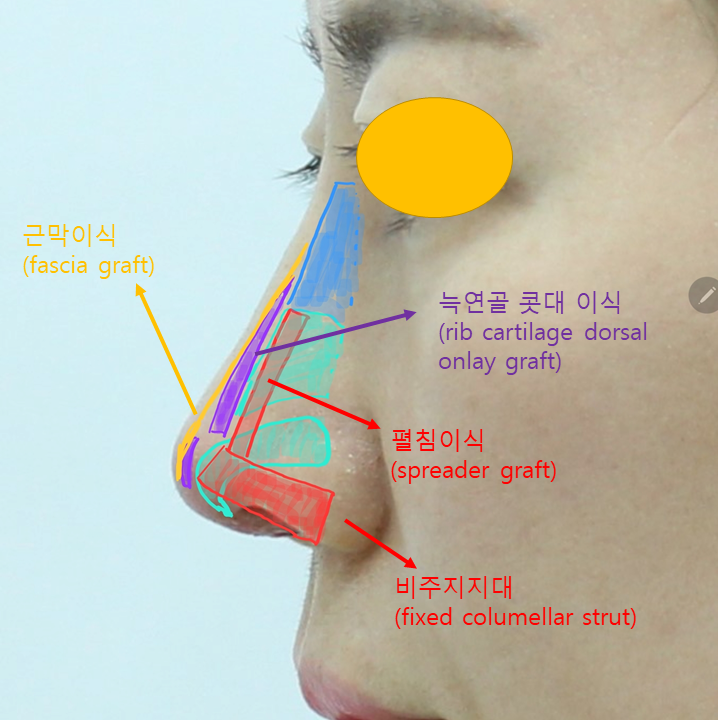
Revision rhinoplasty using autologous rib cartilage. Revision rhinoplasty with costal cartilage. Implant removal.
Using autologous rib cartilage can strengthen the support of the nasal tip, so it is often used to correct a drooping nasal tip.
And if septal deviation is present, it can over time cause the support structure of the nasal tip to bend, leading to a drooping tip, and in severe cases it can cause columellar deviation and nostril asymmetry, so correction is recommended.
Along with correction of septal deviation, placing a spreader graft on the side with the weaker support structure helps prevent recurrence of the deviation.
When rib cartilage is used instead of an implant for the nasal bridge, proper carving is necessary to prevent warping, and it is important to cover the cartilage well with fascia to prevent the cartilage from showing through the bridge.
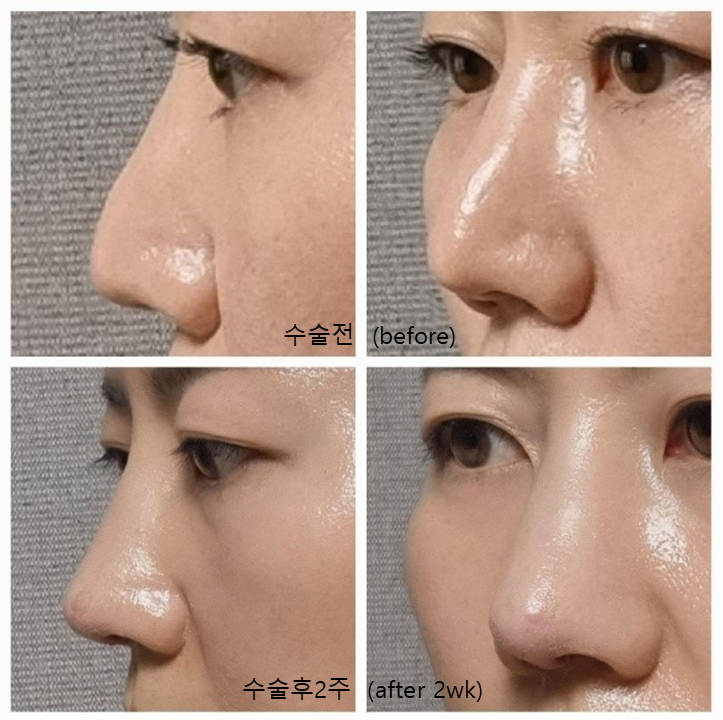
Before and after autologous tissue rhinoplasty after implant removal. This is a partially modeled image with consent for disclosure.
The biggest advantage of rhinoplasty using autologous tissue is that it does not have implant-related side effects.
Not all implants cause side effects such as inflammation, contracture, or visibility, but they can occur at some rate, so if you are worried about them, it may be worth considering autologous tissue rhinoplasty.