As time passes after rhinoplasty, a contracture-type deformity in which the tip of the nose gradually turns upward can cause significant stress for patients.
In particular, when contracture develops around a silicone implant and the surrounding tissue at the same time, it can lead not only to changes in the shape of the nose but also to thinning skin and even implant protrusion.
The case introduced today is a reconstruction case of a woman in her early 30s who had previously undergone rhinoplasty using septal cartilage and a silicone implant.
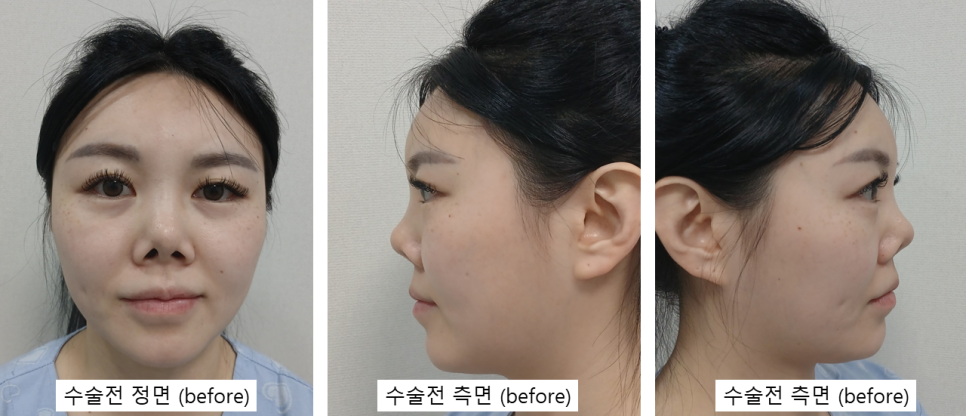 Before-and-after review of a contracted nose. Review of revision surgery for a contracted nose. A real model whose release has been consented to.
The patient had undergone rhinoplasty about 3 to 4 years earlier at another clinic using septal cartilage and a silicone implant.
At first there were no major problems, but over time the tip of the nose gradually began to turn upward, and the nostril show became more pronounced.
In particular, the silicone implant started to protrude into the right nostril, causing very significant cosmetic stress.
The patient was very worried that she “never wanted to experience silicone-related side effects again,”
so the revision surgery was planned using only autologous tissue.
- Internal structure check on preoperative CT -
In revision rhinoplasty, a preoperative CT scan is performed to check the internal problems and current condition of the nose, as well as the height of the previous implant.
On the preoperative CT scan, the tip of the nose was seen to be severely upturned beyond the normal range.
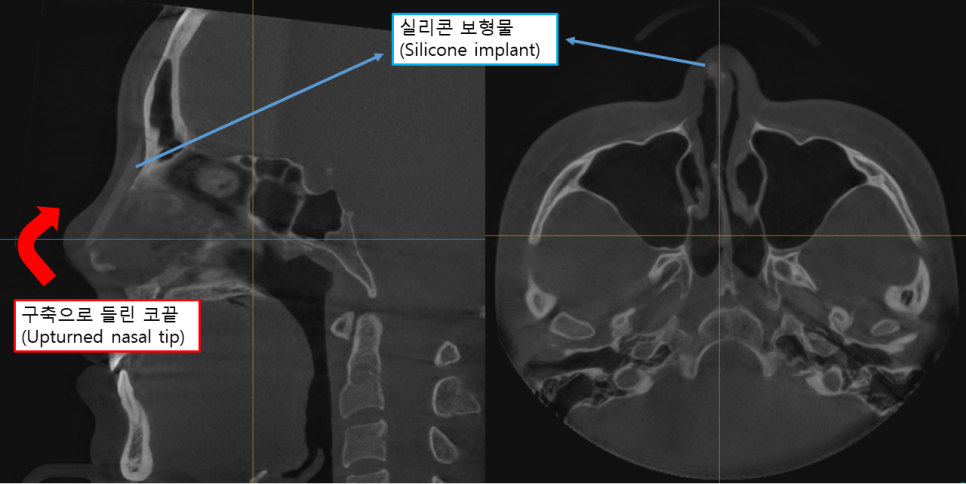 Rhinoplasty CT. Revision rhinoplasty CT. Nose surgery CT scan. Contracted nose CT scan. Silicone implant protrusion. Implant protrusion. Silicone protrusion
In addition, signs of the silicone implant protruding into the inside of the right nostril were also observed.
In cases like this, simply replacing the implant alone is not enough for proper correction, and carefully releasing the contracted tissue itself is very important.
- Contracted nose revision using autologous rib cartilage -
In this surgery, the existing silicone implant and the surrounding capsule tissue were first completely removed.
Then, to return the nasal tip structure, which had been pulled upward due to contracture, to its normal position,
scar tissue around the alar cartilage at the tip of the nose and the contracted structures were very delicately dissected and separated.
Surgery for a contracted nose is not simply an operation to raise the nose,
but rather the key lies in sufficiently loosening the shortened and pulled tissue and rearranging it in the proper direction.
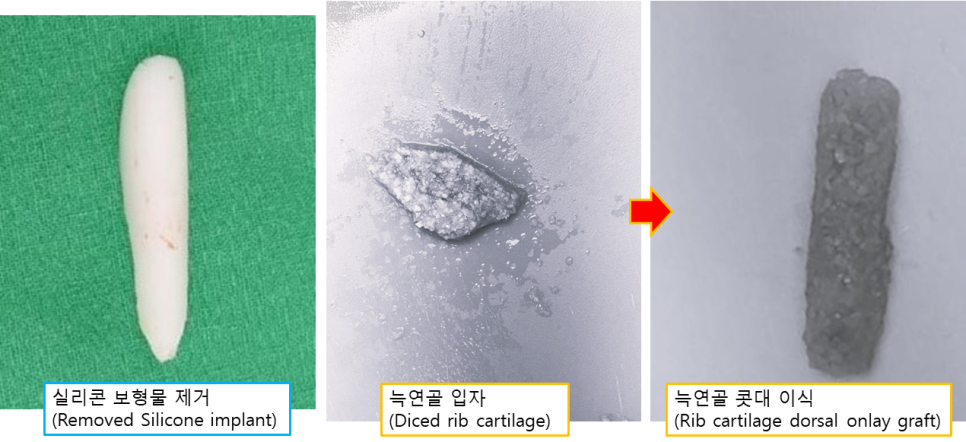
Because the patient had a strong aversion to silicone,
a tissue substitute for the bridge of the nose was needed, and the plan was made using only autologous tissue.
The nasal bridge was naturally augmented using an autologous implant made by finely processing rib cartilage into small particles,
and the nasal tip was also stably supported using autologous rib cartilage.
Because autologous rib cartilage is the patient’s own tissue,
the risk of a foreign-body reaction is low,
and it can be a particularly advantageous option in cases where the tissue condition is poor, such as revision surgery for a contracted nose.
- Results that naturally corrected tip upturning and excessive nostril show -
Looking at the before-and-after photos, the biggest change is that the severely upturned nasal tip has come down naturally.
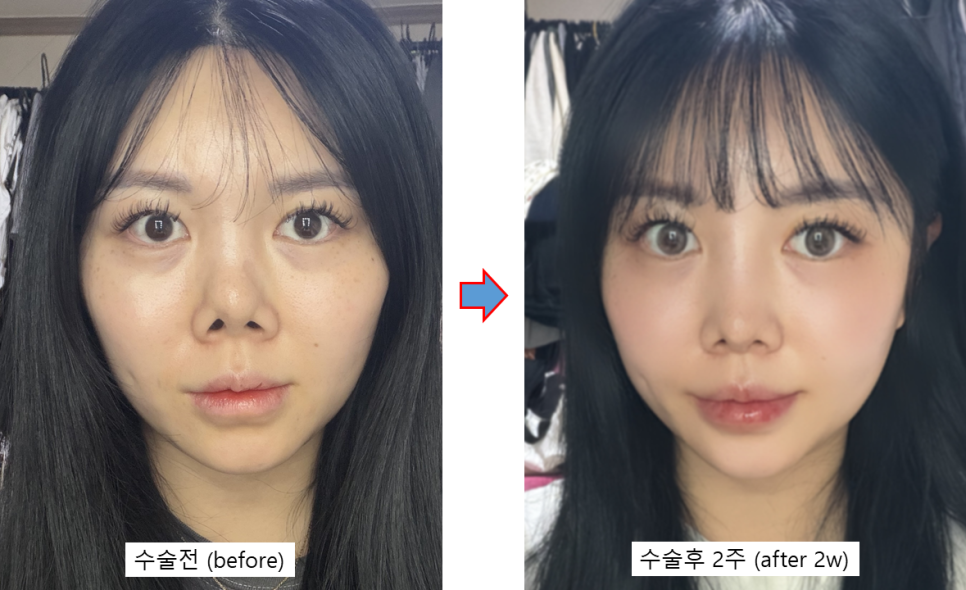 Before and after a contracted nose. Before and after contracted nose surgery. Review of contracted nose surgery. Silicone side effects. Silicone removal. Implant removal. A real model whose release has been consented to.
Before surgery, the nostril show was excessively pronounced and there was asymmetry on both sides,
but after surgery, the nostril show returned to the normal range and the asymmetry was also greatly improved.
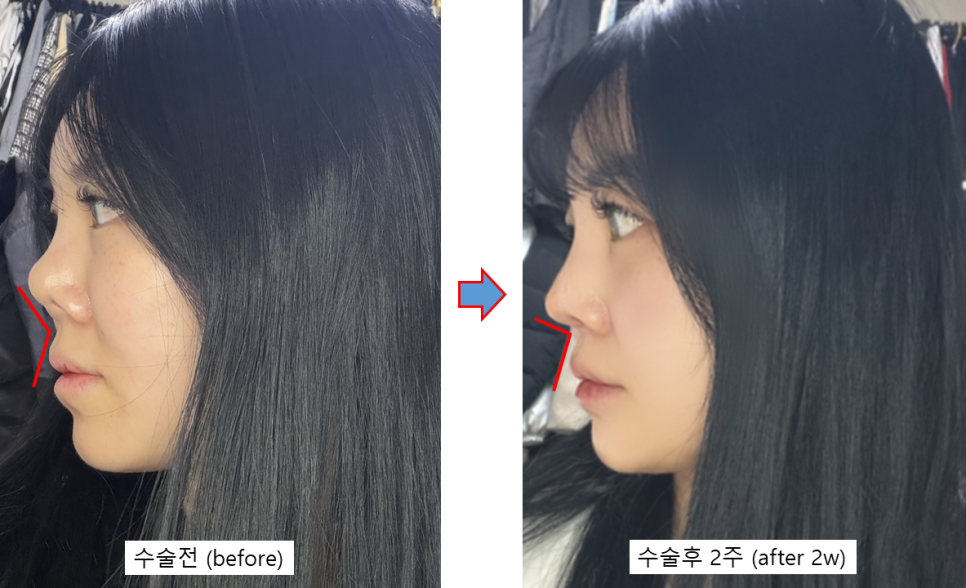 Correction of the nasolabial angle. Normal nasolabial angle. Bringing down a contracted nose. Before and after a contracted nose. Before and after revision surgery for a contracted nose. A real model whose release has been consented to.
The change from the side view was also very clear.
Before surgery, due to the contracture, the angle formed by the nasal tip and the upper lip (nasolabial angle) was severely upturned at more than 130 degrees,
but after surgery, it returned to a natural angle of about 95 degrees, creating a much more stable and softer impression.
- In revision surgery for a contracted nose, the concept of ‘reconstruction’ is important, not just simple replacement -
Reusing a silicone implant in contracted-nose rhinoplasty can be risky.
And the result depends on how stably the damaged and contracted tissue is released and reconstructed.
In particular, when silicone protrusion or severe upturning of the nasal tip is present,
it is important to prioritize tissue stability and long-term durability rather than forcing the nose to be higher.
 Review of revision rhinoplasty. Upturned nose surgery. Contracted nose surgery. Correction of a turned-up nose. Autologous tissue rhinoplasty. A real model whose release has been consented to.