When I consult with patients about anti-aging procedures, there is one question I am often asked.
"I’m still in my 40s, so why does my face look more sagging than others my age?"
The rate of aging is not determined by age alone.
Many factors have an impact, including skin elasticity, changes in fat, lifestyle habits, and weight fluctuations,
but one of them is how well the facial skeleton supports the soft tissue.
The case I am introducing today clearly demonstrates this characteristic.
- Having a small face does not always mean looking younger -
There is a common perception that a small face makes a person look youthful.
A small face does have many advantages, but
when the underlying skeleton is small or the support from the cheekbones and midface is insufficient,
the structures supporting the soft tissue may be relatively inadequate over time.
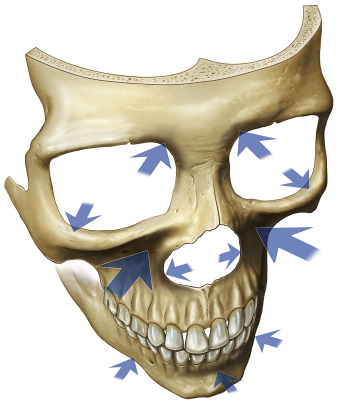
Bone resorption and facial bones with aging. Bone resorption. Source: Plastic Surgery Research
As aging progresses, it is not only the skin that stretches.
Changes also occur in the fat, the SMAS layer, and the retaining ligaments. The facial bones also undergo gradual bone resorption, resulting in reduced support.
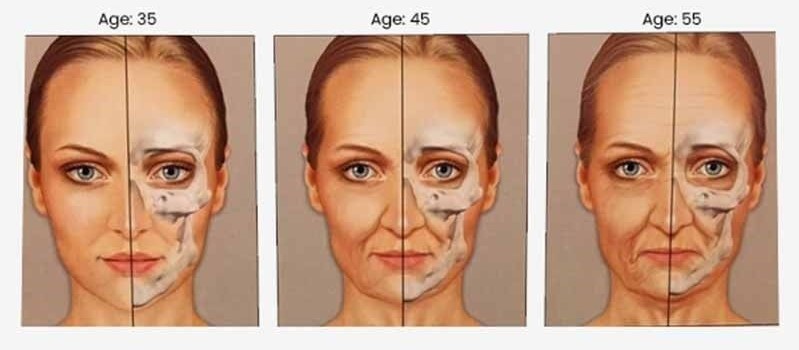
Changes in the facial skeleton with aging. Aging and bone resorption. The process of facial aging. Facial aging.
As a result, even people of the same age and weight may notice nasolabial folds, sagging around the mouth, and a drooping jawline becoming more apparent sooner.
Of course, this does not apply to everyone with a small face, and differences depend on each individual’s skeletal structure and soft-tissue characteristics.
- A Deep Mini Facelift Case in a Woman in Her Mid-40s -
This patient was a woman in her mid-40s.
Overall, she had a relatively small facial skeleton,
and she said that in the past, she had undergone implant surgery on the chin and nasolabial areas to compensate for insufficient volume.
She had also received filler treatments in the front cheek and nasolabial areas.
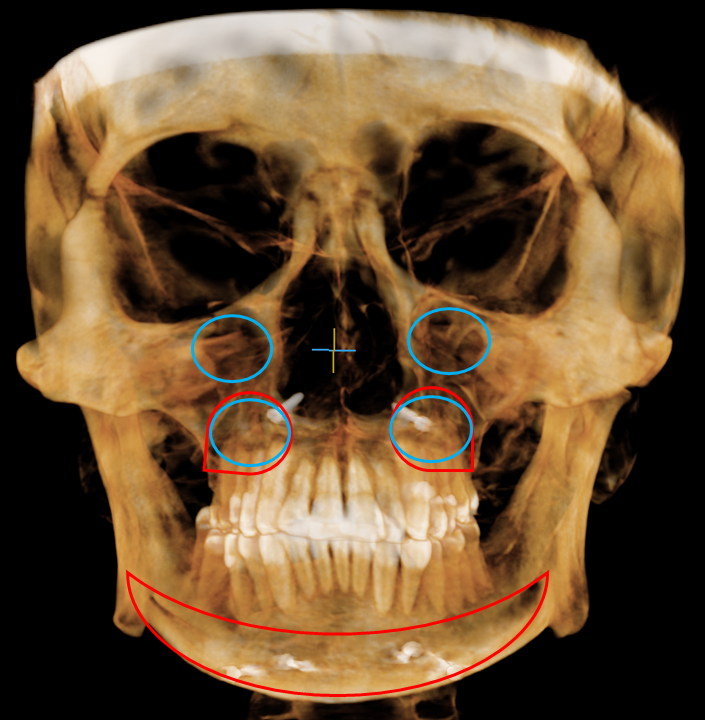
Facial implants. Chin implant. Malar implants. Nasolabial fillers. Front cheek fillers.
However, as time passed, having implants and fillers could not prevent aging.
Implants can supplement insufficient volume,
but they cannot keep the soft tissue itself, which gradually moves downward over time, in its original position.
Fillers, too, are often unable to support the soft tissue after a certain period, as they are absorbed or spread.
As a result, compared with what would typically be expected in her mid-40s, sagging in the nasolabial folds, around the mouth, and along the jawline was relatively pronounced.
In such cases, energy-based devices (EBDs) using ultrasound or radiofrequency have clear limitations,
and thread lifting often cannot meet expectations because its effects do not last for a long period.
The important point is to restore the deep soft tissue that has moved downward to its original position along with the sagging skin.
A deep mini facelift is a mini facelift that applies the deep-plane facelift technique, which has recently been receiving attention.
Although the procedure is performed through limited incisions, it also corrects the deeper tissues beneath the SMAS layer,
and because the retaining ligaments are sufficiently released,
it may help improve nasolabial folds, sagging around the mouth, and a weakened jawline in a more natural way.
Surgery was planned for this patient according to these principles.
- Around 3 Weeks After Deep Mini Facelift Surgery -
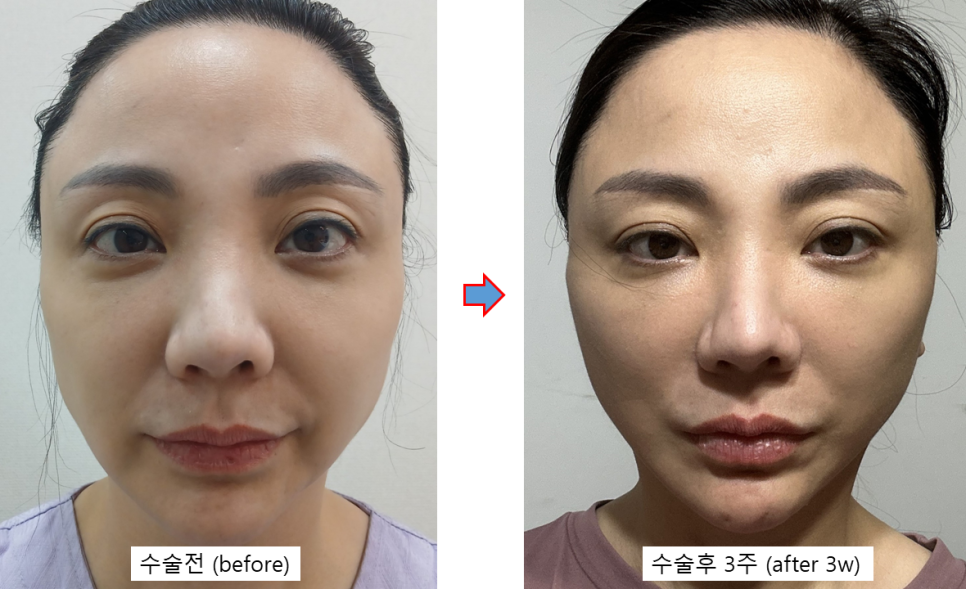
Before and after a deep mini facelift. Deep mini facelift review. Before and after a mini facelift. Mini facelift review. Mini facelift in the 40s. Mini facelift in the 50s. This is a real model who consented to publication.
These are photographs taken before surgery and approximately three weeks after surgery.
Although recovery was still in progress,
compared with before surgery, the nasolabial folds were softened, the heavy feeling around the mouth was reduced,
and the overall facial contours appeared more refined.
In particular, the impression of pronounced sagging on a small face had improved,
resulting in a more natural and lively appearance.
As more time passes and the tissues stabilize, the results are expected to look even more natural.
- In Anti-Aging Surgery, the Cause of Sagging Must Also Be Examined -
Facial aging is not simply a matter of the skin stretching.
It is a complex process involving changes in the skeleton, the movement and reduction of fat, sagging of the deep tissues, and reduced skin elasticity.
Therefore, even among people in their 40s, the way aging appears can vary greatly depending on the structure of the face.
Not everyone with a small face sags quickly,
but when skeletal support is relatively insufficient, sagging may appear more pronounced,
so it is important to develop a customized anti-aging plan that fully takes these characteristics into account.

Mini facelift review. Mini facelift effects. Deep mini facelift review. Mini lifting review. Mini facelift in the 40s. This is a real model who consented to publication.