One of the questions most frequently asked by patients preparing for revision double eyelid surgery is:
"Won’t there be a lot of scarring if I undergo revision incisional surgery?"
This is an even greater concern for people who have previously undergone incisional double eyelid surgery,
as many of them have already experienced discomfort caused by scarring or adhesions.
The patient introduced today is a woman in her late 50s.
After undergoing incisional double eyelid surgery many years ago, she had difficulty opening her eyes and discomfort when closing them,
and the severe asymmetry between her eyes caused discomfort in her daily life as well.
In this revision surgery, revision double eyelid surgery and ptosis correction were performed together to improve both function and appearance.
This was also a useful case in which the scar maturation process could be observed sequentially from one to six months after surgery.
- Eyes with severe adhesions and depressed scars before surgery -
Before surgery, the asymmetry between the double eyelid lines was very pronounced.
When her eyes were closed, the incision lines appeared deeply depressed, and the skin appeared to be strongly attached to the underlying tissue.
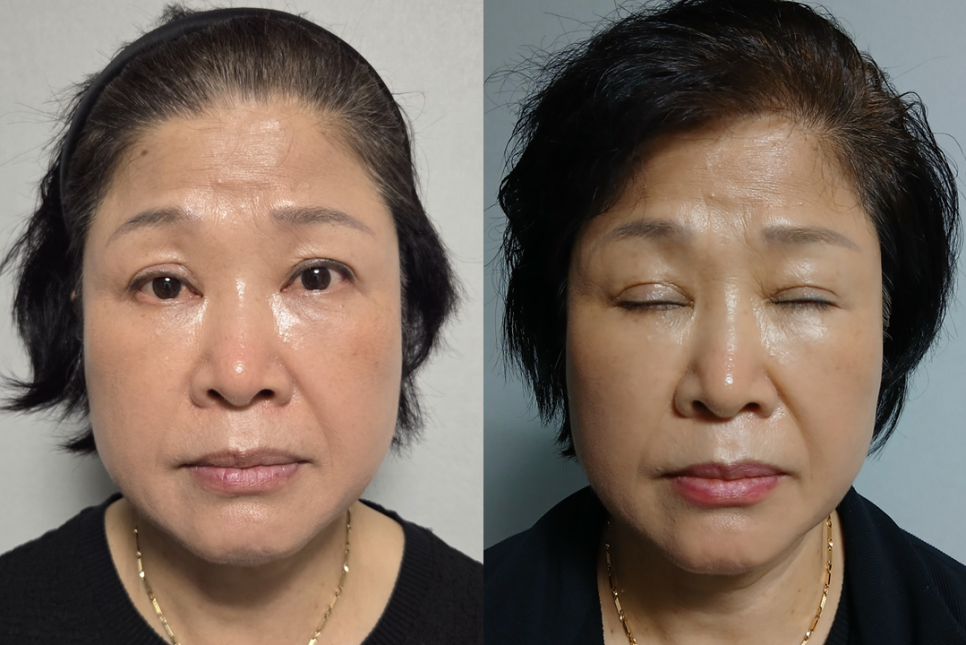
Revision double eyelid surgery review. Double eyelid scars. Depressed double eyelid scars. Asymmetrical double eyelids. Uneven double eyelids. This is a real model who consented to having the images made public.
She also had unnatural movement when opening and closing her eyes and consistently complained of a pulling sensation and discomfort.
This appearance can occur when there are severe adhesions from previous double eyelid surgery,
and is often associated with the tarsal fixation method that was commonly used in the past.
- How does previous tarsal fixation differ from current soft-tissue fixation? -
In earlier incisional double eyelid surgery, the skin of the eyelid was often directly fixed to a firm tissue called the tarsal plate to create the double eyelid.
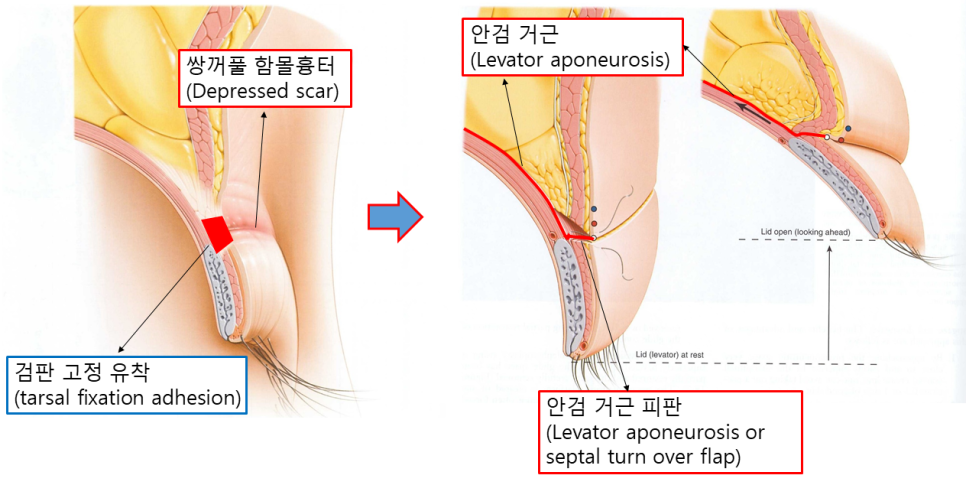
Depressed double eyelid scars. Double eyelid fixation methods. Tarsal fixation method. SAJT fixation. Levator miniflap fixation. Double eyelid fixation techniques. Source: Asian Blepharoplasty and the Eyelid Crease
Because the tarsal plate is very firm, this method had the advantage of providing strong fixation,
but over time, the skin and deeper tissues could become strongly adhered to each other.
During this process, the following could occur:
-
Depressed scars along the incision line
-
Deep lines visible when the eyes were closed
-
A pulling sensation in the skin
-
Discomfort when opening and closing the eyes
In contrast, to reduce these drawbacks, current techniques generally use softer tissues, such as the soft tissue at the end of the levator aponeurosis
or a flap of the orbital septum (Septal Turnover Flap), to create the double eyelid.
Because soft tissue moves naturally and maintains its elasticity, it is much less likely to cause deep depression of the skin.
In revision surgery, after sufficiently releasing the existing adhesions, recreating the double eyelid using this approach can lead to a more natural and comfortable appearance of the eyes.
- How do scars change after revision incisional double eyelid surgery? -
Even when revision incisional surgery is performed successfully, it is necessary to wait for the scars to mature.
For this patient, the progress was photographed at one, three, four, five, and six months after surgery, allowing the changes to be observed over time.
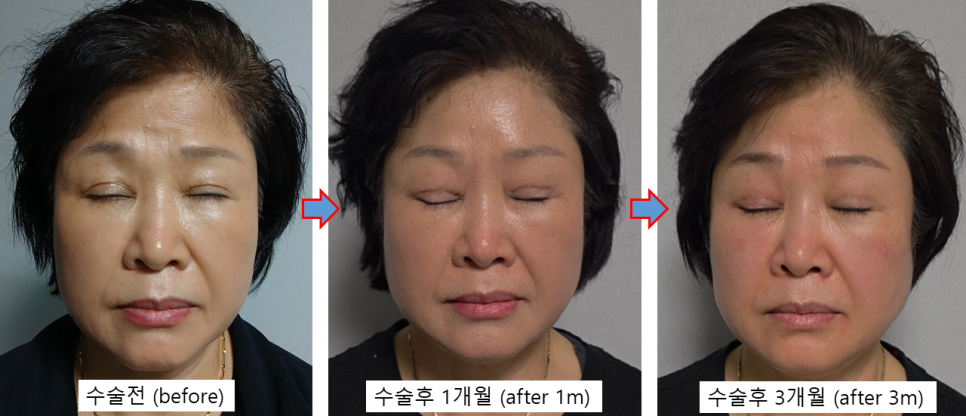
Revision double eyelid surgery scars. Double eyelid surgery scars. Depressed double eyelid scars. Double eyelid surgery scar maturation process. Revision double eyelid surgery scar maturation process. This is a real model who consented to having the images made public.
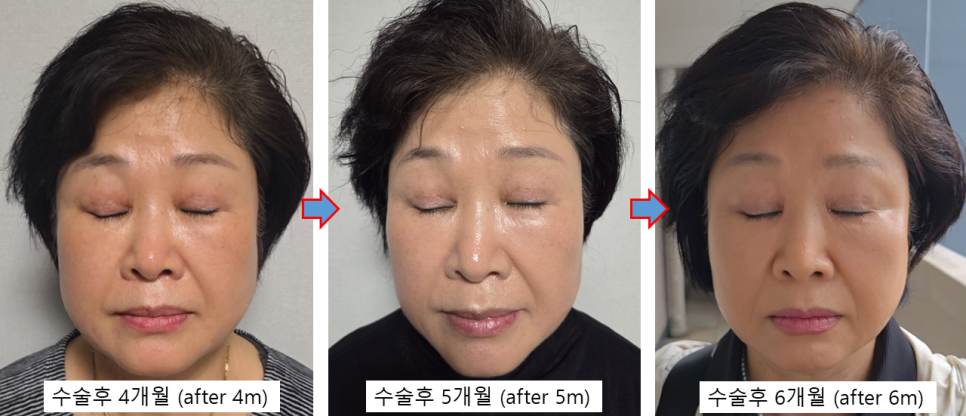
Revision double eyelid surgery scars. Double eyelid surgery scars. Depressed double eyelid scars. Double eyelid surgery scar maturation process. Revision double eyelid surgery scar maturation process. This is a real model who consented to having the images made public.
One month after surgery
The scars are still most noticeable at this stage.
The incision lines remain reddish, and the tissue also feels firm to the touch.
Many patients feel uncomfortable and become concerned, but this is actually a normal part of the scar-healing process.
Three months after surgery
By three months, the scar tissue begins to mature in earnest.
The redness gradually fades, and the tissue around the incision lines becomes softer.
The scars look much more natural than before, both when the eyes are open and when they are closed.
Four to five months after surgery
During this period, the color and thickness of the scars continue to improve.
As the skin and soft tissue stabilize, the incision lines gradually become less noticeable.
From this point onward, most patients no longer pay much attention to their scars in daily life.
Six months after surgery
At around six months, the scars enter the final stage of maturation.
Even when the eyes are closed, the incision lines do not stand out significantly, and the severely depressed scars seen before surgery have almost disappeared, resulting in a natural appearance.
Of course, the rate of scar maturation may vary from person to person,
but it is important to observe the results of revision incisional surgery for at least approximately six months.
- Before and after revision double eyelid surgery -
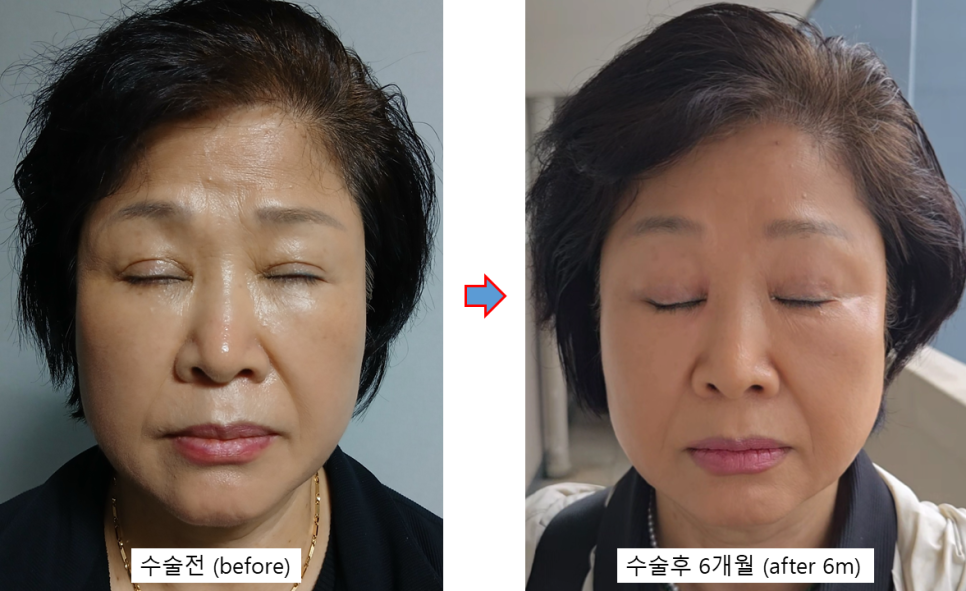
Depressed scars after revision double eyelid surgery. Revision double eyelid surgery review. Before and after revision double eyelid surgery. Depressed scar correction. Middle-aged double eyelid surgery review. Before and after middle-aged double eyelid surgery. This is a real model who consented to having the images made public.
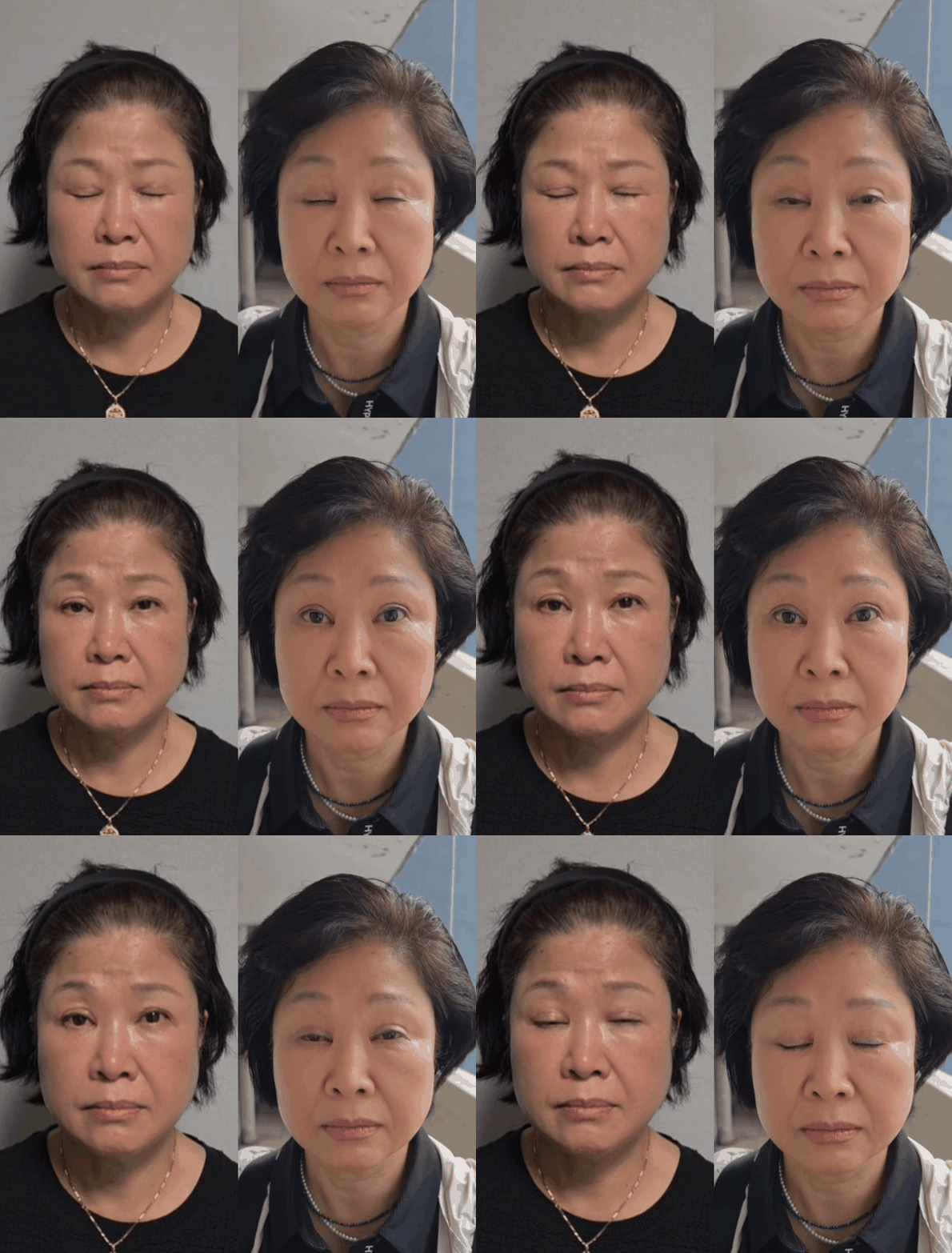
Middle-aged double eyelid surgery review. Before and after middle-aged double eyelid surgery. Middle-aged double eyelid surgery review. Before and after middle-aged double eyelid surgery. Improvement of depressed double eyelid scars. Correction of depressed double eyelid scars. This is a real model who consented to having the images made public.
Before surgery, the eyelids could not move naturally because of the deep adhesions,
and the pulling sensation was clearly visible even when the eyes were closed.
After revision surgery, the adhesions were sufficiently released and ptosis correction was performed at the same time,
making the movements involved in opening and closing the eyes much smoother.
The improvement was not limited to the shape of the double eyelids; the eyelids themselves could also be seen moving more comfortably.
These changes, which can be difficult to understand from a single photograph, can be seen more clearly in moving footage.
- The most important aspect of revision surgery is correcting the underlying cause of the problem -
In revision surgery, there is something that must be addressed before creating a new eyelid line.
That is how carefully the adhesions and scars caused by the previous surgery are released,
and which tissue is used to form the double eyelid securely.
Even with the same incisional method, the shape of the scars and the movement of the eyelids can differ greatly depending on the fixation method and how the tissues are handled.
In this patient’s case as well, the procedure did more than simply improve symmetry between the eyes.
It improved the severe depressed scars and adhesions while also restoring the function of opening and closing the eyes.
With revision incisional double eyelid surgery, it is important not to judge the results based only on the appearance immediately after surgery,
but to wait for the scars to mature sufficiently.
Scars that initially appear firm and reddish gradually become softer and more natural over time.
If you are considering revision surgery, do not focus only on your current appearance.
Understanding the process of how the scars change can be very helpful in achieving a satisfactory result.
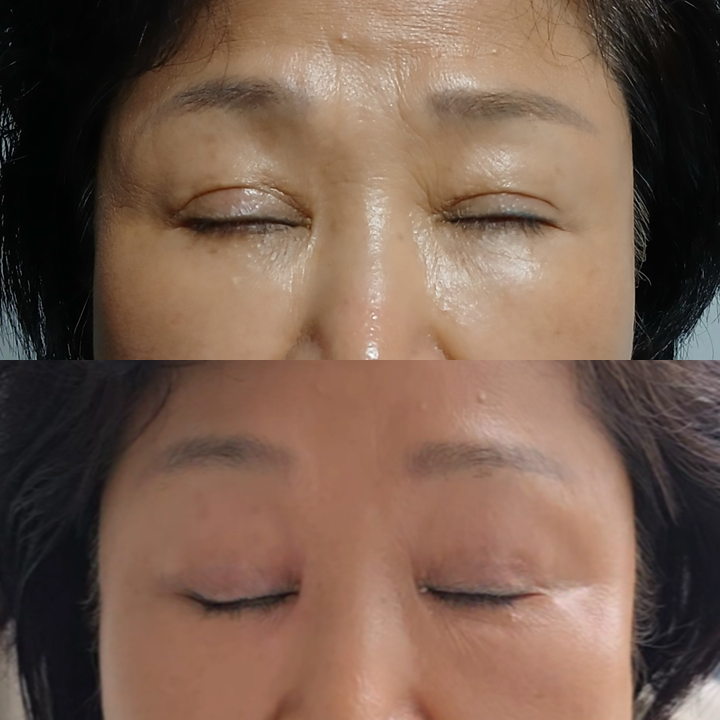
For another case involving improvement of depressed scars after double eyelid surgery, please refer to the blog post below.