In recent consultations, I have noticed a significant increase in inquiries about the “vertical mini facelift.”
“Isn’t pulling vertically supposed to look more natural?”
“Is a vertical mini facelift a better procedure than a conventional mini facelift?”
It seems that many people have become interested as various plastic surgery clinics have recently begun using the term “vertical mini facelift.”
To give you the conclusion first,
the concept of lifting using a vertical vector is certainly meaningful in itself,
and it also aligns well with the current direction of development in facelift surgery.
- Why did the concept of “vertical” emerge? -
In the past, mini facelifts often involved pulling the skin and SMAS in a 45-degree direction, namely superolaterally (Superior and Lateral).
However, as the face ages, it is not simply that the skin becomes lax.
The cheek fat and SMAS layer also move downward under the influence of gravity.
Therefore, in recent facelift procedures, the important concept is not merely pulling the skin sideways,
but returning sagging tissues to their original, higher position.
Against this background, the concept of the “Vertical Vector” began to receive greater emphasis.
In particular, American plastic surgeon Andrew Jacono discussed the vertical lifting vector of the face in
Minimal Access Deep Plane Extended Vertical Facelift.
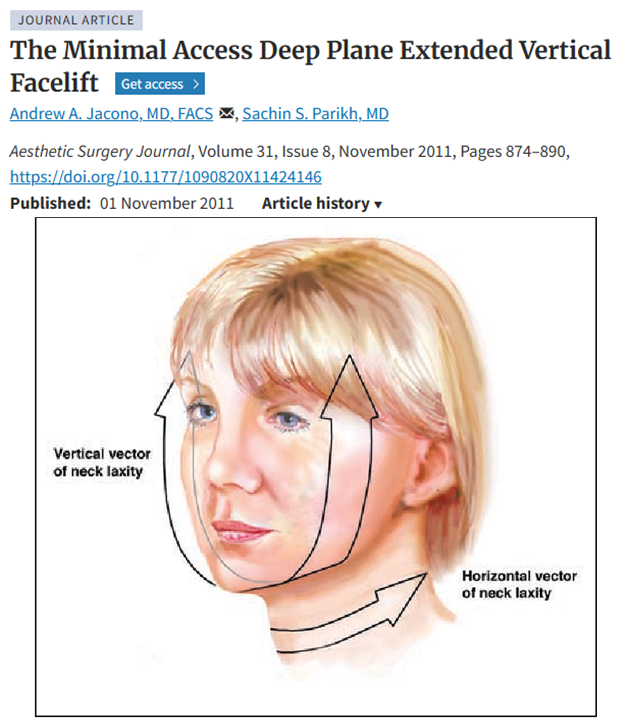
Mini facelift vector. Facelift vector. Vertical mini facelift. Mini facelift lifting. Source: Aesthetic Surgery Journal.
The procedure is designed to reposition the midface and jawline in a direction closer to vertical,
while lifting the neck in a superolateral direction to achieve results suited to the anatomical characteristics of each area.
But something is more important than the direction.
If pulling vertically were the most important factor, pulling only the skin strongly upward should produce good results.
But that is not how the actual surgery works.
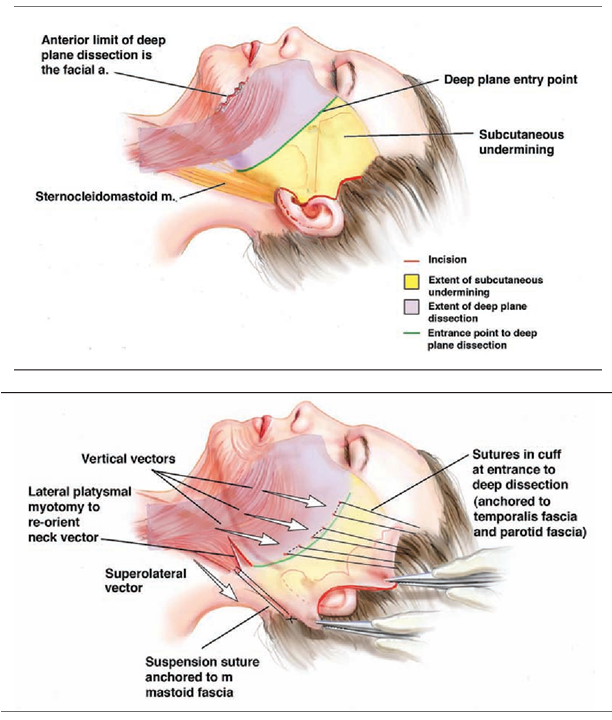
Vertical mini facelift. MADE mini facelift. Deep mini facelift. Source: Aesthetic Surgery Journal.
The SMAS layer of the face is firmly fixed by multiple retaining ligaments.
Unless these retaining ligaments are sufficiently released, the tissues cannot move naturally in the desired direction.
Forcing them upward only increases tension, and over time, forces act to return them to their original position.
In other words, the first issue to address before deciding on the pulling direction is creating an environment in which the tissues can move freely.
- Effects of a Deep Mini Facelift and Before-and-After Results -
This is precisely why the Deep Plane Facelift has recently received favorable evaluations.
In a Deep Plane procedure, the sub-SMAS plane is sufficiently dissected,
and the retaining ligaments are appropriately released so that the skin and SMAS can move together as a single structure.
Only when this condition has been created can the tissues be naturally repositioned.
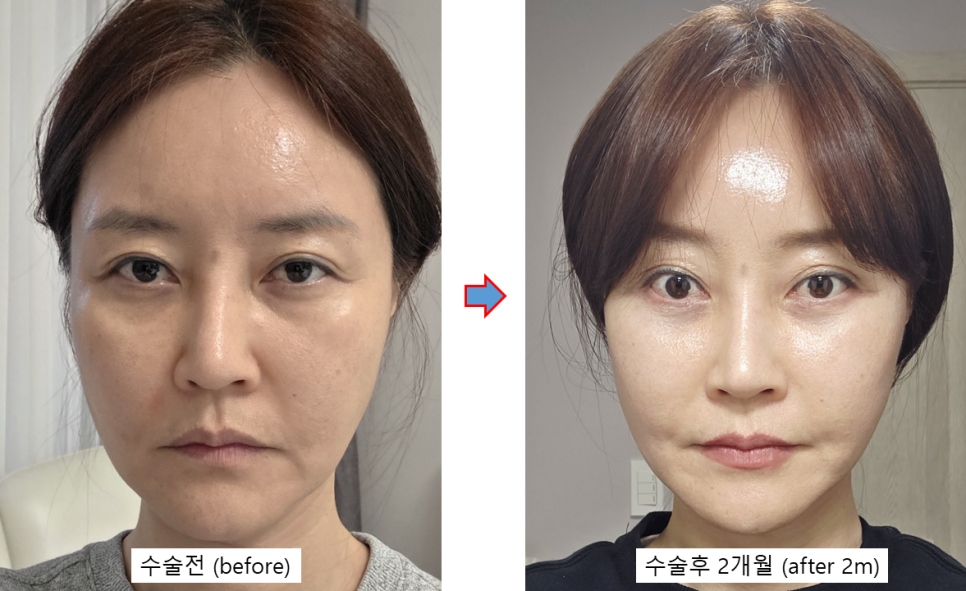
Before and after a mini facelift. Mini facelift review. Before and after a vertical mini facelift. Vertical mini facelift review. This is a real model whose case was published with consent.
The patient was a woman in her mid-40s. Before surgery, sagging in the cheeks made
her nasolabial folds and the wrinkles around her mouth (marionette lines) appear more pronounced,
but after surgery, the sagging soft tissues were naturally repositioned,
resulting in a noticeably softer appearance in these areas.
In addition, the sagging cheek tissue and jawline were refined, making the facial contour smoother and slimmer,
and creating an overall younger, more vibrant impression.
- The Extent of Dissection Matters More Than the Lifting Direction -
In a facelift or mini facelift, dissection of the deep layer (the Deep Plane) and management of the retaining ligaments come first,
while the lifting direction is determined afterward.
A vertical vector is meaningful only if the tissues can ultimately move.
As the name “vertical mini facelift” has recently become widely used,
it is easy to assume that simply pulling vertically will produce good results.
However, what matters in an actual facelift is not simply pulling upward.
The key to modern facelift surgery is to sufficiently dissect the tissues beneath the SMAS,
appropriately manage the retaining ligaments to create a state in which the sagging tissues can move naturally,
and then reposition them using the vector most suitable for each area.
A vertical vector becomes meaningful only when these principles are in place.
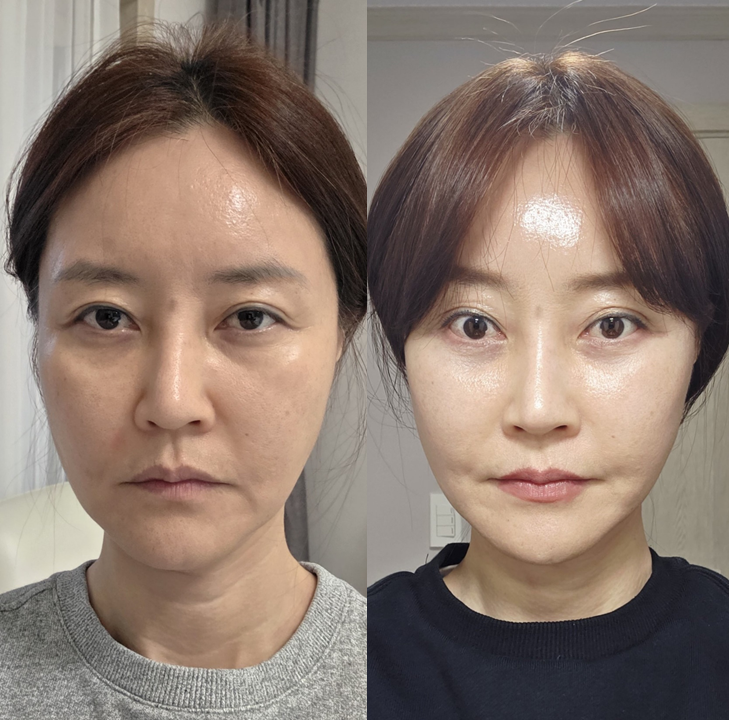
Before and after a mini facelift. Mini facelift review. Vertical mini facelift. Vertical lifting. Before and after a deep mini facelift. This is a real model whose case was published with consent.
For information about another mini facelift case involving a patient in her 40s, please see the blog post below.