Zygoma reduction surgery is a contouring procedure commonly performed to reduce the width of the face and create a softer facial shape.
The most widely performed method today is L-osteotomy,
followed by moving the zygomatic bone segment inward (medially) and securing it in place.
Recently, a technique that fixes the zygomatic bone segment upward (superior fixation) has been used to minimize soft-tissue sagging,
and it does help prevent cheek sagging in practice.
However, even when these methods are used, changes such as sagging of the front cheeks or a heavier appearance around the mouth may occur after zygoma reduction surgery.
- Why Does Cheek Sagging Occur After Zygoma Reduction? -
Many people ask, “Why do my cheeks sag when I only had my zygoma reduced?”
The biggest reason is that the volume of the facial bones themselves decreases.
The zygomatic bones do not simply determine the width of the face; they form a framework that supports the skin, fat, and muscles.
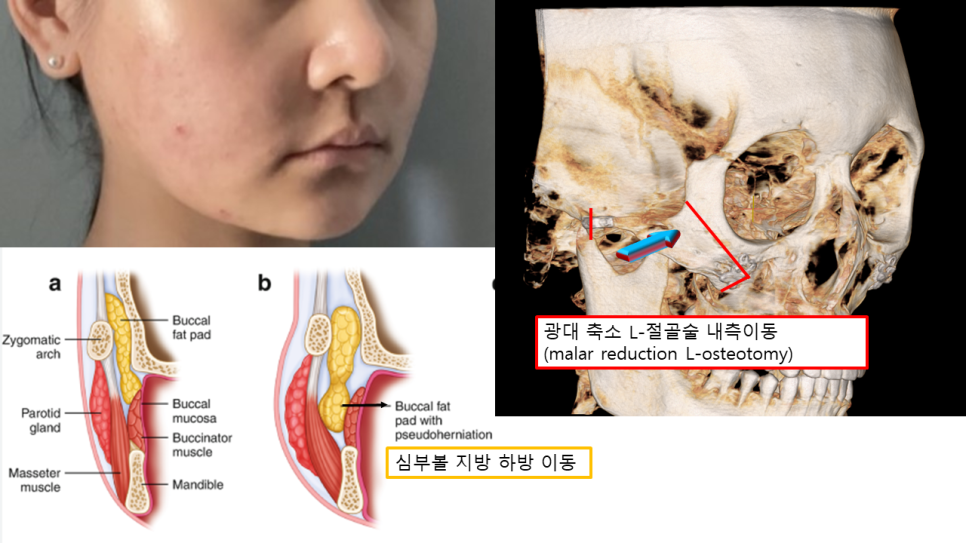
Zygoma reduction surgery. Cheek sagging after zygoma reduction. Soft-tissue sagging after zygoma reduction. Medial movement after zygoma reduction. Zygomatic osteotomy. This is a partial model whose publication was authorized.
After L-osteotomy, moving the zygomatic bone segment inward reduces the width of the face,
but at the same time, the volume of the framework that had supported the face also decreases.
Although the bone becomes smaller, the skin, fat, and soft tissues such as the SMAS remain,
so some people may experience cheek sagging.
Another factor to consider is the buccal fat pad.
When the zygomatic segment is moved inward after L-osteotomy, the buccal fat space also changes.
During this process, the segment moved medially may partially compress the buccal fat,
and this change may affect the position and downward movement of the deep fat.
In other words, cheek sagging after zygoma reduction is often caused not simply by loose skin, but by the combined effects of:
-
Reduced facial bone volume
-
Excess skin and soft tissue
-
Changes in the position of the deep fat
-
Customized Mini Facelift After Zygoma Reduction -
Cheek sagging that develops after zygoma reduction ultimately requires lifting the remaining soft tissue back to the position where it originally belonged.
In particular, patients in their 20s and 30s often have experienced little aging-related change.
In other words, in most cases, only the cheek sagging that developed after contouring surgery needs to be corrected, rather than typical age-related facial sagging.
In such cases, a mini facelift alone can often provide sufficient improvement,
rather than a traditional facelift.
- Releasing the Retaining Ligaments Is Also Important in a Mini Facelift -
A mini facelift is not a procedure in which simply pulling the skin lifts the face.
The most important step is
adequately releasing the zygomatic retaining ligament beneath the SMAS layer.
If the retaining ligament remains intact, it creates resistance when the sagging tissue is pulled upward, preventing the desired degree of lifting.
When the retaining ligament is sufficiently released, the tissue can move naturally,
allowing for more stable lifting without excessive tension.
In mini facelifts with short incisions, a high-resolution Full HD endoscope may also be used to obtain a clear view.
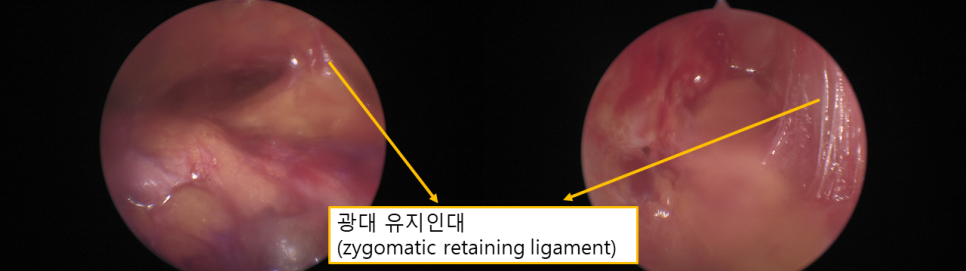
Zygomatic retaining ligament. Endoscopic mini facelift. Endoscopic hidden facelift. Endoscopic facelift. High-resolution surgical endoscope.
Using a high-resolution surgical endoscope makes it possible to
identify the zygomatic retaining ligament directly through a narrow incision and release it more precisely.
- Will There Be Significant Scarring? -
The incision scars are the biggest concern for people considering a mini facelift.
In practice, the extent of the incision is determined according to the patient’s condition,
but in most cases, the incision is hidden inside the hairline and follows the natural contours of the ear,
so it becomes difficult to notice over time.
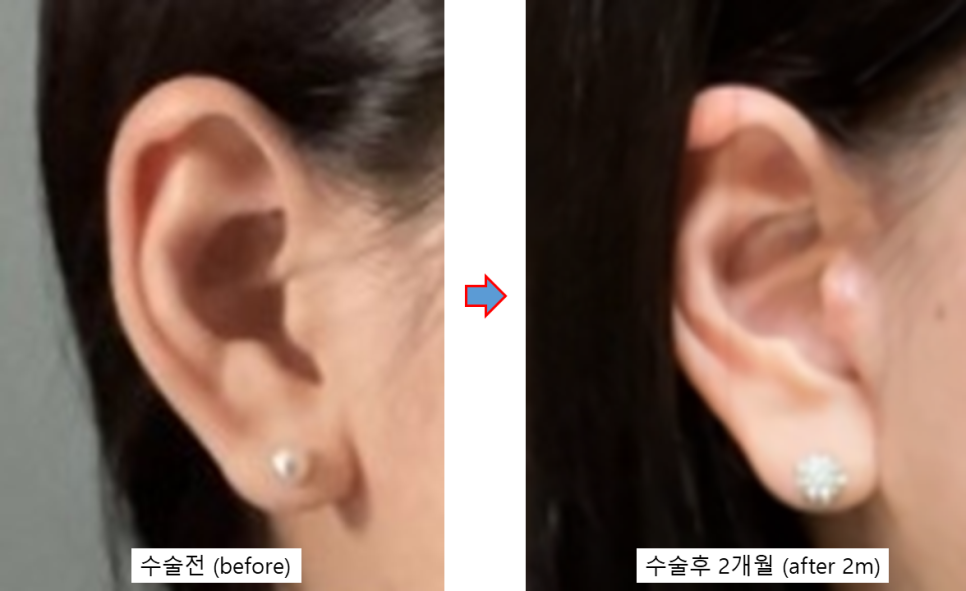
Mini facelift scars. Mini facelift incision. Mini facelift review. This is a partial model whose publication was authorized.
In this case as well, photographs taken two months after surgery showed that the incision area was barely visible.
After five to six months, when scar maturation is complete, it will become even more natural in appearance.
- Changes Seen in Before-and-After Photos of a Mini Facelift -
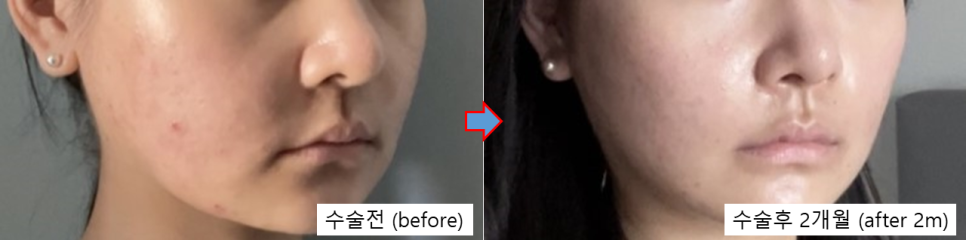
Before and after a mini facelift. Mini facelift review. Mini facelift results. Mini facelift in the 20s. This is a partial model whose publication was authorized.
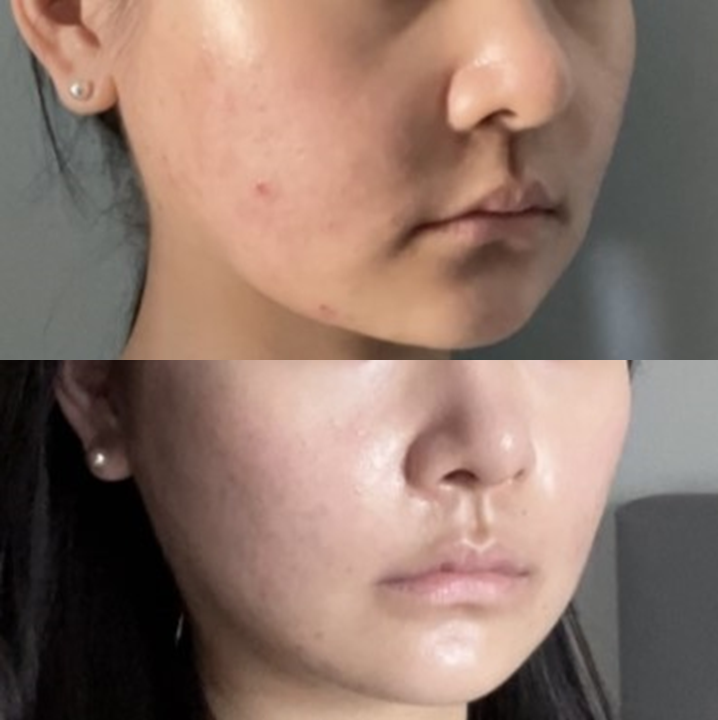
Before surgery, the front cheeks had descended after zygoma reduction, with wrinkles around the mouth and a heavy facial appearance.
In photographs taken two months after the mini facelift, the sagging front cheeks had recovered naturally,
and the wrinkles around the mouth had also improved.
Above all, the most significant change was that the face had been lifted naturally, without looking overly pulled, as if it were still the person’s original face.
Zygoma reduction is a highly effective procedure for making the facial shape smaller and softer.
However, as the volume of the facial framework decreases, some people may experience cheek sagging,
which results from changes not only in the skin but also in the soft tissues and deep fat.
In particular, people in their 20s and 30s often want to correct only the sagging that developed after contouring surgery,
rather than undergo lifting because of aging.
By selecting an appropriate technique through customized incisions, it is possible to expect a natural and satisfying result.
Hidden deep mini facelift. Deep mini facelift. Customized facelift. Facelift after contouring surgery. Facelift after facial contouring surgery. This is a partial model whose publication was authorized.
What is the deep-plane technique, which can also be applied in a mini facelift?