Three-Month Follow-Up After Revision Rhinoplasty for an Implant-Related Contracted Nose
This case involved a female patient in her early 30s.
She had previously undergone rhinoplasty using a silicone implant, but over time, contracture gradually developed, leaving the nasal tip shortened and pulled upward.
During this surgery, the existing silicone implant was removed, the contracted tissue was sufficiently released, and the shortened nasal tip was lengthened.
The existing silicone implant in the nasal bridge was also removed, and an autologous nasal bridge was created using the patient's own rib cartilage.
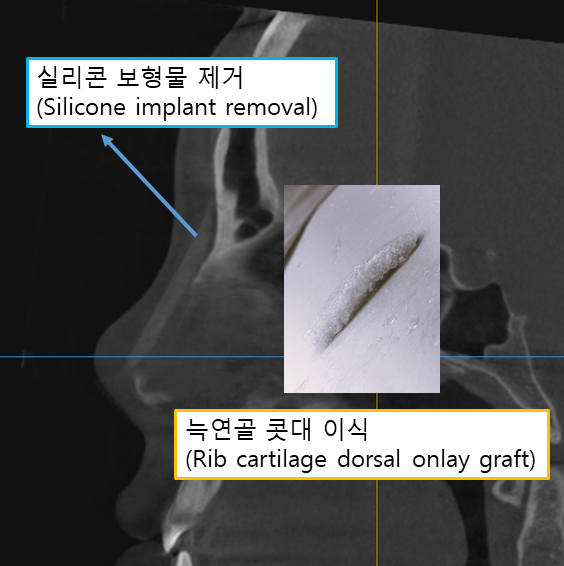
Preoperative CT. Rhinoplasty CT. Silicone implant removal. Rib cartilage nasal bridge grafting after silicone removal.
- Why is rib cartilage diced to create the nasal bridge? -
In this surgery, instead of using the rib cartilage as one solid block, it was processed into small pieces of diced cartilage to create the nasal bridge.
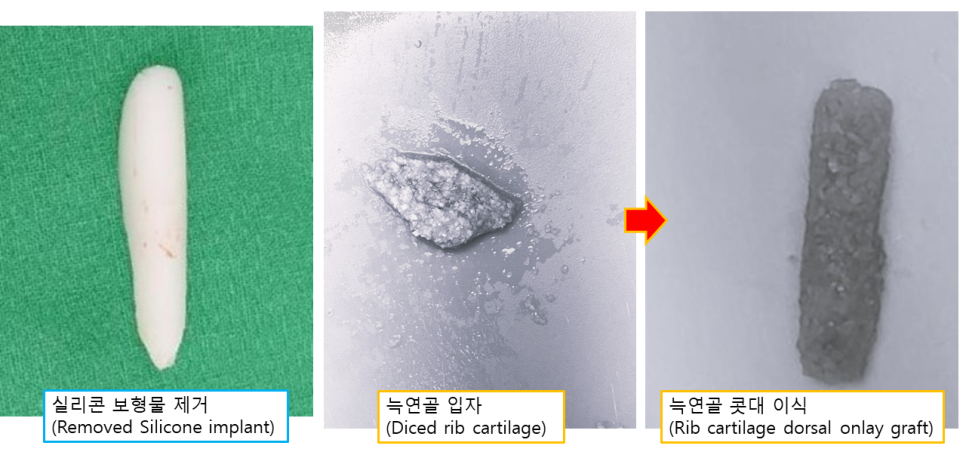
Rib cartilage nasal bridge graft. Rib cartilage nasal bridge. Rib cartilage rhinoplasty. Diced rib cartilage rhinoplasty.
When rib cartilage is used as a large solid block, warping of the cartilage over time can become a concern.
By contrast, using finely diced cartilage can reduce the risk of warping while allowing the desired height and shape of the nasal bridge to be created more precisely.
For this patient, the nasal bridge was created at approximately 5 mm in height, similar to the height of the existing silicone implant.
- “But won't rib cartilage be absorbed later?” -
This is one of the most common questions about rhinoplasty using rib cartilage.
Using autologous tissue does not mean that the appearance immediately after surgery will remain exactly 100% unchanged.
As postoperative swelling subsides, some volume change in the grafted cartilage may occur.
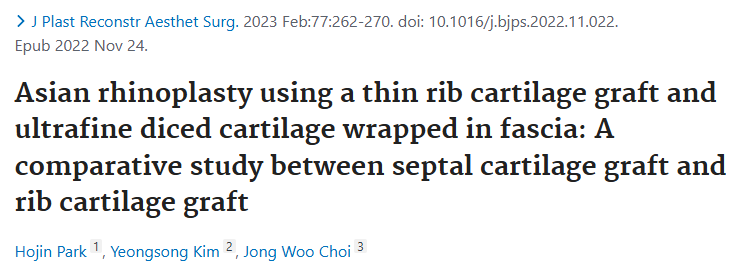
Paper related to cartilage absorption. Source: Journal of Plastic, Reconstructive & Aesthetic Surgery.
Studies using diced cartilage have shown some variation depending on the research methods, but long-term volume changes have generally been reported to be within 10%.
In particular, a study of 53 Asian rhinoplasty patients who underwent nasal bridge augmentation using ultrafine diced cartilage observed volume reductions of approximately 7.5% at the sellion and 7.8% at the rhinion through three-dimensional image analysis.
Therefore, rather than saying that “there is no absorption at all,” it is more accurate to explain that some absorption or volume change may occur, but that most of the tissue remains stable.
Of course, actual results may vary depending on the patient's tissue condition, the condition of the rib cartilage, how the cartilage is processed, and the blood flow and tissue environment at the graft site.
- What was the actual course of recovery for this patient? -
In this case, the nasal bridge appears relatively high from 10 to 14 days after surgery because swelling is still present during this period.
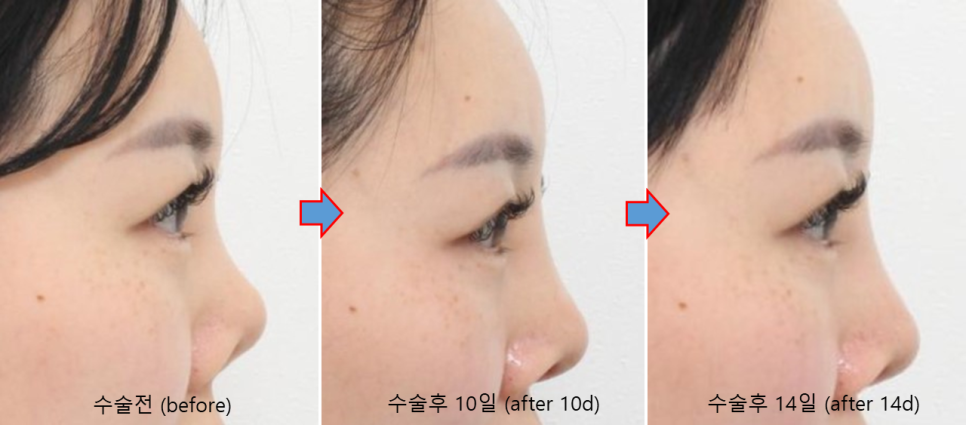
Contracted-nose rhinoplasty. Rib cartilage rhinoplasty recovery. Rib cartilage rhinoplasty absorption. Swelling after rib cartilage rhinoplasty. This is a real model who consented to the publication of the images.
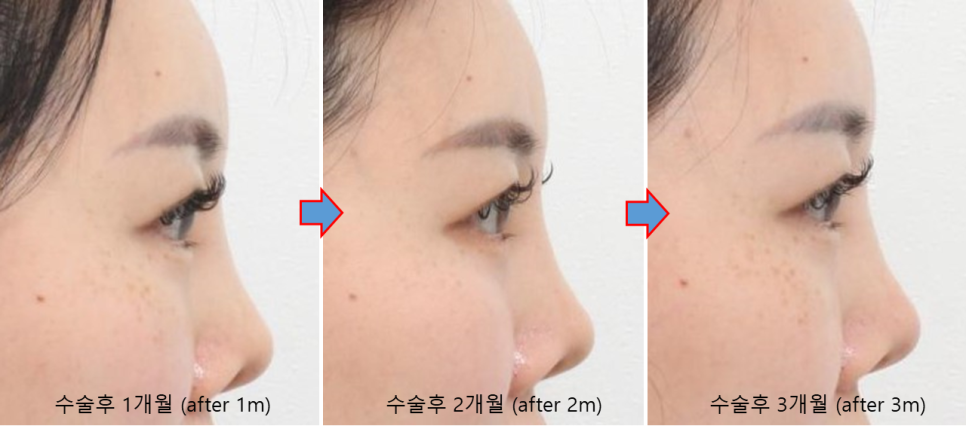
Rib cartilage nasal bridge. Rib cartilage nasal bridge surgery. Rib cartilage rhinoplasty review. This is a real model who consented to the publication of the images.
However, from one month to three months after surgery, once the swelling had subsided to some extent, the height of the nasal bridge remained almost the same.
In particular, when comparing the appearance before surgery with that at three months after surgery, the initially planned nasal bridge height of approximately 5 mm had not decreased significantly and was being maintained stably.
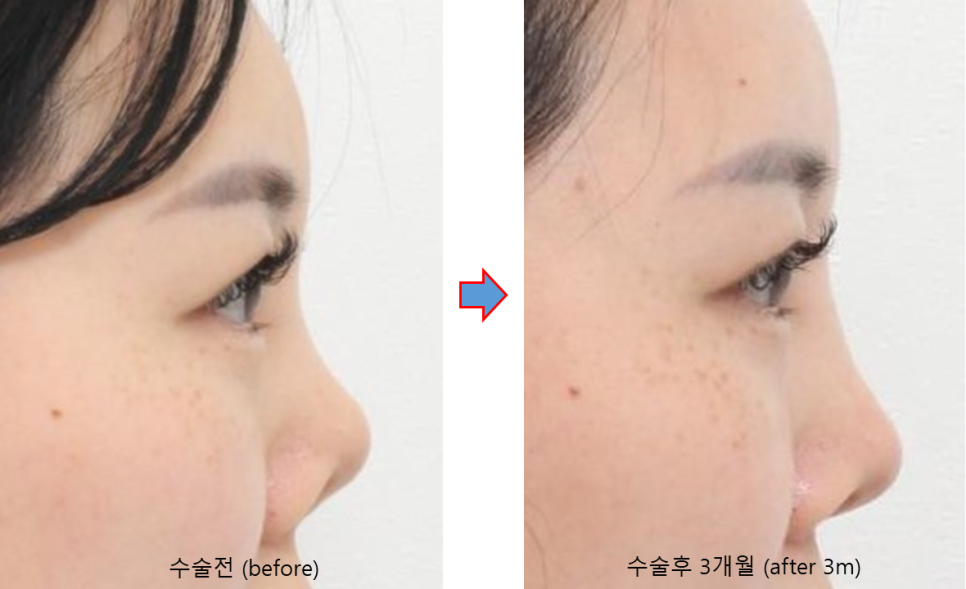
Before and after contracted-nose rhinoplasty. Contracted-nose rhinoplasty review. Rib cartilage revision rhinoplasty. Rib cartilage rhinoplasty. This is a real model who consented to the publication of the images.
Based on my experience performing these surgeries, I believe that the degree of graft survival can also be considered to be approximately within 90%.
However, this figure of 90% is not an official value established by a specific paper; it is an assessment based on actual clinical experience.
- The important question is not whether there is “no absorption at all.” -
Even in rhinoplasty using autologous tissue, some degree of volume change may naturally occur.
What matters is whether, despite some volume change, the desired height and shape of the nasal bridge remain stable over the long term.
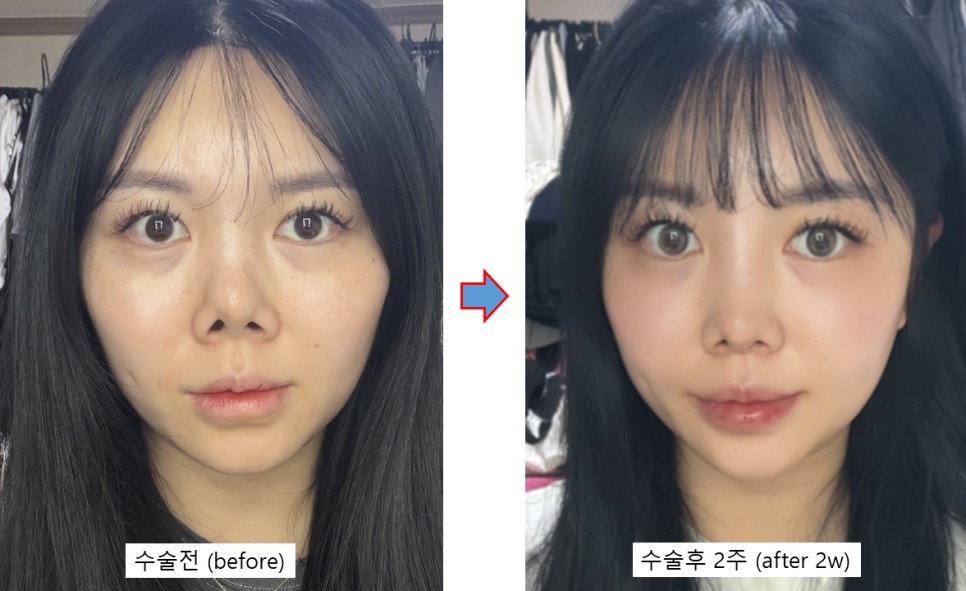
Before and after revision surgery for a contracted nose. Review of revision surgery for a contracted nose. This is a real model who consented to the publication of the images.
In this case, while removing the silicone implant and correcting the contracture, a nasal bridge approximately 5 mm high was created using autologous tissue made from finely diced rib cartilage.
It was confirmed that the nasal bridge remained stable through three months after surgery.
※ Surgical results and the recovery process may vary from person to person.

Contracted-nose surgery. Contracted-nose rhinoplasty. Before and after revision rhinoplasty. Revision rhinoplasty review. This is a real model who consented to the publication of the images.
If a contracted nose has developed due to complications from a silicone implant, please refer to the blog post below for information about rhinoplasty.