Many people in their late 40s feel that the area beneath their eyes has changed compared with the past.
As the under-eye fat gradually protrudes and the tear troughs become deeper, the face may begin to look tired.
This is also a time when reduced skin elasticity can lead people to wonder whether they should undergo lower eyelid surgery or lower eyelid fat repositioning.
However, not everyone in their 40s needs lower eyelid surgery.
If the skin sagging is not severe and the main concerns are protruding under-eye fat and hollowness in the tear troughs,
natural improvement may be possible with under-eye fat repositioning alone instead of an incision-based lower eyelid procedure.
- Case of Lower Eyelid Fat Repositioning in the Late 40s -
This patient was a woman in her late 40s. The under-eye fat and tear troughs were noticeable, while the contours of the under-eye rolls were relatively indistinct.
Because the patient did not want lower eyelid surgery involving a skin incision,
only lower eyelid fat repositioning was performed to improve the transition between the bulging under-eye fat and the tear troughs.
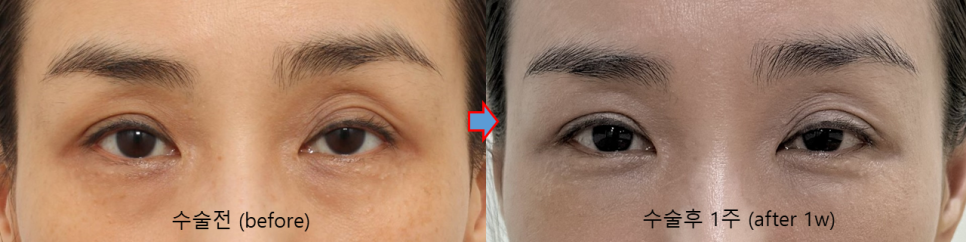
Lower eyelid fat repositioning in the 40s. One week after lower eyelid fat repositioning. Before and after lower eyelid fat repositioning. This is a model who consented to having the relevant images made public.
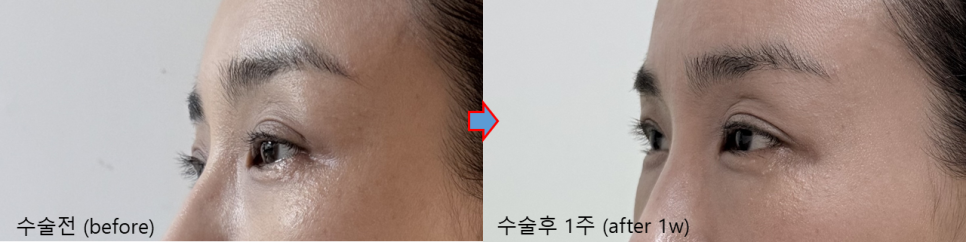
Swelling after lower eyelid fat repositioning. Recovery period after lower eyelid fat repositioning. Under-eye rolls after lower eyelid fat repositioning. This is a model who consented to having the relevant images made public.
After surgery, the patient recovered quickly, with limited bruising and swelling.
Because there was no visible external incision, suture removal was not necessary.
After surgery, the reduced fullness beneath the eyes also naturally softened the hollowness of the tear troughs.
However, there was another noticeable change in this case.
The contours of the under-eye rolls became much more defined.
- How Are Under-Eye Rolls Formed? -
Under-eye rolls are often thought to be bulging fat or skin beneath the eyes,
but anatomically, they are primarily associated with the pre-tarsal portion of the orbicularis oculi muscle,
that is, the pretarsal orbicularis oculi muscle.
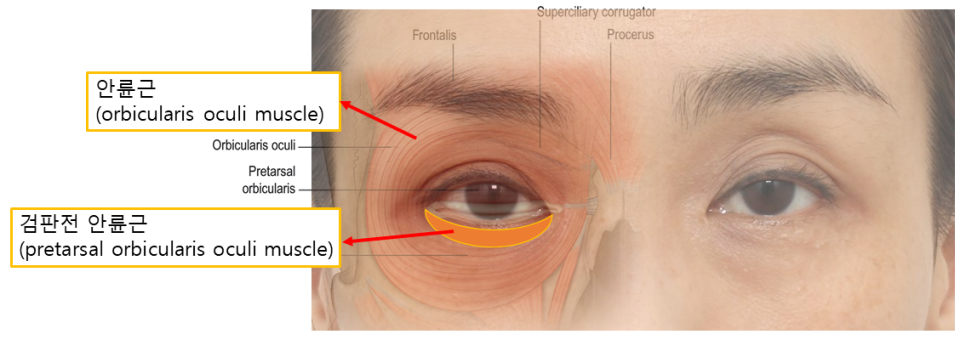
Structure of the under-eye roll. Under-eye roll muscle. Under-eye roll. Orbicularis oculi muscle. Pretarsal orbicularis oculi muscle. Under-eye muscle. Lower eyelid fat repositioning. This is a model who consented to having the relevant images made public.
Therefore, for the contours of the under-eye rolls to be clearly visible, it is important not only to consider the under-eye rolls themselves,
but also to ensure that the boundary between them and the tissues beneath the eyes is clearly defined.
- Why Protruding Under-Eye Fat Can Make Under-Eye Rolls Less Visible -
When the under-eye fat pads protrude, volume increases broadly, including beneath the under-eye rolls,
which can make the border of the orbicularis oculi muscle less distinct.
As a result, even when the under-eye rolls are clearly present,
the contours between
under-eye roll → under-eye fat → tear trough
may blend together, making the under-eye rolls appear relatively indistinct.
In this case as well, the protruding under-eye fat and tear troughs were visible together before surgery, making the contours of the under-eye rolls unclear.
After lower eyelid fat repositioning, however, the protruding fat was repositioned to fill the tear troughs and the area became more refined,
allowing the border of the under-eye rolls formed by the orbicularis oculi muscle to appear more clearly.
In other words, the under-eye rolls were not created separately.
Nor were the under-eye rolls emphasized by removing the under-eye fat.
Rather, as the unnecessary fullness and hollowness beneath the eyes were refined,
the pre-existing anatomical contours of the under-eye rolls became more visible.
Of course, if someone wants under-eye rolls that are somewhat more defined and prominent, microfat grafting is also possible.
- Important Considerations for Lower Eyelid Fat Repositioning in Your 40s. -
After the age of 40, skin sagging beneath the eyes may also be present. Therefore, rather than simply removing under-eye fat,
it is important to consider both the protruding fat and the hollowness of the tear troughs.
In particular, excessive removal of under-eye fat may instead make the area look hollow or create an older-looking appearance.
For this reason, it is important to reposition the under-eye fat toward the tear troughs to create a natural transition between the fullness and hollowness.
As in this case, even when a patient does not want lower eyelid surgery, accurately assessing the patient's skin condition and the anatomical structures beneath the eyes
and selecting an appropriate surgical method can naturally improve the three-dimensional appearance and contours beneath the eyes without a skin incision.
Most importantly, the goal is not to remove all the under-eye fat without distinction,
but to determine where there is fullness, where there is hollowness, and how to create a natural transition between them.
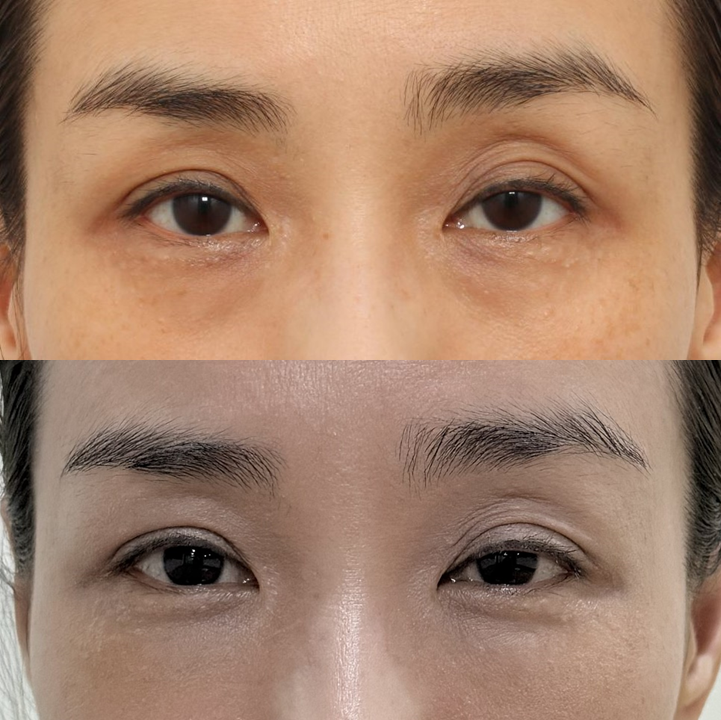
Before and after lower eyelid fat repositioning. Reviews of lower eyelid fat repositioning. Lower eyelid fat repositioning in the 40s. Lower eyelid fat repositioning in the late 40s. This is a model who consented to having the relevant images made public.
For a case involving lower eyelid fat repositioning and under-eye roll fat grafting in the late 40s, please refer to the blog below.