Hello, this is Dana Plastic Surgery 😊
Today, we’ll take some time to talk about what types of female pattern hair loss there are and how it begins.

Female pattern hair loss is similar in the broader sense to male pattern hair loss in that hair falls out, but the pattern is a little different.
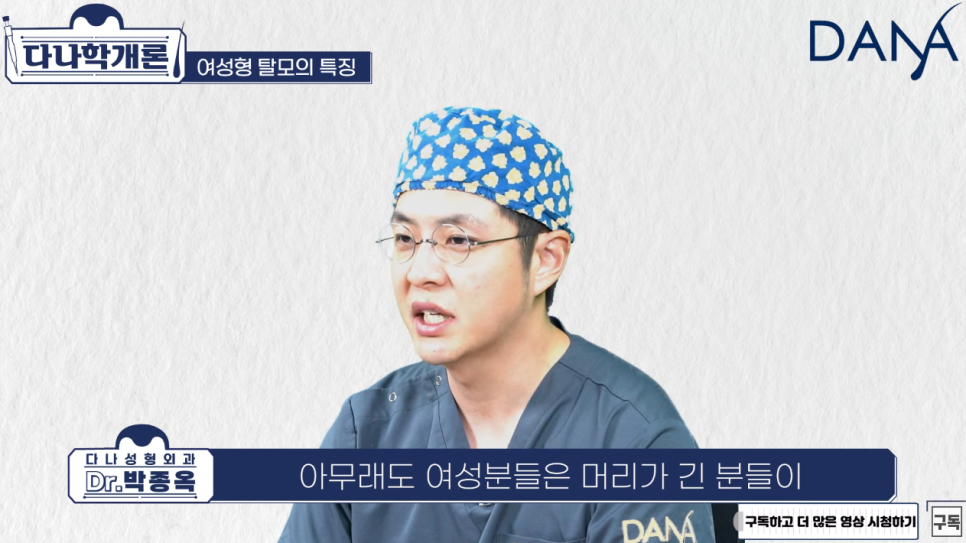
Many women tend to have longer hair and often wear styles that cover the head, so

it may take a little longer to notice compared with men.
However, hair loss can also occur in younger people, so it’s a good idea to check regularly.
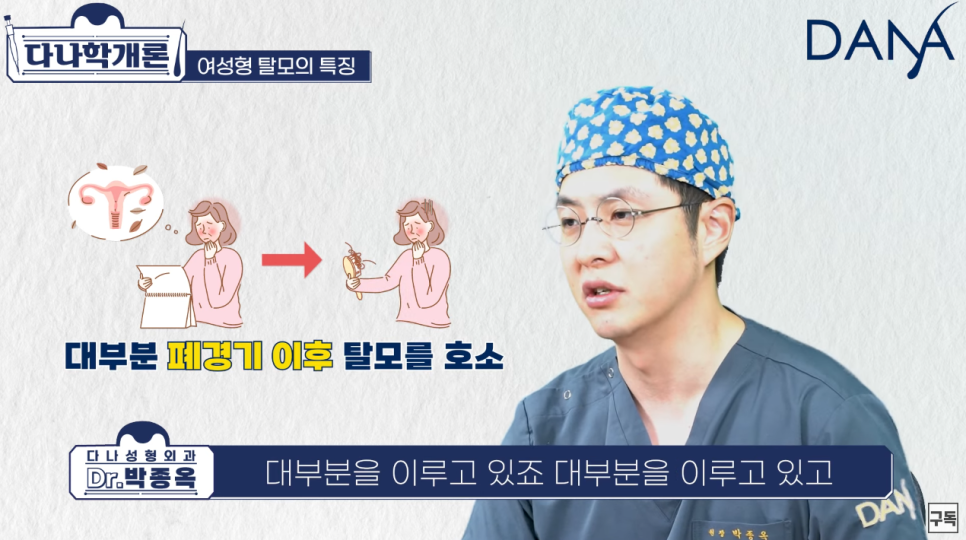
Also, many of the people who report hair loss are more often those after menopause rather than younger women.
The point that is a little different from men in such cases is
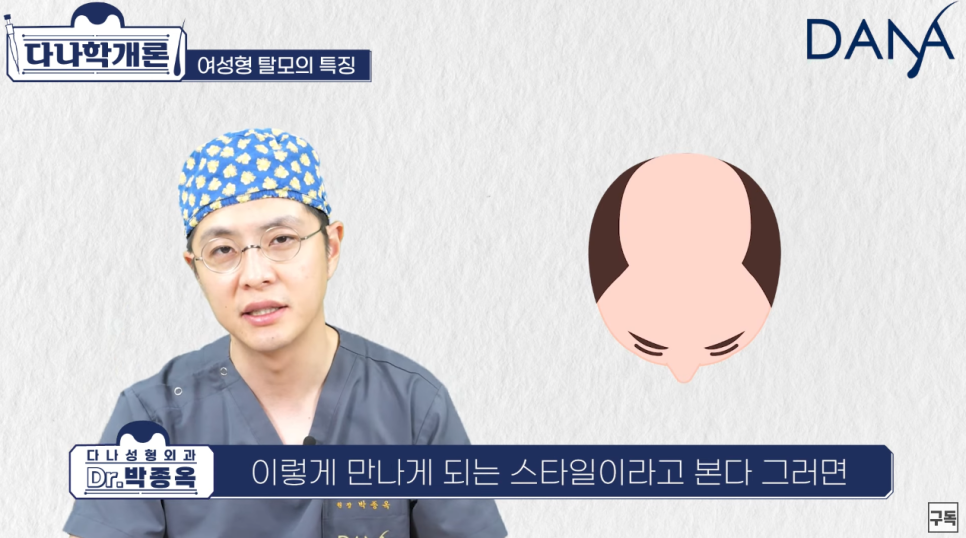
that male hair loss is typically a style where the M-shaped hairline recedes and meets the thinning at the crown,

whereas in female pattern hair loss, the hair at the crown usually becomes thinner.
A typical feature of female pattern hair loss is thinning that begins at the crown and progresses overall to the mid-scalp and frontal area.
Usually, when parting the hair, the hair becomes thinner around the part line.

If you feel that the part is getting wider or that the part is more noticeable than usual,
it may be worth suspecting female pattern hair loss.
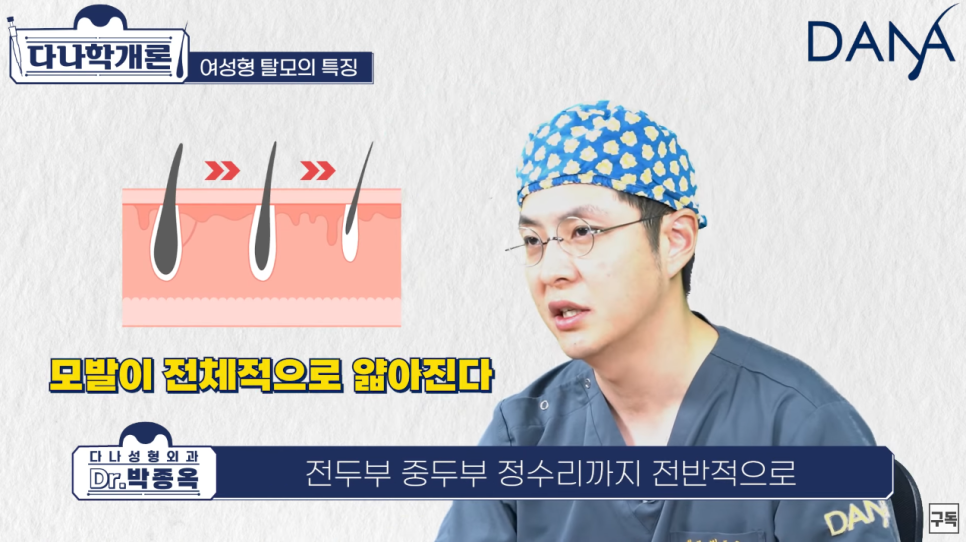
Female pattern hair loss causes the hair to become thinner overall.
The hair thins not only in the temporal and occipital areas, but also throughout the frontal area, mid-scalp, and crown, which is why many people worry about it.
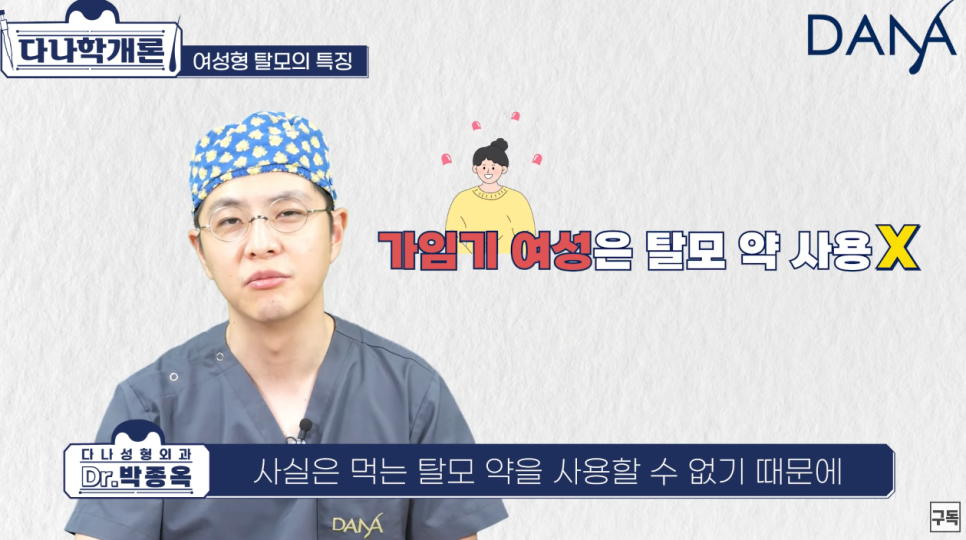
In addition, if you are a woman of childbearing age, you cannot use oral hair loss medication, so there are limitations in treatment,
and for postmenopausal women, oral hair loss medication is sometimes prescribed in part.

So, if you take oral hair loss medication together, you may see some improvement.
However, for younger people, there are limitations to treatment.
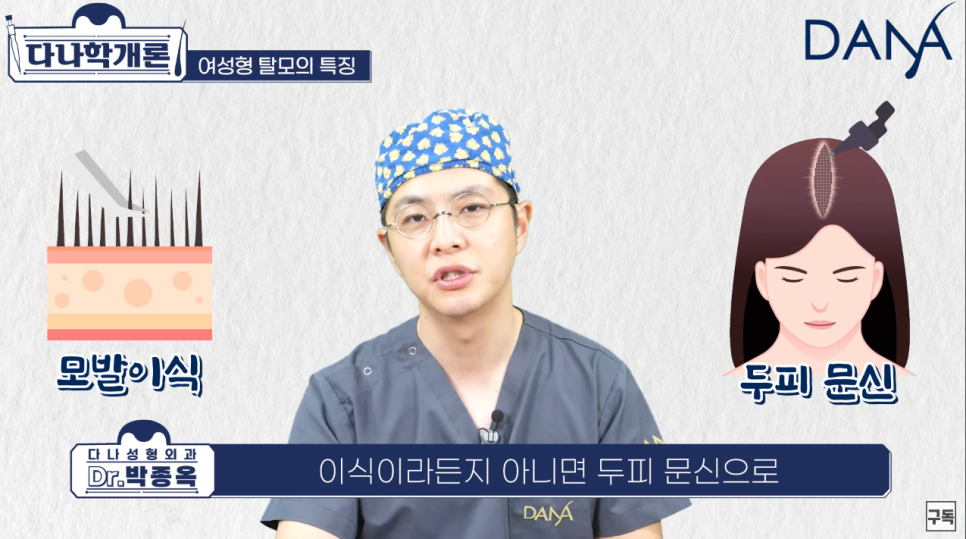
Because younger people cannot address it simply by taking hair loss medication,
we improve it through hair transplantation or scalp micropigmentation.
Scalp micropigmentation is a procedure that reduces the contrast between the hair color and the scalp,
so scalp visibility and related issues can be improved significantly.
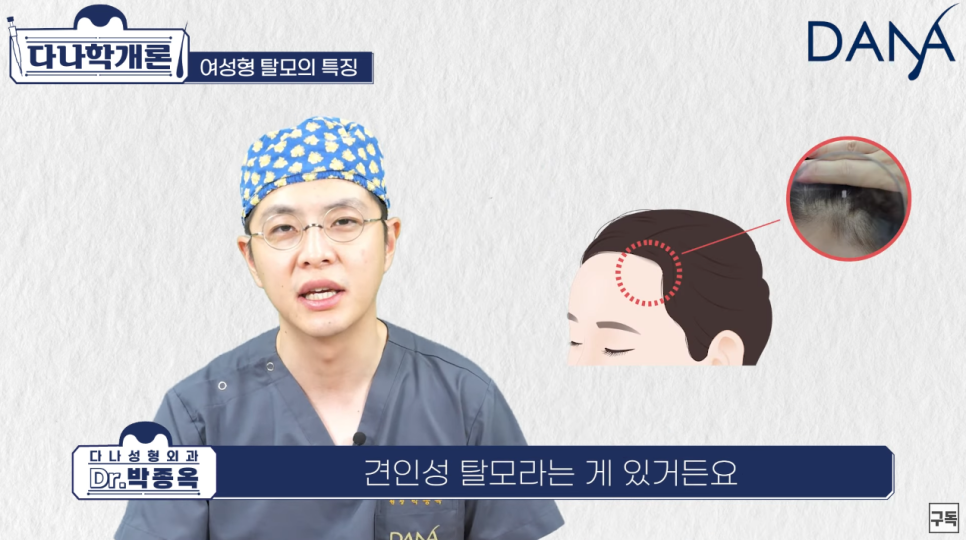
Another characteristic of female pattern hair loss is traction alopecia.
Many women tie their hair up.
It does not cause traction alopecia simply from tying the hair with ordinary tension, but when it is tied very tightly and pulled,

wearing that hairstyle for a long time can lead to hair loss because of the constant pulling force.
Pulling the hair back tightly is not very good for hair health, so unless there is a special reason,
a tightly pulled hairstyle is best avoided.
If the period of tightly pulling the hair back is not too long, traction alopecia may improve.
However, if traction alopecia is severe and has been left untreated for a long time, it may not improve even as time passes, so
in such cases, it is better to visit a hospital and receive an accurate diagnosis.
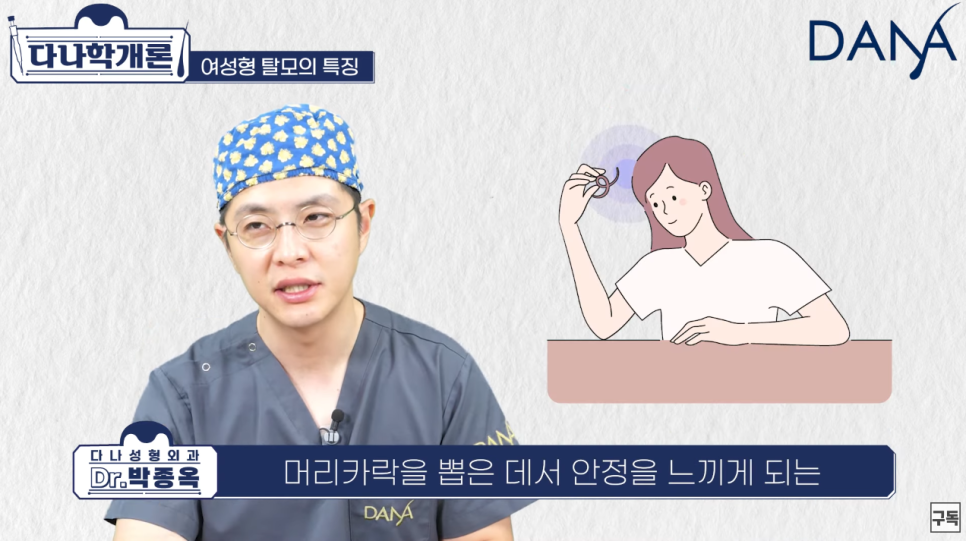
Another symptom of female pattern hair loss is trichotillomania. Trichotillomania is one of the conditions in which
pulling out hair brings a sense of relief. A person pulls out hair without realizing it, regardless of their own will, and

if hair is continuously pulled out from one area like that, hair loss may occur later in that area where hair no longer grows.
If you have trichotillomania and there is no hair or the density is reduced, treatment of the trichotillomania symptoms should come first.
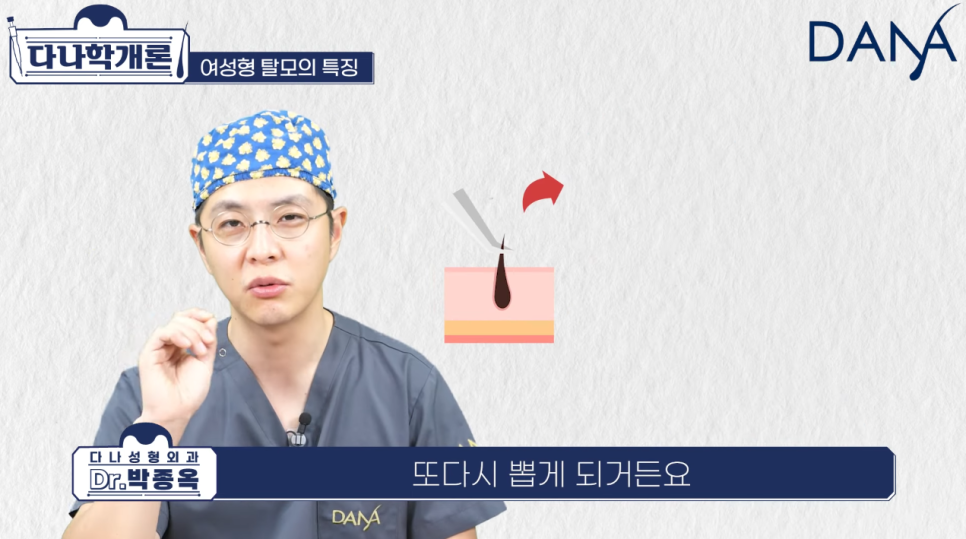
If transplantation is performed without that first step, you may unknowingly pull out the transplanted hair again.
In the end, this can become a vicious cycle in which hair no longer grows again, so it is important to treat trichotillomania first
and then undergo transplantation.
Today, we looked at the types and symptoms of female pattern hair loss.
If the hair loss you are experiencing is similar to the types of female pattern hair loss, do not leave it untreated,
and it is better to visit a hospital for an accurate consultation and examination 😊
For more details, please check Dana Plastic Surgery’s YouTube channel!
https://www.youtube.com/watch?v=59tHocNk_gE