Hello!
This is Dana Plastic Surgery, a hospital specializing in hair transplant surgery!
If you are considering hair loss treatment and hair transplantation, you may be wondering which method to choose between the “strip” and “non-incisional” methods.
Many people choose a surgical method simply based on cost or concerns about scarring.
However, did you know that one of the things you must check for a successful hair transplant is scalp elasticity?
Today, we will take an in-depth look at the importance of scalp elasticity in preventing hair transplant failure.
What Happens When Surgery Is Performed Without Measuring Scalp Elasticity
What Is “Scalp Elasticity”?
“Scalp elasticity” refers to the width, measured in millimeters or centimeters, within which both sides of the scalp can meet and be safely sutured after a strip of scalp is removed during strip surgery.
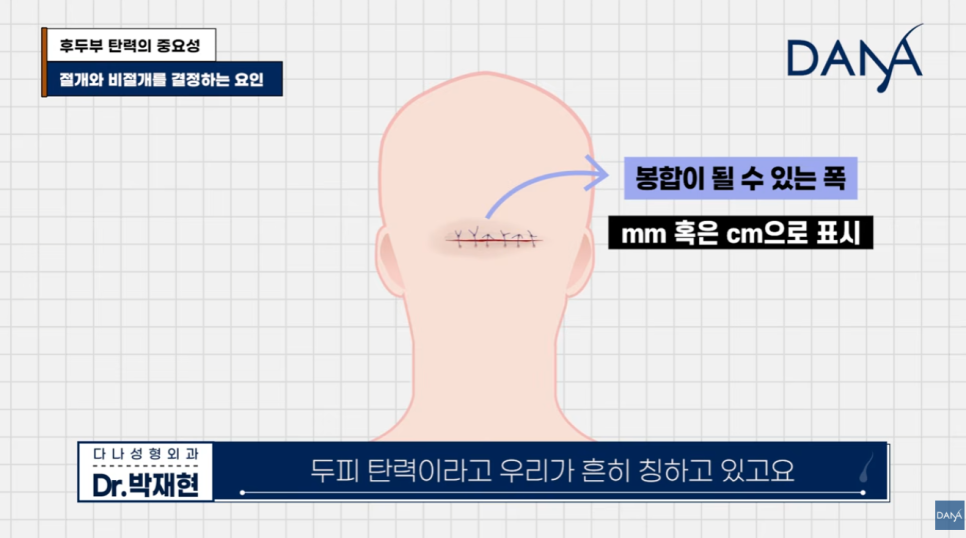


However, surprisingly, there are cases in which the incision is made according to a fixed formula without precisely measuring this elasticity.
For example, the approach may be to “always make a 15 mm (1.5 cm) incision for the first surgery and a 10 mm (1.0 cm) incision for the second surgery.”
But scalp conditions vary greatly from person to person.
In fact, when scalp elasticity is measured, quite a few people have a width of less than 15 mm.
What happens when the scalp of such individuals is incised excessively?




To prevent these side effects and perform surgery safely, it is important to accurately measure your scalp elasticity.




If you know the removable width (scalp elasticity), the incision length, and the hair density per square centimeter (㎠), you can estimate with some accuracy the number of hairs that can be harvested before surgery.
Dana Plastic Surgery developed its own scalp elasticity measuring device by improving the shortcomings of the measuring instrument developed in the United States (the laxometer) and incorporating 3D scanning technology.
This device is provided in every consultation room to safely and accurately assess each patient’s scalp condition.
Strip vs. Non-Incisional: How Is the Decision Made?
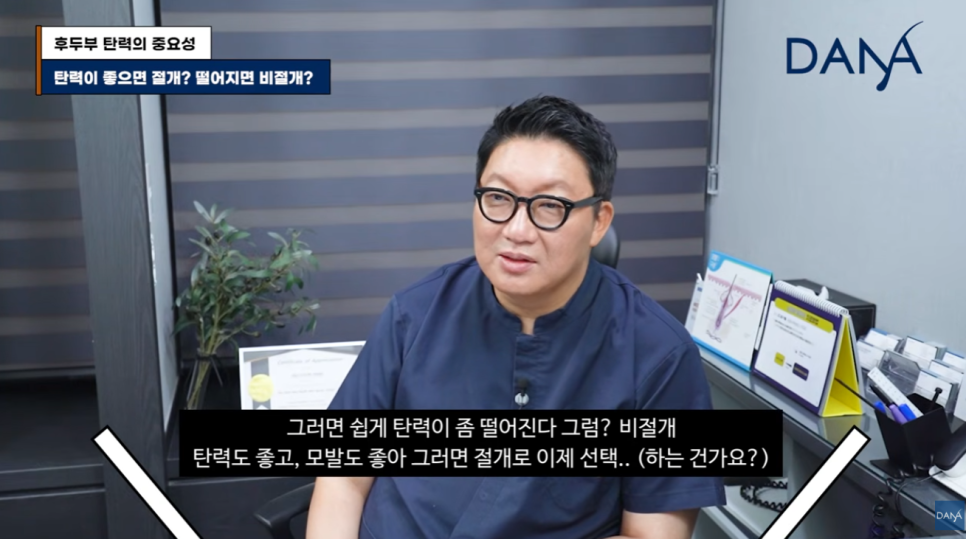
When scalp elasticity is good and hair condition is also favorable: The strip method can generally be selected safely.
When scalp elasticity is reduced and an incision is difficult: It is safer to proceed with the non-incisional method without overexerting the scalp.
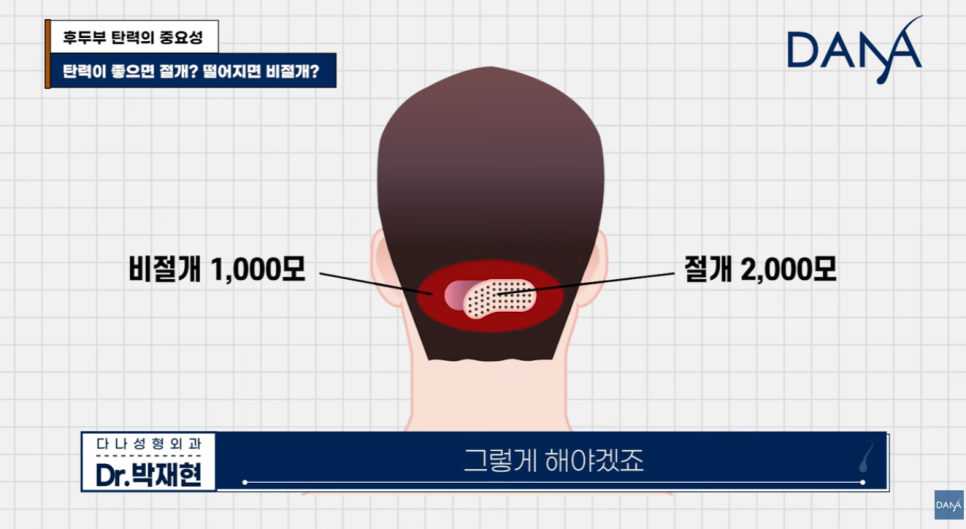
What if the required number of hairs is insufficient?
For example, if the target amount to be transplanted is 3,000 hairs, but only 2,000 hairs can be obtained through the strip method due to the limitations of scalp elasticity, what should be done?
In this case, rather than forcibly increasing the width of the incision, a sensible option is to safely harvest 2,000 hairs using the strip method and then collect the remaining 1,000 hairs through the non-incisional method—a combined approach.

Of course, the surgical method is ultimately determined by considering various factors together, including not only the medical condition of the scalp but also the patient’s preferences, usual hairstyle, and budget (cost).
You should carefully choose a hospital that can accurately diagnose your scalp condition, identify the appropriate surgical method, and perform the surgery safely.
We hope today’s information helps those considering hair transplantation make a careful and informed decision.
Have a healthy day!