Hello. This is Lifton Dermatology Clinic.
Today, I would like to explain a collagen booster (collagen regeneration injection) called Radiesse, which may sound somewhat unfamiliar.
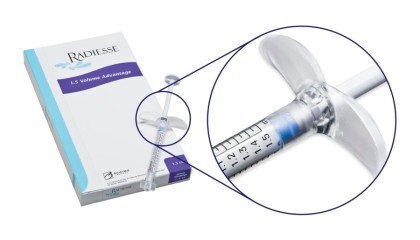
Radiesse
When filling in skin that has lost volume due to aging, hyaluronic acid (HA) fillers have held the leading position in volume treatments for the past 10 years.
Recently, I feel that bioplastic polymers known as collagen regeneration injections (or collagen boosters) are replacing existing HA fillers. This has been especially noticeable over the past 1 to 2 years, as I practice in Gangnam, the center of the aesthetic market.
I think this change in patient preference may be due to a growing demand for more natural-looking results and for volumizing that uses collagen produced by the body itself rather than volume created from outside, while also lasting longer.^^
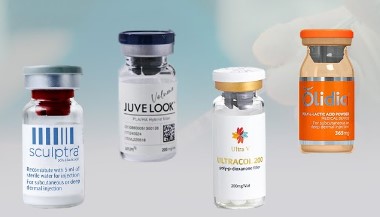
Collagen regeneration injections such as Sculptra, Juvéderm Voluma, and Ultherapy
Along with these collagen regeneration injections, such as UltraCol (PDO), Juvéderm Voluma (PDLLA), and Sculptra (PLLA), which have recently been representative products, today I would like to explain a new product called Radiesse (CaHA).
In addition, both of the directors at our Lifton Dermatology Clinic have been selected as key doctors for Radiesse by Merz Aesthetics, the manufacturer of Radiesse. Merz is already a multinational company well known for Ultherapy, a lifting device. I feel a sense of responsibility to continue studying Radiesse treatment experience and techniques going forward.
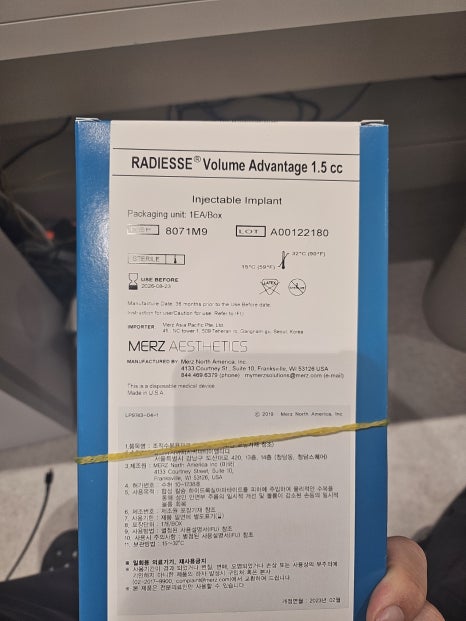
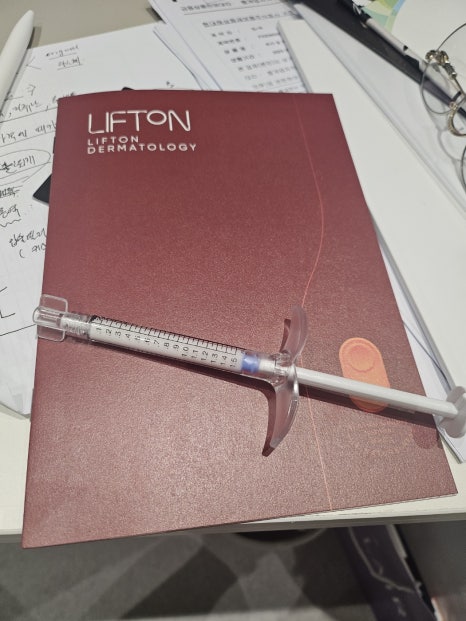
Many of you may be unfamiliar with the name Radiesse, but in fact, Radiesse is not a new product. It was approved by the U.S. FDA in 2006 as a treatment for facial fat loss symptoms in patients with acquired immunodeficiency syndrome. It was also introduced in Korea in the past and used "like a filler," but it did not gain much response and was eventually forgotten. There are reasons for this, which I will cover below.
One Radiesse syringe contains 1.5 cc and is composed of 30% CaHA (calcium hydroxylapatite) and 70% CMC (carboxymethyl cellulose) gel. Unlike existing filler products that contain hyaluronic acid, Radiesse can be thought of as a structure in which calcium particles are floating within a soft CMC gel.
Then, does that mean calcium is injected into the face? That may sound scary, but CaHA (the calcium component of Radiesse) is surprisingly tissue-friendly. And one concern patients always have with collagen regeneration injections such as Juvéderm and Sculptra is nodules. Although nodules have decreased significantly in recent years as dilution methods and treatment techniques have improved, nodule-related issues are still heard not infrequently. CaHA, the ingredient in Radiesse, is a bioceramic and is less likely to cause nodules within tissue. (Nevertheless, if the practitioner injects it all in one area and it clumps together, there is still a risk of nodule formation.)
Why is the likelihood of nodule formation low?
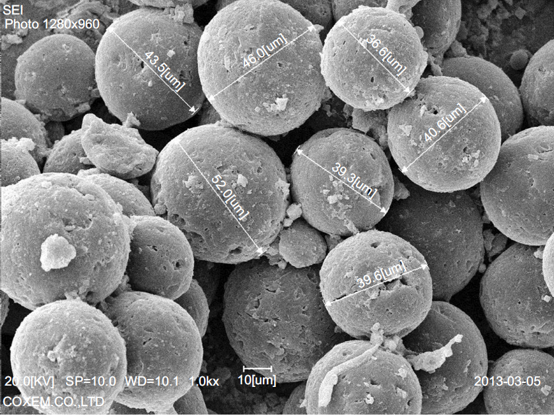
Particle size as 36-52 microns at 1000x magnification.
In the electron microscope image, you can see that Radiesse particles are uniformly spherical and about 40 microns in size. When particles remain within the skin, this helps reduce the sensation of foreignness and unnaturalness. If the particles are too small (less than 10 microns), they are easily phagocytosed by phagocytes, making the collagen regeneration effect less pronounced. If the particles are too large and irregular, the surface may become uneven after the procedure, or nodules may form and clump together. It is most ideal for particles of an appropriate size to be distributed uniformly.
Also, as mentioned earlier, because using it "like a filler" in the past carried a risk of clumping or nodule formation, it is generally diluted for use, just like other collagen regeneration injections. Even overseas, where Radiesse has been used more actively than in Korea, it is mostly diluted before use.
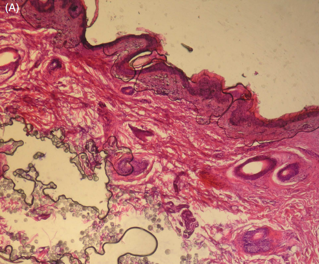
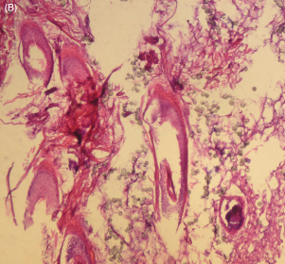
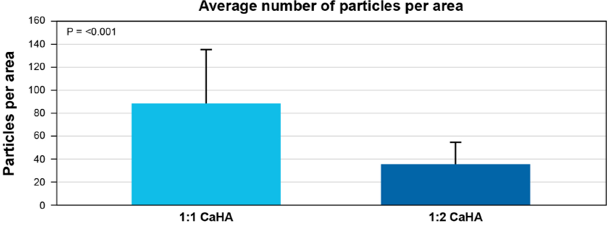
A. Skin injected with Radiesse diluted 1:1 showed an average of 70 particles observed B. In the sample injected with a 1:2 dilution, an average of 32 particles
As can be seen in the figure above, Radiesse diluted twice was found to have particles more evenly distributed within the tissue than Radiesse diluted once. Needless to say, as the dilution ratio increases, the particles are more evenly spread over a wider area, reducing the likelihood of nodules. At our clinic, we perform treatments using different dilution ratios depending on the purpose. When using a higher dilution, the goal is skin texture, fine wrinkles, and elasticity rather than volume effect. If a localized volume improvement is desired, we lower the dilution ratio to make the tissue fill out and create an effect similar to a filler.
I will cover more details about Radiesse in the next post.