Hello. This is Lifton Dermatology.
In Parts 1 and 2, we explained Radiesse.
To summarize, alongside skin boosters, collagen-synthesis-stimulating injections represented by Juvelook Volume (PDLLA) and Sculptra (PLLA) are receiving a lot of attention. Radiesse (CaHA) was also previously used like a filler, but considering its ingredients, composition, and effects, it seems more appropriate to use it as a collagen-synthesis-stimulating injection.
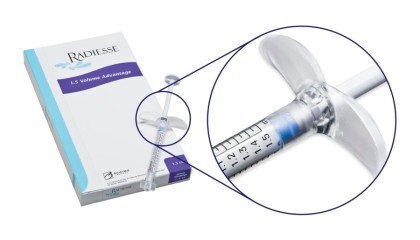
Radiesse is still thought of as a filler by more doctors, but overseas it is already being used more often as a collagen-synthesis injection rather than a filler. In our clinic as well, we usually dilute Radiesse and perform it for collagen-boosting purposes rather than injecting it like a filler. When performed this way, there are several advantages.
First, compared with using it in one area like a filler for volumizing, this can help prevent overcorrection or undercorrection.
In the case of fillers, the particles are injected and gradually broken down over time, but in the case of Radiesse, once the CMC gel breaks down, collagen production increases from the remaining particles. So if it is used like a filler, the volume may end up increasing more than expected, or it may be formed too little.
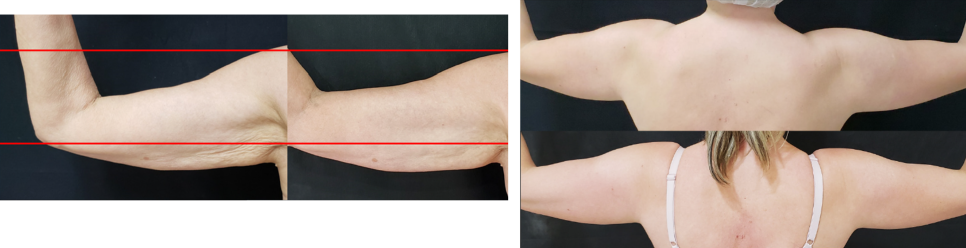 Treating sagging upper arm skin with diluted Radiesse. Photos before treatment and 3 months after treatment
Second, the Radiesse particles themselves are spread out widely to allow enough space for interaction between the Radiesse particles and fibroblasts. The larger the contact area between the injected Radiesse particles and the surrounding tissue, the stronger the stimulation of collagen synthesis. Therefore, even when using the same amount of Radiesse, diluting it can provide a greater collagen-synthesis-promoting effect.
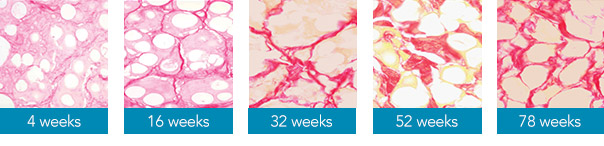
New collagen formation over time around Radiesse particles (CaHA)
Third, by adjusting the dilution ratio of Radiesse, customized treatment for each patient is possible. A higher dilution ratio allows the solution to spread more evenly and widely overall, and not only does it spread more broadly, it also increases penetration depth. On the other hand, a lower dilution ratio reduces diffusion of the Radiesse particles into the surrounding tissue and can provide a stronger regenerative effect in the treated area. So if you want to correct localized volume, the solution is made a bit more concentrated for the procedure.
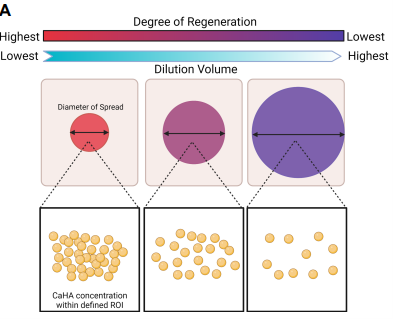
Distribution of Radiesse particles according to dilution ratio
As shown in the figure, the lighter the dilution of Radiesse, the more widely and deeply it spreads. As the diluted solution becomes thinner, the number of Radiesse particles per unit area decreases and they spread more evenly, but the collagen-synthesis effect decreases.
On the other hand, if it is used without dilution or diluted too lightly, the particles can clump together in one place, reducing the area that can communicate with surrounding fibroblasts and tissue cells. As a result, the collagen-synthesis effect cannot be properly achieved, and a strong regenerative effect appears only around the clumped particles, which also increases the risk of the commonly problematic nodule formation.
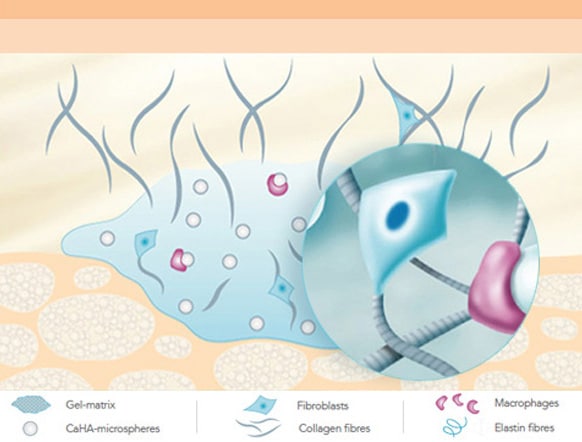
Radiesse particles interact with surrounding fibroblasts and form new tissue
Over three parts, we looked at Radiesse, a collagen-regenerative injection that may feel somewhat unfamiliar. From consulting in the clinic, it seems that more and more people are coming in having already decided on a product in advance. “I only want Juvelook Volume. I never want fillers. Under the eyes, I only want Ultracol.” ... and so on. People often come in with a firm decision(?) already made, and in the end we end up doing what they want, but after actually meeting and consulting with them face to face, there were many cases where a different method could produce better results. As with all procedures, I don’t think there is a single correct answer. There are now so many different volumizing procedures and products available, so I hope you choose the method that suits you and can deliver results. ^^ Thank you.