Hello. This is Lifton Dermatology Clinic.
These days, there are so many lifting devices.
In the past, when people thought of lifting devices, they only thought of Ulthera/Thermage, but over the past few years, a wide variety of devices have been introduced.
Thermage CPT has been followed by a new FLX version, and products that imitate Ulthera and Thermage have already been on the market for a long time. In addition to HIFU and monopolar RF, devices that apply different principles and add a different approach—such as InMode, Titanium, and Onda Lifting—have recently been getting attention.
What they all have in common is that they deliver “heat.”
So how should heat be delivered?
Is it enough to simply deliver a lot of it? Should it just be strong?
The answer is to adjust it to each individual.
However, even we doctors are not gods, so when we see a first-time patient’s face, we cannot immediately know, “This is the appropriate intensity for treatment!”
In most cases, treatment is started at an average intensity or slightly stronger intensity, and it is important to feel the skin’s response and then adjust the intensity and apply the appropriate technique accordingly.
If you recklessly go in too strongly, you could cause side effects that cannot be reversed.
Some practitioners or patients feel satisfied by receiving or providing strong treatment. As evidence of that, they show the total energy amount.
A representative example is Thermage. When Thermage is finished, the total energy amount appears on the screen.
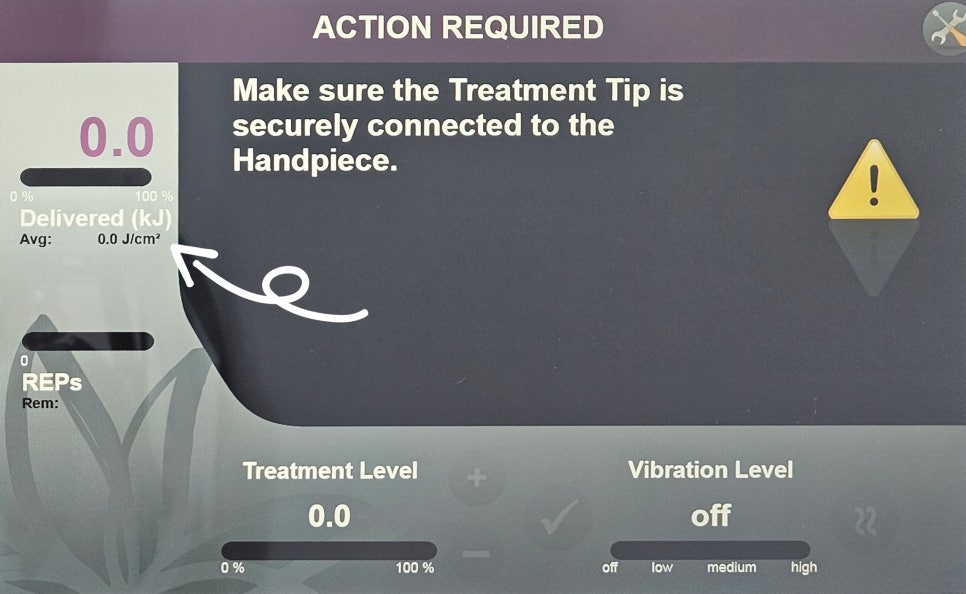
But there is something we need to know.
Even if treatment is performed with the same total energy amount, the dispersion of energy will differ depending on the treatment area. The effects of 300 Thermage shots on the cheeks and 600 Thermage shots on the entire abdomen would be very different, right?
Also, we need to look at the depth at which the energy is delivered. Since our skin is not a single thin layer, it has to be considered in three dimensions. Some treatments mainly deliver energy to the dermis, some are limited to the SMAS layer, and some spread broadly from the dermis to the subcutaneous fat.
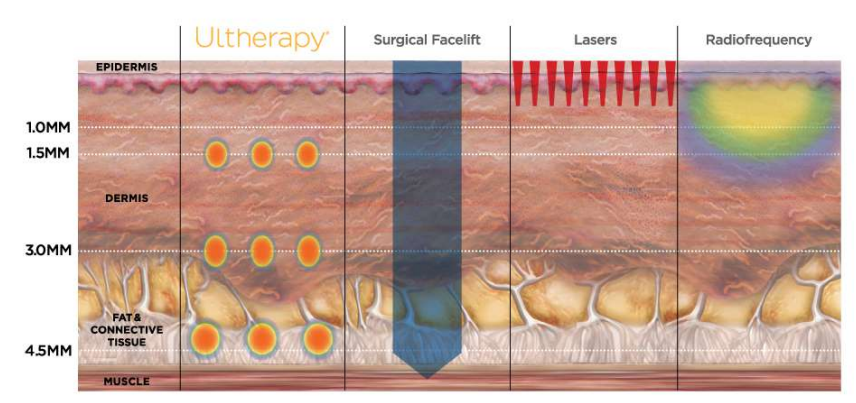
This is a famous illustration, right? It shows that the skin layer where heat acts differs depending on each treatment device/principle.
In fact, collagen regeneration varies depending on temperature.
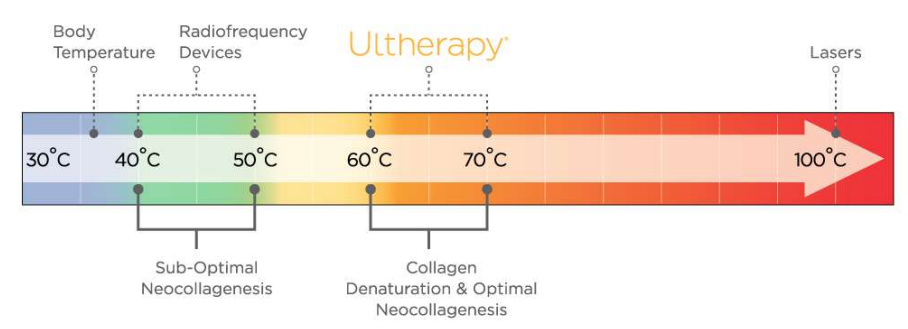
This is also a famous illustration. Not only 60–70°C, but even 40–50°C can greatly help collagen production if stimulation is applied for a sufficient amount of time.
Collagen grows well at an “appropriate temperature,” not simply at a “higher temperature.”
You should always keep this in mind when receiving treatment.