Hello.
I am Kim Geun-il,
Director of 365서울원탑치과.
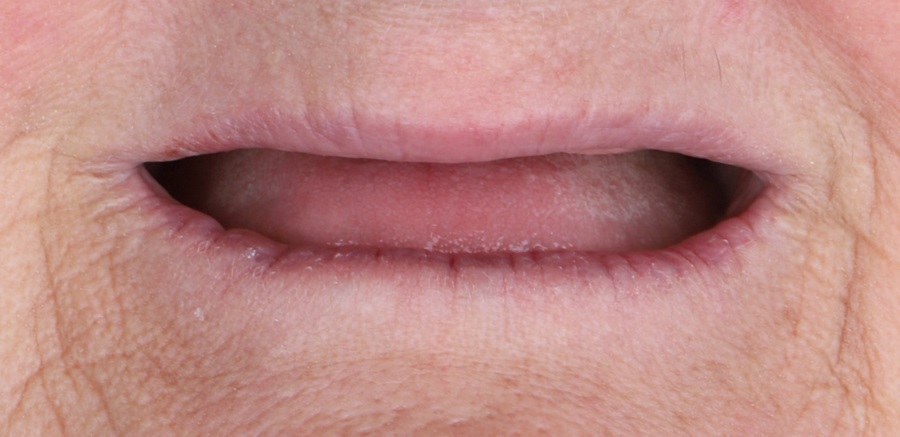
When you reach an edentulous state, with no teeth remaining,
not only do you lose the pleasure of chewing food,
but your speech may become unclear and the shape of your face may even change,
causing extreme stress.
In such cases, the first option considered is often
“full-mouth implant treatment,”
but there is one question
that patients ask most frequently in the consultation room.
Doctor,
I heard that people have 28 teeth.
Does that mean I need to have all 28 replaced with implants?
The cost is also a concern,
and I am afraid and worried that
the surgery will take too long.
Because of the term “full-mouth implants,”
many patients sometimes come to the dental clinic
with numerous misunderstandings and concerns.
To give you the conclusion first,
even if you have no teeth remaining,
there is absolutely no need to place an implant
for every missing tooth, so please do not worry.
For full-mouth implant treatment,
if 6 to 8 implants are firmly placed in each of the maxilla (upper jaw) and mandible (lower jaw),
for a total of 12 to 16 implant fixtures,
you can sufficiently restore strong chewing ability
similar to that of your natural teeth.
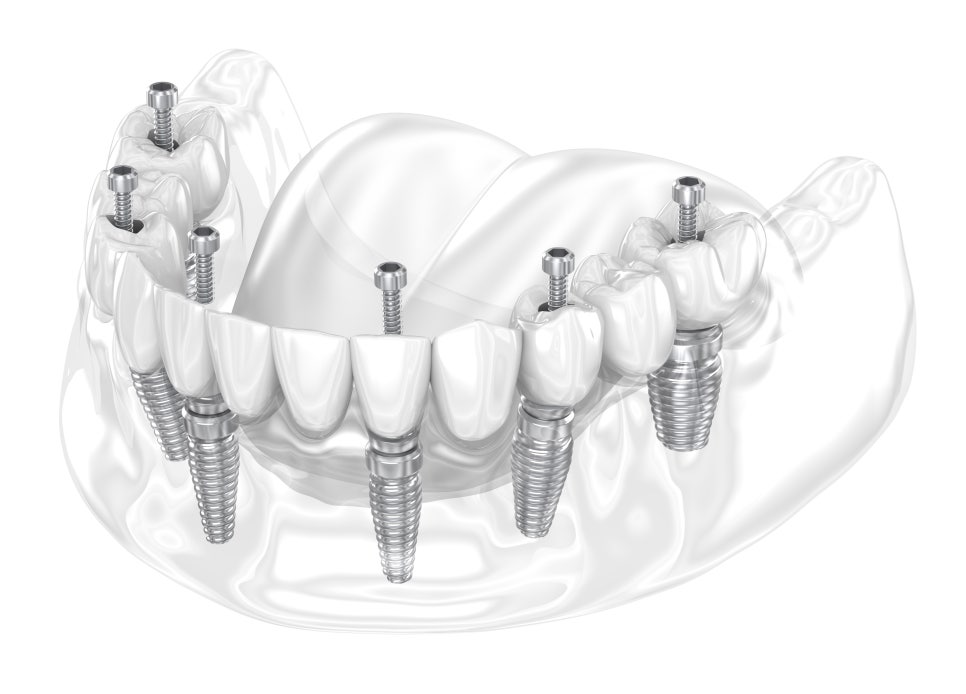
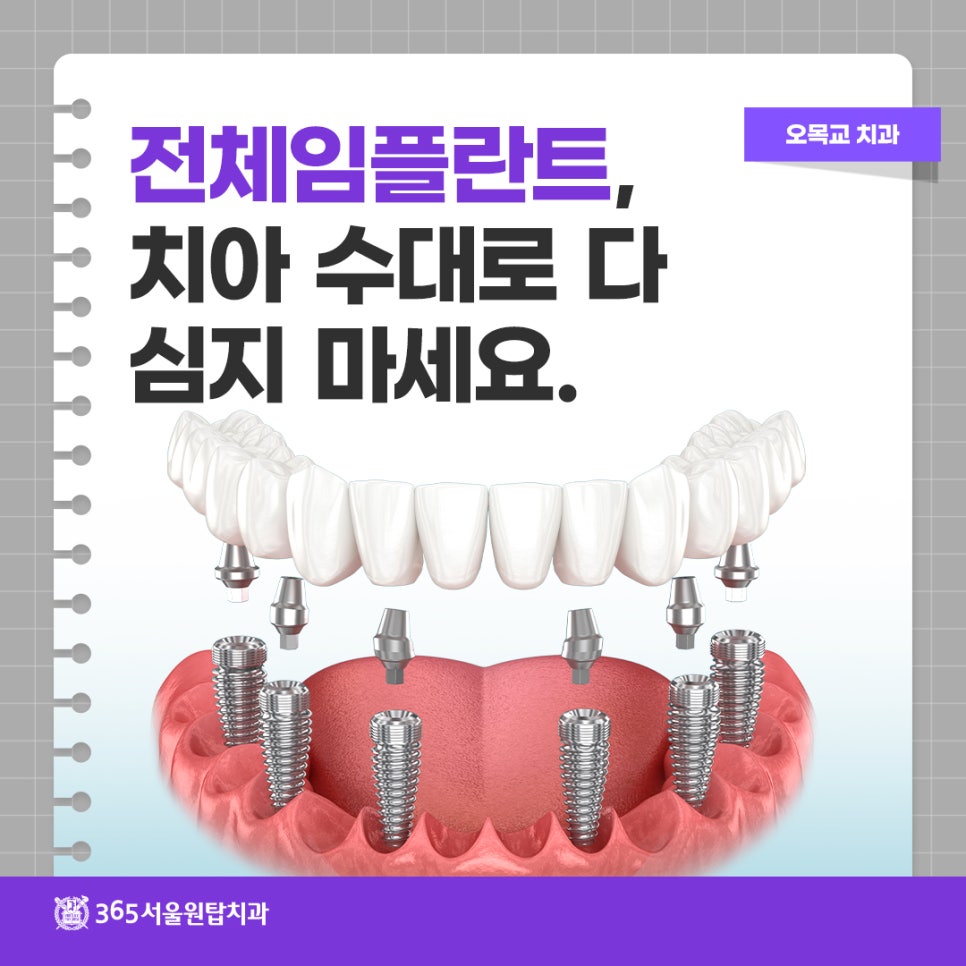
It is not necessary to place all 28 implants; 6–8 fixtures in each jaw are sufficient.
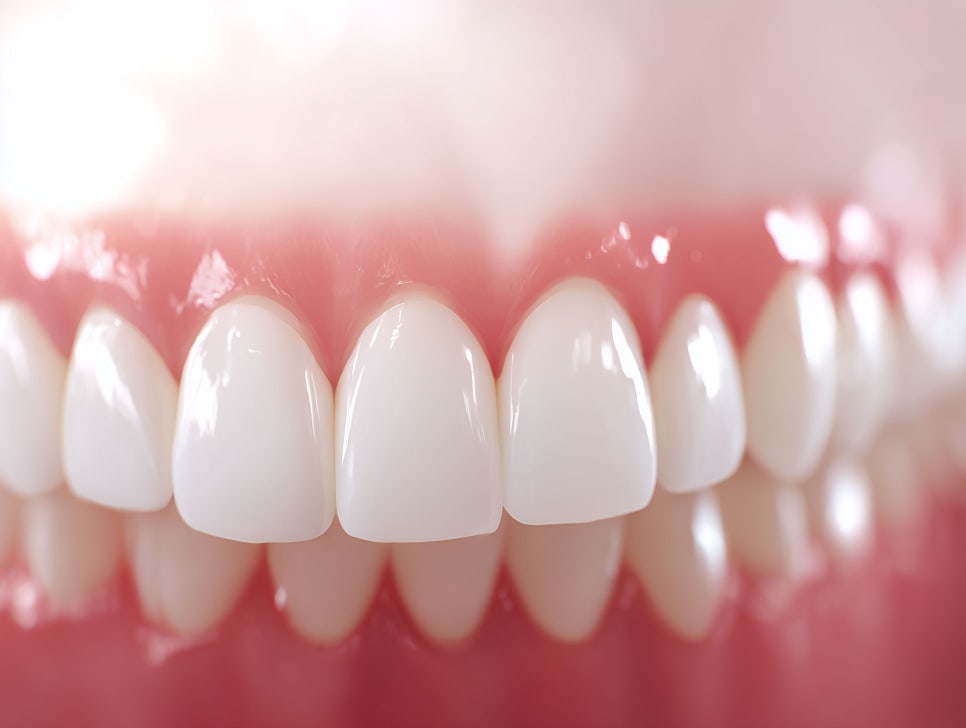
Excluding the wisdom teeth, there are a total of 28 teeth
in the upper and lower jaws combined.
However, when all the teeth have been lost,
there is no medical need to fill all of these spaces
with implant fixtures.
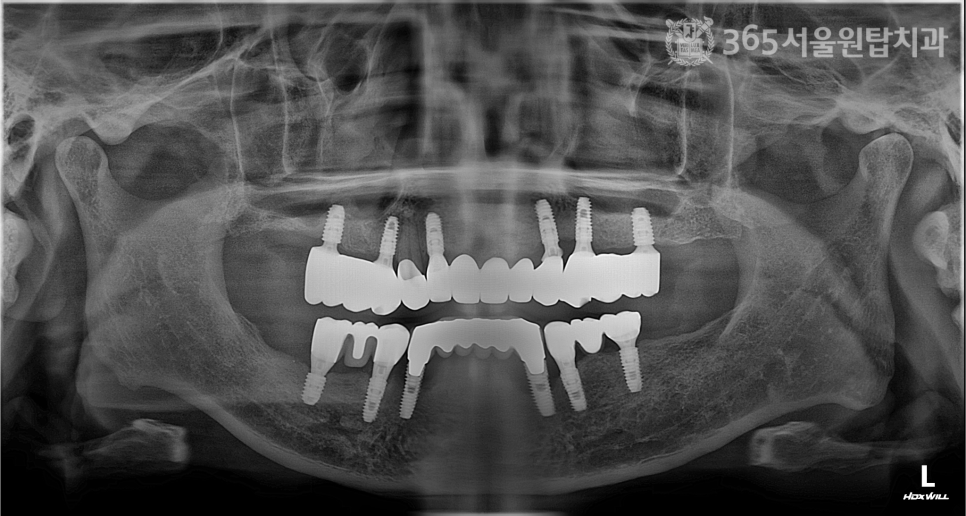
Example image for explanation / Photographed by 365서울원탑치과 on 2025.02.14
This is because implants have the characteristic
of being more firmly anchored in the jawbone
than natural teeth.
If fixtures are placed forcefully in every space left by a missing tooth,
the distance between the implants may become too narrow,
which can instead interfere with blood circulation within the jawbone
and cause an adverse effect in which the implants do not properly fuse with the bone.
It would also unnecessarily increase
the patient’s surgical burden and cost.
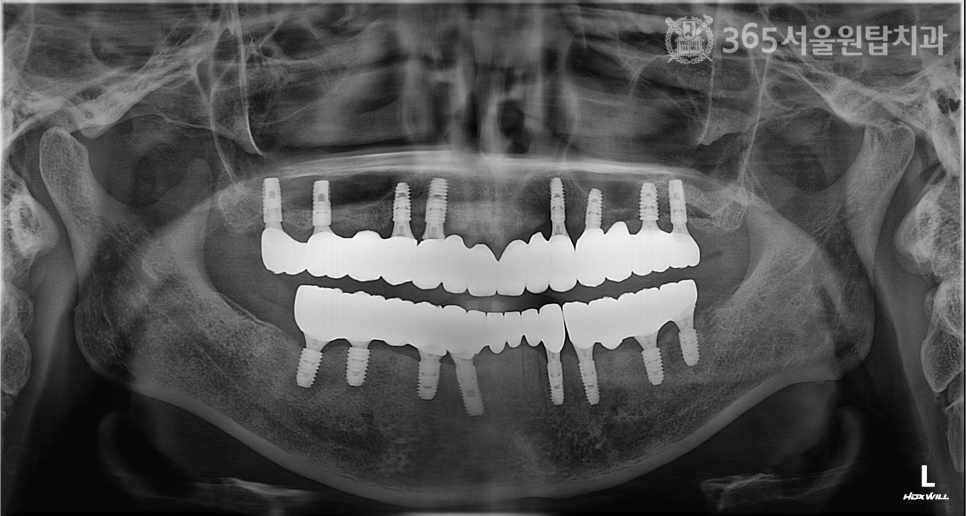
Example image for explanation / Photographed by 365서울원탑치과 on 2024.04.21
The most ideal full-mouth implant treatment
is to strategically place 6–8 implant fixtures in each jaw,
at key positions where the bone is strongest
and best able to withstand force.
If 12–14 tooth-shaped prostheses are then connected
and placed on top in the form of a bridge,
the function of the entire set of teeth
can be sufficiently reproduced without difficulty,
even with fewer implants.
The number of implants is determined according to the oral structure that distributes chewing forces and the patient’s eating habits.
Then why do some people receive six implants,
while others receive eight?
The exact number is determined through a “biomechanical calculation”
based on the patient’s oral structure and lifestyle habits.
- Bone thickness of the upper jaw (maxilla) and lower jaw (mandible)
The lower jawbone is hard and dense,
so it can generally withstand sufficient force with around six implants.
However, the upper jawbone is relatively porous
and has a lower density,
so placing around eight implants—one or two more—to distribute the force
is considered safer.
- The patient’s eating habits and chewing force
Those who regularly enjoy meat or hard foods,
have particularly strong chewing force,
or grind their teeth at night
need to distribute the impact placed on the implants.
Therefore, the number of fixtures may need to be increased slightly
to support long-term durability.
- The condition of the opposing teeth
The implant position and number
are also adjusted in detail according to
the balance of forces received when the upper and lower teeth come together.
Full-mouth implant treatment is not simply better because more implants are placed.
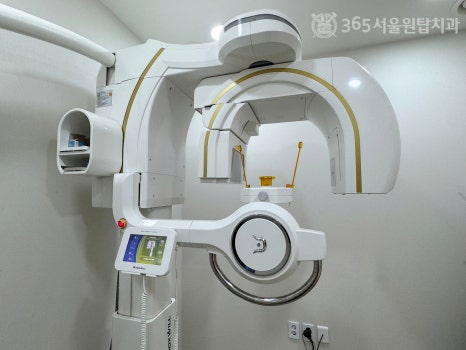
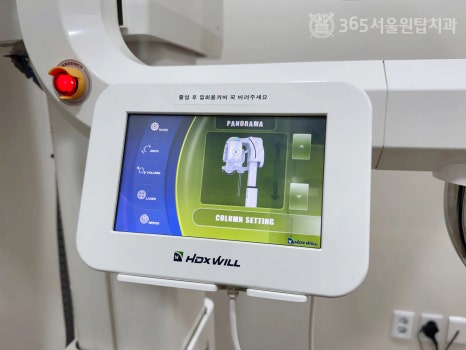
When planning full-mouth implant treatment,
what matters is not simply placing as many implants as possible,
but accurately analyzing the three-dimensional structure
of the patient’s remaining jawbone using 3D CT equipment
and placing the “optimal number”
in the most efficient positions.
This is the true key to reducing surgical pain
and using implants for 10 or 20 years.
Also, being older does not automatically mean
that implant treatment is impossible.
Rather than becoming discouraged because you have no teeth,
worrying that you are too old,
or delaying treatment because of cost concerns,
it is not too late to receive a thorough diagnosis
and take sufficient time to consider your options.
I, dentist Kim Geun-il,
will always do my best for the day
when every patient can enjoy delicious food
without worrying about their teeth.
Thank you.
📍 365서울원탑치과의원
179 Gangseo-ro, 4th Floor, Dongmyeong M Building, Gangseo-gu, Seoul
Omokgyo Dental Clinic / Gangseo-gu Dental Clinic / Hwagok Station Dental Clinic
1-minute walk from Exit 8 of Hwagok Station