Hello, I’m Ahn Byung-jun, the chief director of Ahn Byung-jun Plastic Surgery Clinic.
“I keep hearing that my eyes look sleepy.”
“When I take photos, one eye looks bigger than the other.”
“The crease is set too thick.”
Many people come to the clinic after undergoing surgery several years ago, but remaining dissatisfied with the results and worrying about it for a long time.
When patients finally decide on eye revision surgery, I can fully understand how much time they spent worrying in front of the mirror during our consultations.
What was the problem with the previous surgery?
During a revision consultation, we carefully examine the current condition of the eyes.
We need to check the position and thickness of the crease, the strength of the eye-opening muscles, left-right balance, and the condition of any scars.
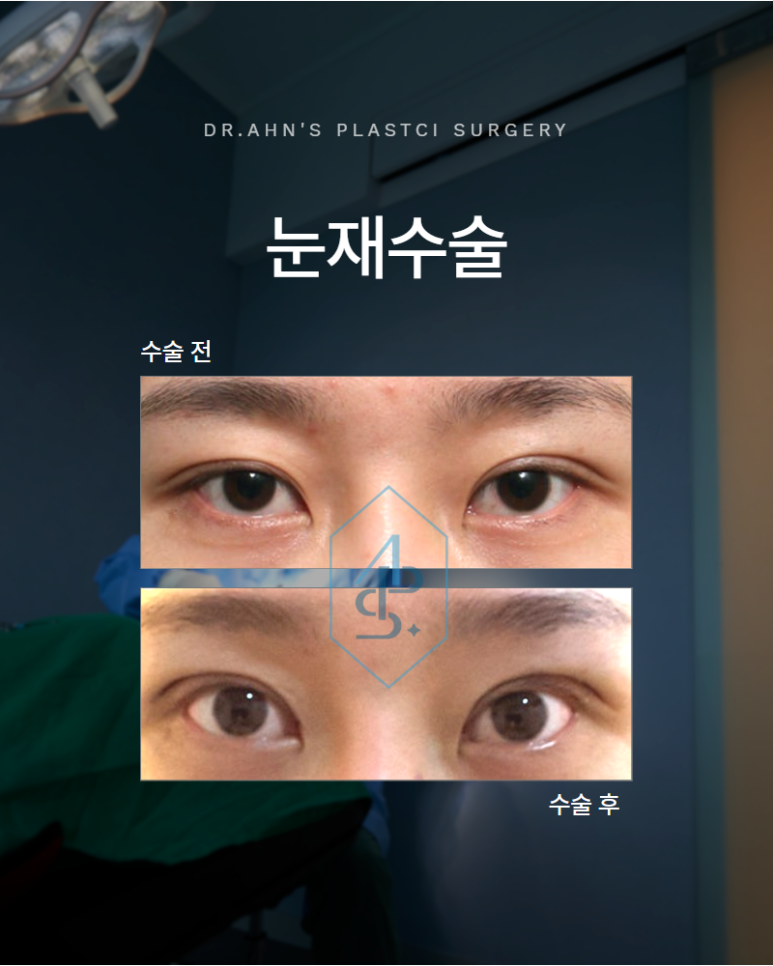
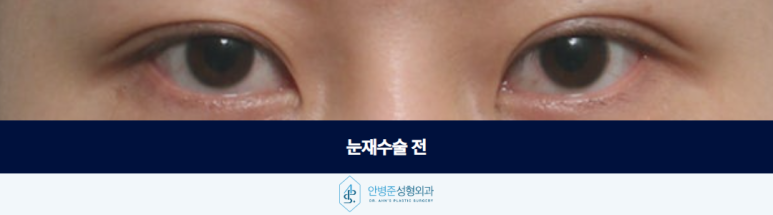
In a case like this one, where double eyelid surgery and epicanthoplasty were performed together four years ago, the already fixed tissue has often loosened or become deformed once.
Typical examples include a double eyelid crease that is too thick and looks swollen like a sausage, or a sleepy-looking impression left behind because the eye-opening muscles are weak.
If mild scleral show is also present, simply adjusting the crease alone makes it difficult to achieve the desired change.
We redesign the entire eye revision plan
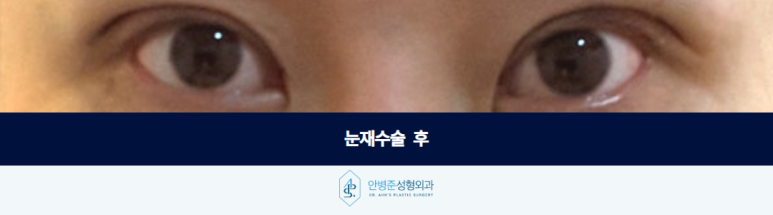
In this case, we removed 3 mm including the existing crease and newly designed the double eyelid crease at 7.5 mm.
At the same time, we performed ptosis correction by advancing the levator palpebrae superioris muscle by 4 mm.
This is a delicate procedure that requires considering multiple structures together.
If the eye-opening muscle is weak, even if a new crease is created, the eyes will not open properly and the sleepy impression will remain.
That is why ptosis correction is used to adjust the shape of the muscle while also planning for functional recovery so that the eyes can move comfortably on their own.
Why we remove the scar line as well
The scar line from the previous surgery is often already adhered within the skin.
If a new line is created and fixed on top of it, the existing scar tissue can interfere and make eye movement look unnatural.
That is why, in eye revision surgery, it is important to remove the excess skin together with the scar line.
This allows the new crease to settle cleanly and makes the eyes look less awkward even when closed.
This is why I often tell patients during consultations that we need to approach it as if we are designing everything from scratch.

When scleral show is also present
Scleral show refers to a condition in which too much of the white below the iris is visible, giving the eyes a strong or uneasy impression.
The approach differs depending on whether this is due to the congenital position of the eyeball or an imbalance in the eye-opening muscles.
In a case like this one, where ptosis correction is combined with redesigning the double eyelid crease, the balance of the eye-opening force is often adjusted and the scleral show is naturally reduced.
The key is not to artificially lower the eyelid, but to correct the eye so that it opens with the proper force.
Recovery and changes after eye revision surgery
Immediately after surgery, swelling and bruising remain quite noticeable.
If you try to judge the results at this stage, it is only natural to feel anxious.
Usually, by around 2 to 3 weeks, more than half of the swelling subsides and the outline begins to show.
It is best to consider the line naturally settled after about 3 months, and the completed result should be evaluated after 6 months.
Eye revision surgery is the process of redesigning unnatural aspects and re-planning the eyes so they can move properly in a functional way.
A natural and long-lasting result can only be achieved when there is an accurate diagnosis and a careful plan.
If you are considering revision surgery, carefully assess the current condition of your eyes with a board-certified plastic surgeon.






Previous image
Next image