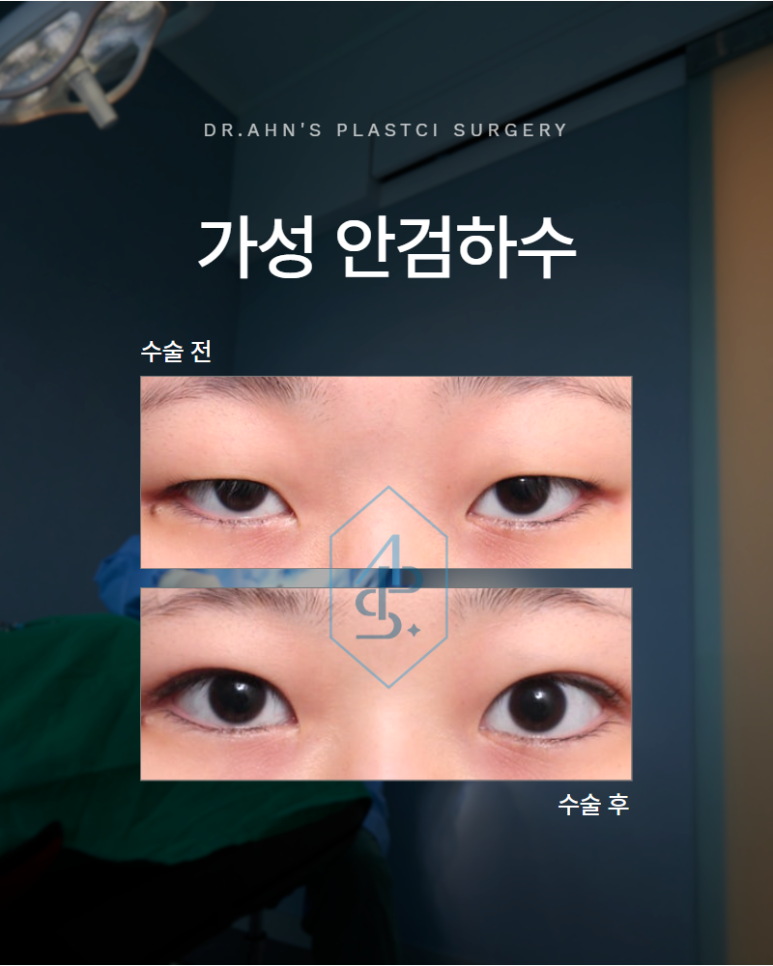
Hello. I am Dr. Byeong-jun Ahn, the director of 안병준성형외과.
Some patients come to us after already being diagnosed with ptosis elsewhere.
However, the situation can be quite different when we examine the eyes directly.
In photographs, the eyes clearly looked like they had ptosis, but the main cause was actually drooping skin on the eyelids.
This is pseudoptosis.
Even when the outward appearance is the same, using the same surgical method may not lead to improvement. Today, I would like to explain this point.
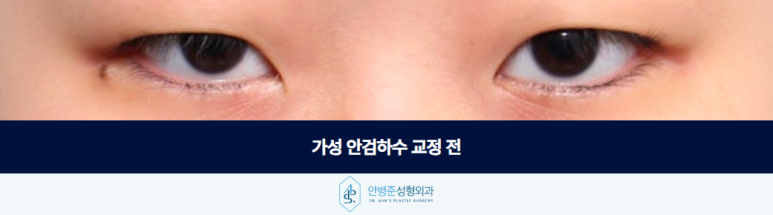
Eyes with recessed eyeballs require a different approach from the beginning
Eyes with a structure in which the eyeballs are even slightly recessed tend to be accompanied by drooping eyelids.
The eyelid skin covers the upper part of the iris, making the eyes appear less open.
In these cases, the muscles themselves are not the problem.
The first step is to remove the excess, drooping skin.
If the eyes still do not open sufficiently after the skin is removed, eye-opening correction surgery can be performed to the extent necessary.
Following this order helps prevent overcorrection and can lead to a natural result.
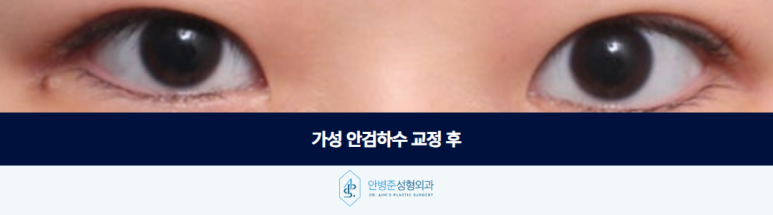
For those considering revision surgery after the buried suture method and non-incisional eye-opening correction
Similar situations also arise frequently during revision-surgery consultations.
Some patients visit us because their eyes still look sleepy even after undergoing the buried suture method and non-incisional eye-opening correction.
In a considerable number of these cases, eye-opening correction was performed first even though the patient had pseudoptosis.
The cause was drooping skin, but only muscle strengthening was performed without removing the excess skin, so the problem remained.
Of course, some people who have undergone the buried suture method and non-incisional eye-opening correction do have true ptosis as well.
Therefore, it is also true that distinguishing pseudoptosis from true ptosis is not easy.
Determining which is the primary cause—or whether both are present—is an important part of the preoperative process.
Surgery should begin by addressing the drooping skin
When the condition is determined to be pseudoptosis, surgery begins by removing the drooping skin.
In this case, the procedure was performed by designing a double-eyelid crease at 8 mm and excising 2 mm of skin.
If the eyes open sufficiently after the skin is removed, a natural result can be achieved without eye-opening correction surgery.
The less unnecessary muscle strengthening is performed, the lower the risk of overcorrection.
After three months, as the eyelids stabilize, a natural appearance begins to take shape.
Pseudoptosis resembles ptosis in appearance.
However, when the cause is different, the surgical approach must also be different, and a different approach leads to a different result.
Repeatedly strengthening the muscles while leaving the drooping skin unaddressed can create a vicious cycle that leads to revision surgery.
If your eyes feel less open, the correct starting point is to first determine whether the issue is caused by the muscles or by the skin.



Previous image
Next image