Hello, this is S Leader Dental Hospital in Gwangjin-gu, greeting you from our Konkuk University area dental clinic.
Do wisdom teeth need to be removed? This is one of the questions people ask most often when they come to the dental clinic. Wisdom teeth
usually refer to the fourth molars that grow in at the very back of the molars. They typically emerge between the late teens and early twenties, and depending on the person, there may be one to four of them—or none at all.
The problem is that merely having wisdom teeth is not necessarily a big issue, but depending on their position, direction, and hygiene management, they can affect the surrounding teeth and gum health, so there are cases where extraction is definitely necessary.

Problems that can occur due to wisdom teeth
First, if a wisdom tooth has grown in straight, the bite is normal, and you can clean it well, then there is no need to remove it. However, in reality, most wisdom teeth grow in while partially buried in the gums, lying on their side, or at an angle while pushing against the adjacent tooth. In such cases, inflammation may recur over time, food may get trapped and cause cavities, and in severe cases, even the root of the adjacent tooth can be damaged.
In particular, because wisdom teeth are in a position that makes them hard to reach with a toothbrush, making them difficult to care for, it is very common for cavities to develop on the inside or for inflammation to occur deep in the gums, even when they appear healthy.

These are the cases in which wisdom teeth should be removed.
If pain or discomfort caused by a wisdom tooth keeps recurring, or if an X-ray shows that it may affect the surrounding teeth, it is a good idea to consider extraction even as a preventive measure. In particular, when a lower wisdom tooth grows in sideways, it can press on the root of the adjacent molar, causing pain, and in severe cases, it can even compress a nerve and cause numbness in the jaw. In such cases, it is not just a problem with one tooth; it can affect the jawbone and nerves as well, so quick action may be needed rather than simple treatment.
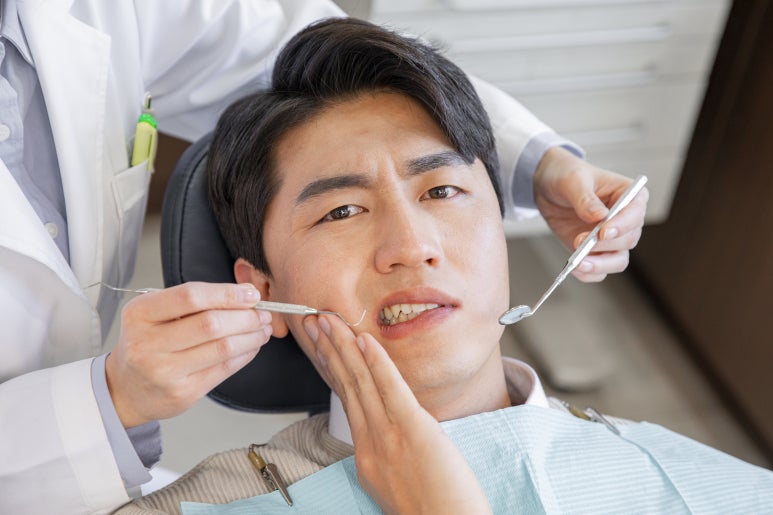
Also, when inflammation develops around a wisdom tooth, taking antibiotics or anti-inflammatory medication often only improves the symptoms temporarily, and the underlying problem deep in the root area is often not resolved. If it is left in place without removal, the inflammation may recur and damage to the surrounding tissue may accumulate. In particular, if pain keeps recurring or swelling appears frequently even during a busy daily routine, the wisdom tooth itself is likely the source of the problem.
Meanwhile, wisdom tooth extraction is often recommended before orthodontic treatment or jaw surgery. This is because wisdom teeth take up space at the back of the jawbone and can interfere with tooth movement or affect the surgical area. Even after orthodontic treatment is finished, wisdom teeth can push from behind and cause the alignment to shift again, so removing them in advance can help achieve more stable results.

Not all wisdom teeth must be removed.
Of course, not all wisdom teeth must be removed. As you get older, recovery after extraction may be slower, and if the tooth is close to a nerve or the roots are complex, the burden of the extraction itself is greater. In such cases, it is better to make the decision carefully after consulting with a dental specialist.
In particular, it is safest to determine whether extraction is necessary after accurately checking the wisdom tooth’s position, direction, and distance from the nerve through X-rays or 3D CT scans.

Wisdom teeth may be a signal to reflect on yourself.
What matters much more than the simple fact that a wisdom tooth “exists” is how it has grown in and how manageable it is to care for. Even if there is no pain, leaving it alone can often lead to bigger problems later, so if you have wisdom teeth, it is very helpful for long-term oral health to have your condition checked regularly at the dental clinic and, if needed, have them removed at the proper time.
Even if they seem fine, if discomfort keeps recurring, I recommend not putting it off and getting it checked at least once.
So far, this was Director Shim Seong-hwan of S Leader Dental Hospital in Gwangjin-gu.
Thank you.