Hello, this is S Leader Dental Hospital, a dental hospital at Konkuk University Entrance that is celebrating its 22nd anniversary this year.
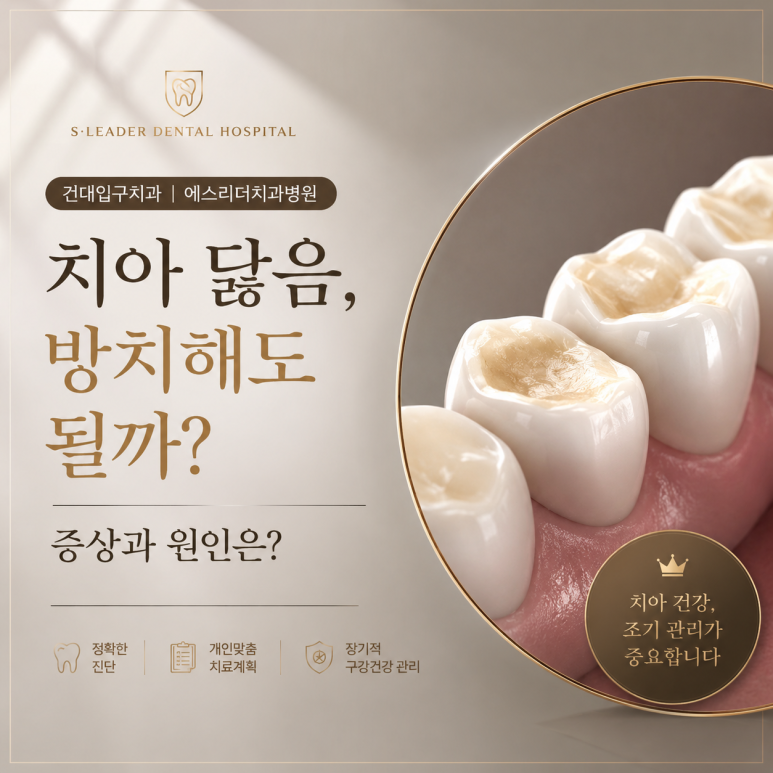
Have you ever looked in the mirror one day and felt that your teeth seemed shorter than they used to be?
Among patients who visit the dentist, quite a few share concerns such as, “The ends of my teeth seem to have become flat,” “My teeth feel sensitive when I drink cold water,” or “My teeth seem smaller than before.”
At first, it is easy to think that this is simply a natural change that comes with age. However, if your teeth are visibly wearing down, it may be a sign of a dental health problem rather than simply a phenomenon of aging.
Tooth wear is particularly characterized by the fact that once it progresses, the teeth do not naturally return to their original condition. Therefore, identifying the cause early and managing it appropriately is extremely important.
Today, S Leader Dental Hospital at Konkuk University Entrance will take an in-depth look at why tooth wear occurs, what symptoms it causes, and what problems may arise if it is left untreated.
What Is Tooth Wear?
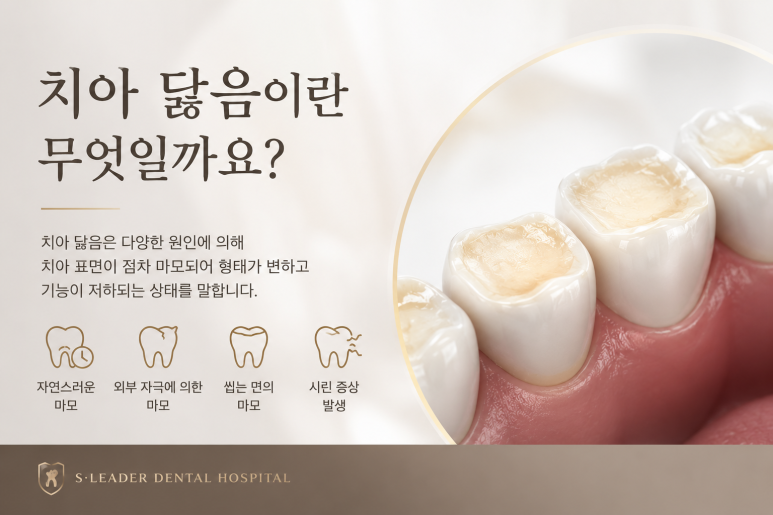
The outermost layer of a tooth is covered by a hard tissue called enamel.
Although enamel is one of the hardest tissues in the human body, it can gradually wear down when repeatedly exposed to continuous friction, pressure, or an acidic environment.
This gradual wearing away of the tooth surface is called tooth abrasion or tooth wear.
There may be no noticeable symptoms in the early stages, but over time, tooth wear can affect the shape and function of the teeth and, in severe cases, may damage the tissues inside the teeth.
What Are the Main Causes of Tooth Wear?
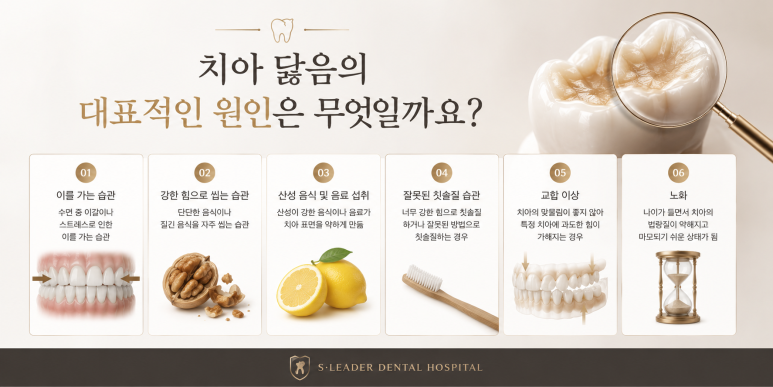
- Grinding or Clenching Your Teeth
This is one of the most common causes of tooth wear.
In particular, people often do not realize that they grind their teeth while sleeping. The strong forces generated during sleep can place much greater pressure on the teeth than normal eating, and if this continues repeatedly, the teeth may wear down quickly.
Caution is also needed if you have a habit of clenching your teeth tightly when you are stressed.
- Eating Tough or Hard Foods
Frequently eating hard foods such as dried squid, ice, or nuts can cause repeated friction on the tooth surface.
Eating these foods once or twice will not necessarily cause a problem, but repeated consumption over a long period may accelerate tooth wear.
- Incorrect Tooth-Brushing Habits
Brushing diligently is good for dental health, but brushing with too much force can instead damage the teeth and gums.
In particular, using a hard-bristled toothbrush or vigorously scrubbing from side to side can cause wear that creates notches around the necks of the teeth.
- Acidic Foods and Beverages
Frequently consuming carbonated drinks, fruit juice, sports drinks, or foods containing large amounts of vinegar can weaken the tooth surface due to acid. If you brush too vigorously in this condition, tooth wear may progress more easily.
- Bite Problems
When the teeth do not come together properly, force may become concentrated on particular teeth. If this continues for a long time, some teeth may wear down faster than other areas.

What Symptoms Occur When Tooth Wear Develops?
Because tooth wear progresses gradually, it often goes unnoticed in the early stages.
However, if you experience the following symptoms, tooth wear may be suspected.
Your teeth feel sensitive
When the enamel on the tooth surface becomes thinner and the underlying dentin is exposed, the teeth may react sensitively to cold or hot foods.
The ends of your teeth become flat
Healthy teeth have appropriate curves and shapes.
However, as wear progresses, the ends of the teeth may gradually become flat and appear shorter.
Your teeth look yellowish
When the enamel wears away and the underlying dentin becomes visible, the teeth may appear yellower than before.
Your chewing function decreases
Changes in tooth shape may reduce chewing efficiency and place additional strain on the jaw joints.
Your jaw feels tired or painful
When tooth wear is caused by teeth grinding, jaw joint pain or muscle fatigue may also occur.
Can Tooth Wear Be Left Untreated?
To put it simply, it is best not to leave tooth wear untreated.
This is because tooth wear does not recover naturally.
In the early stages, it may cause nothing more than sensitivity, but over time, it can lead to increasingly serious problems.
As the enamel continues to wear away, the area of exposed dentin may expand and sensitivity may worsen.
In addition, changes in tooth shape can disrupt bite balance, and excessive force may become concentrated on particular teeth, increasing the possibility of further wear or cracks.
In severe cases, damage may progress close to the nerve inside the tooth, potentially making root canal treatment necessary.
Therefore, it is important to identify the cause and begin management early.
How Is Tooth Wear Treated?
The treatment method may vary depending on the cause and extent of the wear.
Improving Lifestyle Habits
The first step is to improve habits such as grinding your teeth or brushing too forcefully. If the cause continues, the same problem may recur even after treatment.
Splint Appliances
If you have a habit of grinding or clenching your teeth, an appliance worn during sleep can help protect the teeth.
Resin Treatment
Areas with early-stage wear can be protected or restored in shape using resin.
Prosthetic Treatment
When wear is severe, prosthetic treatment such as crowns may be considered. This may help restore tooth function and aesthetics and prevent further damage.
S Leader Dental Hospital at Konkuk University Entrance
We Thoroughly Check the Causes of Tooth Wear
Tooth wear is not simply a matter of the teeth becoming slightly worn. It can affect function, aesthetics, and long-term oral health.
Because symptoms may be mild in the early stages, it is easy to leave the condition untreated. However, the scope of treatment may increase over time, so it is important to identify the cause and begin management early.
At S Leader Dental Hospital at Konkuk University Entrance, we thoroughly examine the cause and extent of tooth wear before explaining a treatment plan suitable for each patient. Rather than treating only the worn areas, we also assess lifestyle habits and bite alignment to help manage dental health from a longer-term perspective.
If your teeth have recently begun to seem shorter or you frequently experience sensitivity, it is better to receive an accurate examination rather than assuming it is simply a result of aging. Paying attention to even small changes may be the best way to maintain healthy teeth for a long time.
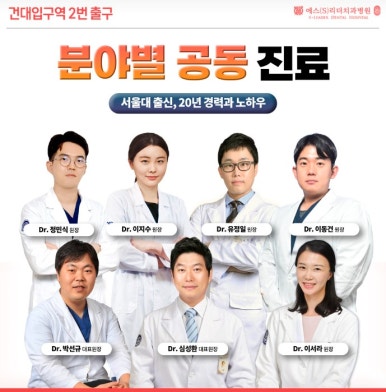

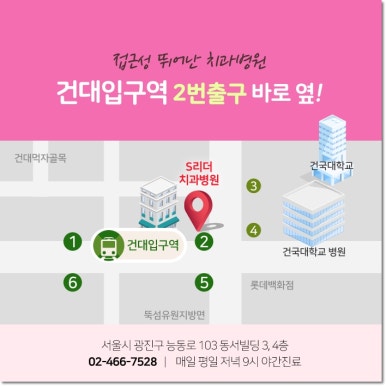
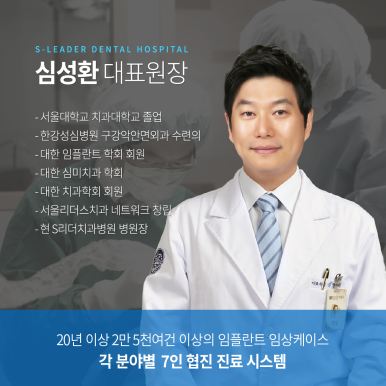

Konkuk University Entrance Dental Clinic :: S Leader Dental Hospital