Hello, this is S Leader Dental Hospital, a dental clinic near Sagaejeong Station that is celebrating its 22nd anniversary this year.
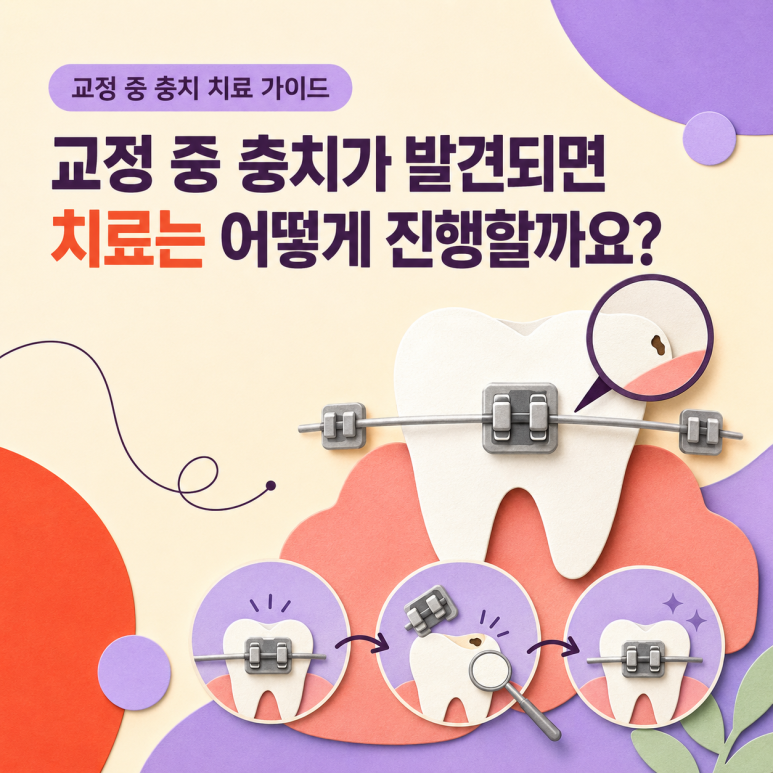
When you begin orthodontic treatment, you look forward to straighter teeth and a balanced bite. However, because orthodontic treatment does not finish quickly, cavities may sometimes be found during the process.
In particular, when fixed orthodontic appliances are attached, food particles and plaque can easily remain around the brackets and wires. Since there are also many areas that are difficult for a toothbrush to reach, more thorough oral care is needed than before orthodontic treatment.
If a cavity is found during a regular checkup, you may have the following concerns.
“Do all of the orthodontic appliances need to be removed?”
“Will orthodontic treatment be stopped because of cavity treatment?”
“Is it okay to receive cavity treatment while my teeth are being moved?”
“Can the orthodontic appliances be attached again after treatment?”
The discovery of a cavity during orthodontic treatment does not necessarily mean that all appliances must be removed or that treatment must be restarted from the beginning. Depending on the cavity’s location and depth and the type of orthodontic appliance being used, cavity treatment can often proceed while adjusting only the necessary areas.
Today, S Leader Dental Hospital near Sagaejeong Station will explain in detail why cavities may be found during orthodontic treatment, treatment methods according to the extent of cavity progression, whether appliances need to be removed, and how to care for the treated area afterward.
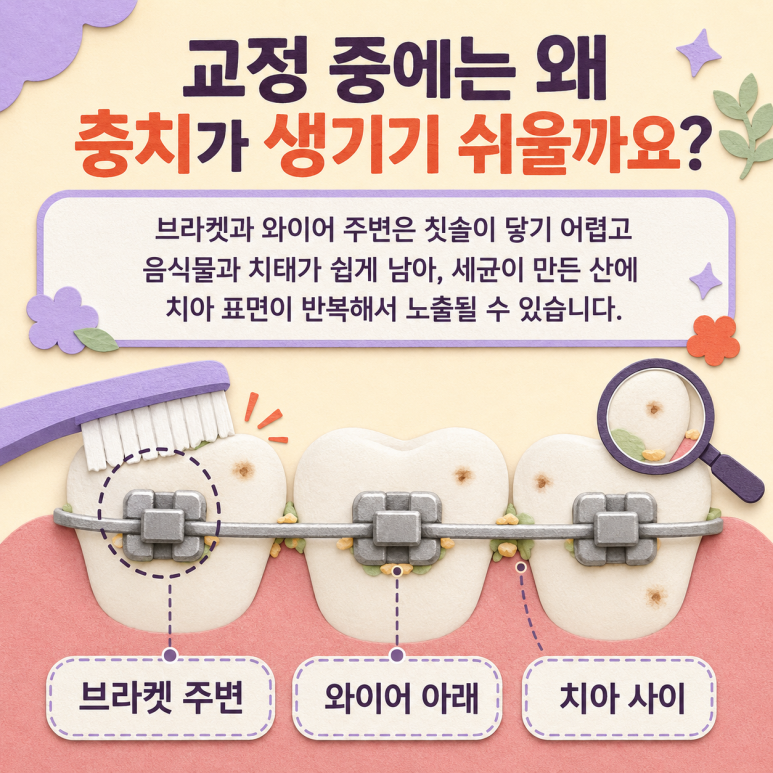
Why are cavities more likely to develop during orthodontic treatment?
Fixed orthodontic appliances work by attaching brackets to the tooth surfaces and connecting them with wires to gradually move the teeth.
Because the brackets and wires cover parts of the tooth surfaces, brushing becomes more complicated than it was before the appliances were attached.
Food particles and plaque can easily remain in the following areas.
-
Above, below, and on both sides of the brackets
-
Between the brackets and gums
-
Under the wires
-
Between the teeth
-
Around orthodontic bands on the molars
-
Between crooked or overlapping teeth
-
Around orthodontic elastics or auxiliary appliances
Bacteria in plaque use the sugars in food to produce acids. When this acidic environment is repeated, minerals can be lost from the tooth surface, causing early demineralization. If left unmanaged, it may progress into an actual cavity.
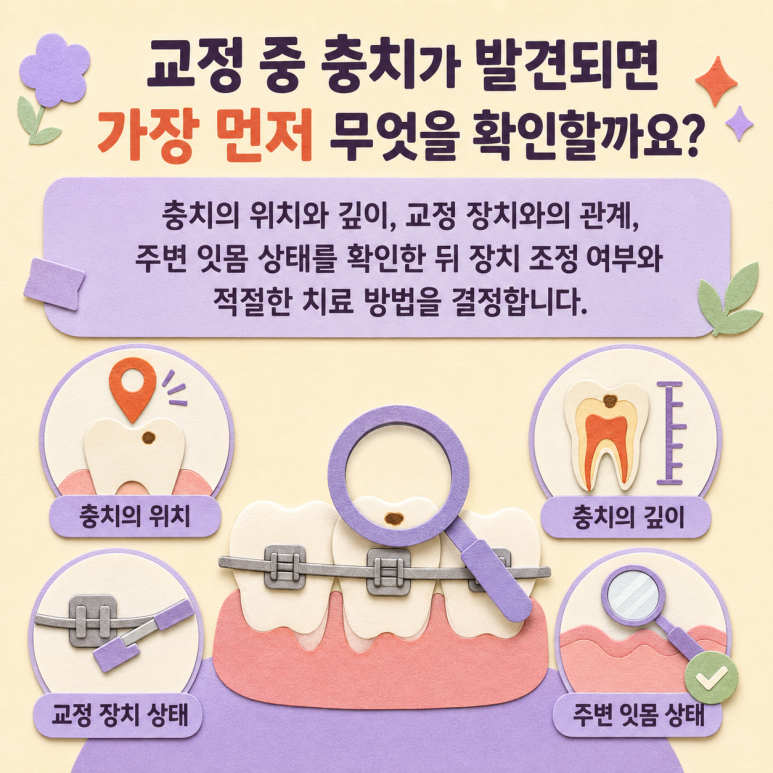
What is checked first when a cavity is found during orthodontic treatment?
Not all cavities are treated in the same way. First, the location and depth of the cavity and the condition of the surrounding orthodontic appliances must be checked.
Location of the cavity
If the cavity is in an area away from the bracket, it may be treated immediately without touching the appliance. On the other hand, if the cavity is beneath the bracket, in an area covered by the wire, or between the teeth, part of the appliance may need to be temporarily removed to secure enough space for treatment.
Extent of cavity progression
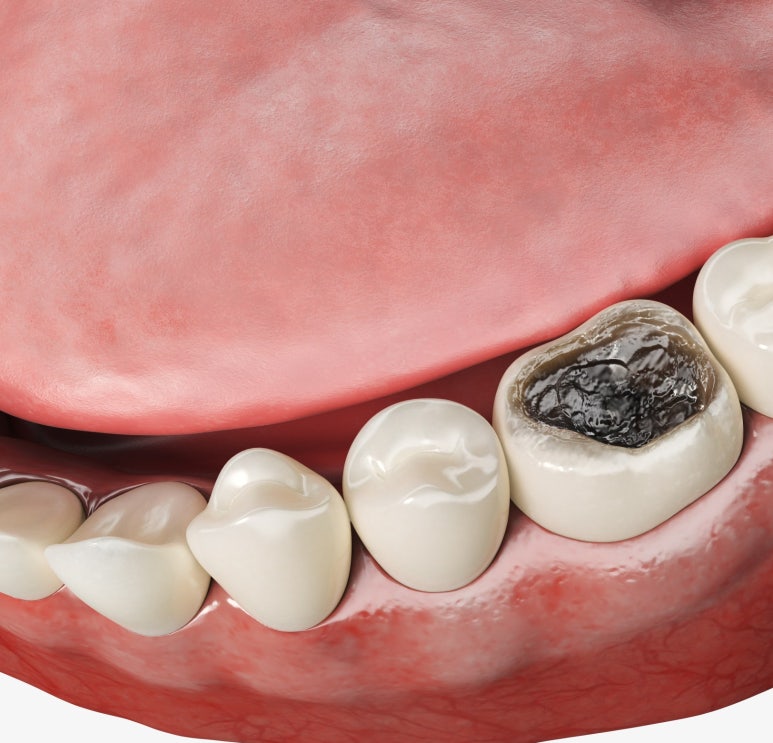
It is necessary to determine whether the tooth surface has only changed color in an early stage or whether an actual hole has formed inside the tooth. The treatment area also varies depending on whether the cavity has progressed close to the nerve.
Current stage of tooth movement
The direction in which the tooth is moving, whether an extraction space is being closed, and whether elastics or auxiliary appliances are being used on the tooth are also taken into consideration.
Condition of the surrounding gums
If the gums around the cavity are swollen or bleeding, or if tartar has accumulated, gum care and scaling may also be necessary.
Type of orthodontic appliance being used
The cavity treatment process and the method of adjusting the orthodontic appliance may vary depending on whether fixed brackets or clear aligners are being used.
When necessary, the area between the teeth, beneath restorations, and the depth of the cavity may be checked through radiographic imaging in addition to a visual examination.
Does an early cavity need to be drilled right away?
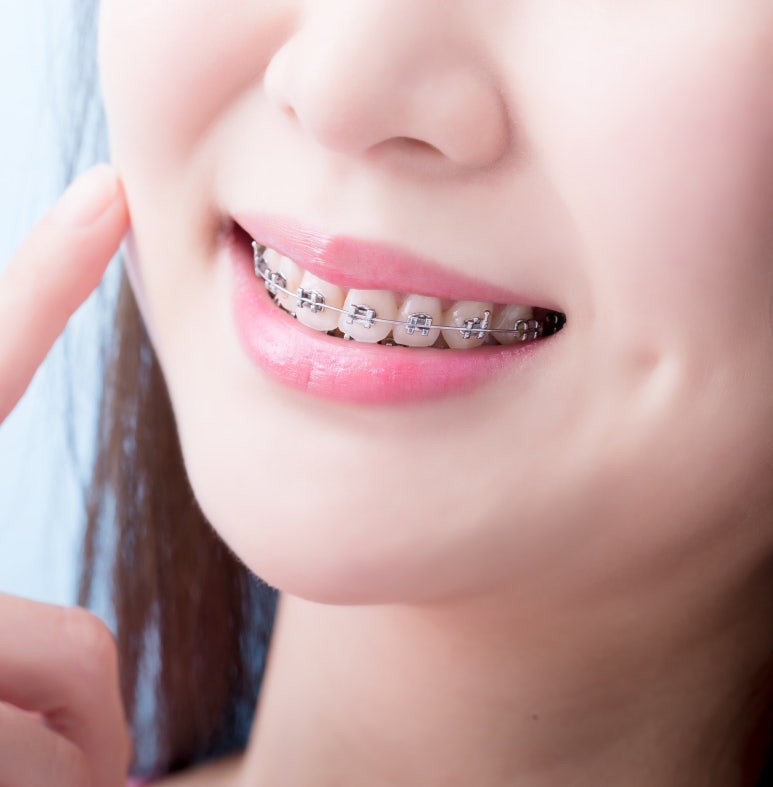
If white, opaque spots appear around a bracket, this may be early demineralization, in which minerals have begun to be lost from the tooth surface.
Because early demineralization occurs before a hole forms in the tooth, depending on the condition, its progression may be controlled through the following methods rather than immediately removing tooth structure for treatment.
-
Thorough plaque removal
-
Using fluoride toothpaste
-
Professional fluoride application at the dental clinic
-
Reducing the intake of sugary foods and acidic drinks
-
Using an appropriate orthodontic toothbrush
-
Regular oral examinations
-
Remineralization treatment when necessary
However, not all white spots indicate the same condition. If the surface is rough or a small hole has already formed, restorative treatment may be necessary, so the exact condition should be checked at a dental clinic.
What is the best way to treat a small cavity?
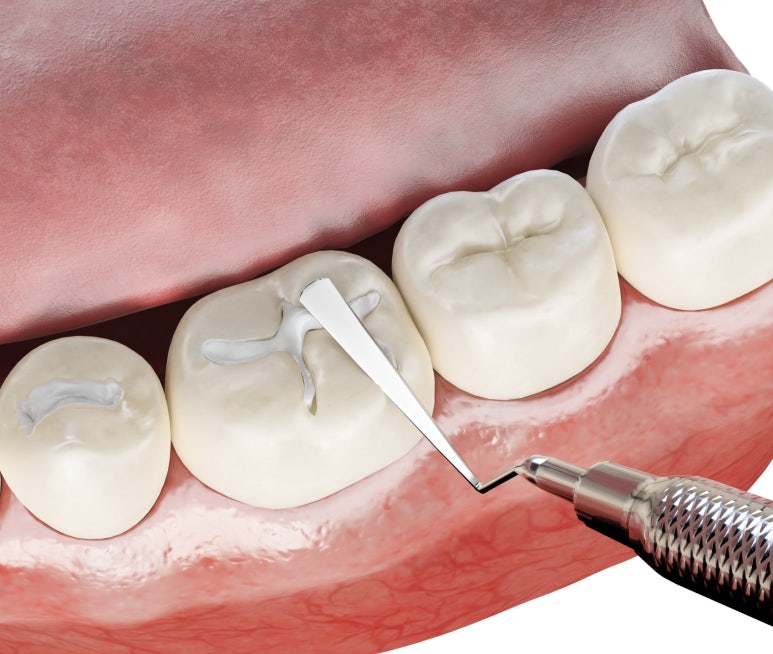
If the cavity is limited to part of the enamel or dentin, the decayed area can be removed and filled with a material such as composite resin.
If the cavity is located away from the bracket or wire and the treatment instruments can reach it sufficiently, treatment may be performed without removing the orthodontic appliance.
For example, if there is a small cavity on the chewing surface of a tooth or on the inner surface where there is no orthodontic appliance, treatment may be possible while leaving the appliance in place.
After treatment, the following points are checked.
-
Whether any decay remains
-
Whether the height of the resin is appropriate
-
Whether the upper and lower teeth come together naturally
-
Whether the restoration interferes with the orthodontic appliance or wire
-
Whether the shape makes it likely for food to become trapped
If the height of the treated area is not properly adjusted, it may cause discomfort when chewing or transmit unnecessary force to teeth undergoing orthodontic movement. Therefore, the bite must be checked carefully.
What should be done if a cavity develops around a bracket?
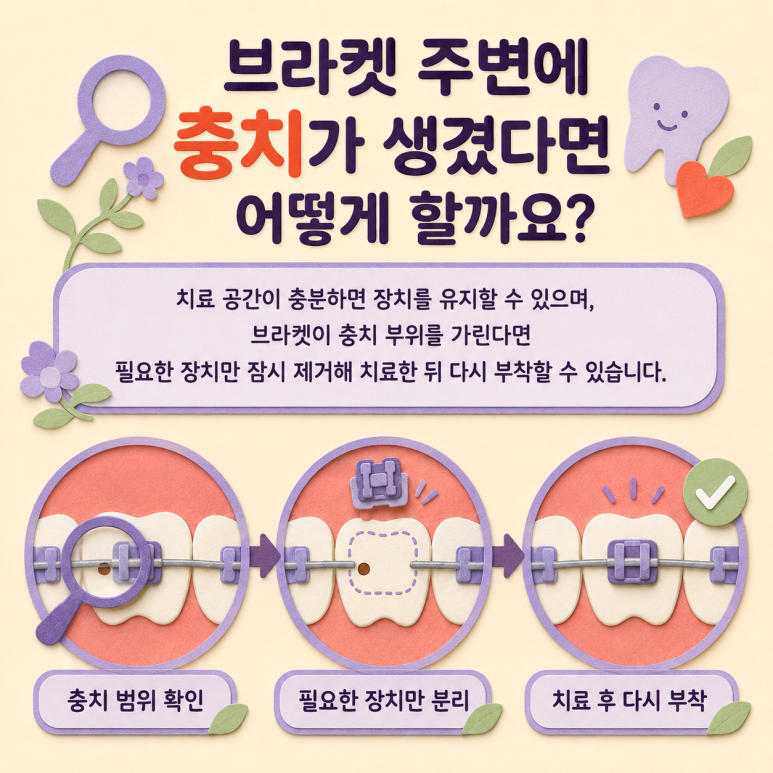
Even if a cavity is immediately next to a bracket, treatment may be possible while keeping the bracket in place if there is enough space.
However, if the cavity extends beneath the bracket or the bracket makes it difficult for treatment instruments to reach the area, that bracket may be temporarily removed.
The general process is as follows.
-
Detach the orthodontic wire or other necessary appliance.
-
Remove the bracket from the tooth with the cavity.
-
Clean away any remaining adhesive and determine the extent of the cavity.
-
Remove the decayed area and perform restorative treatment.
-
Check the shape and bite of the treated tooth.
-
Reattach the bracket when appropriate.
-
Reconnect the wire and continue orthodontic treatment.
Rather than removing all orthodontic appliances at once, it is often possible to temporarily detach only the parts that are necessary.
However, if a large area has been treated or a new restoration is needed, the bracket may be reattached after the restoration has stabilized.
How are cavities between the teeth treated?
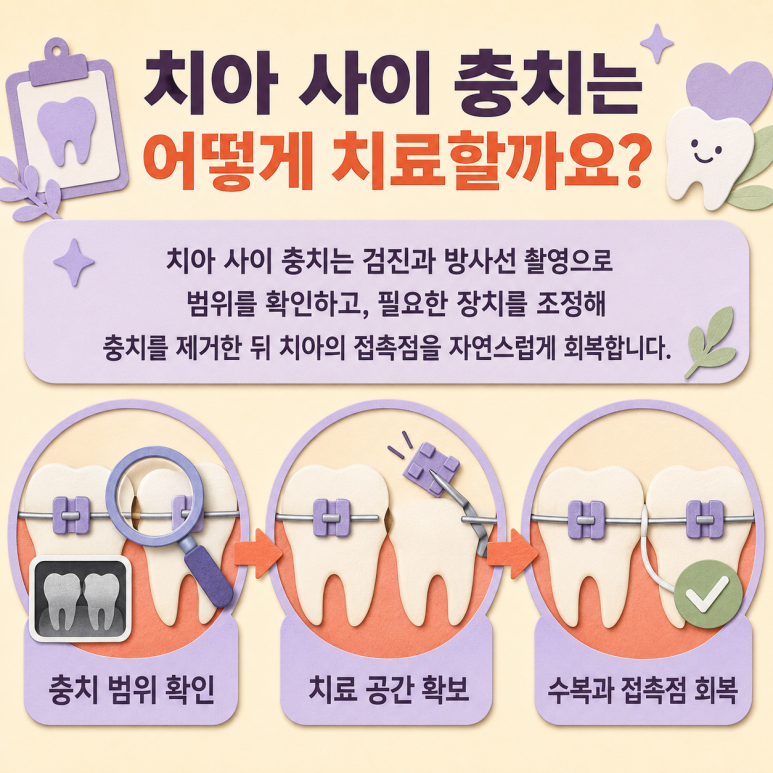
During orthodontic treatment, food particles and plaque can easily remain between the teeth. In particular, when teeth overlap or are unevenly aligned, cavities between the teeth may be difficult to detect visually.
Interproximal cavities may also be found through radiographic examination. If treatment is necessary, the wire or bracket in that area may be temporarily adjusted to provide access to the cavity.
After the cavity is removed, the contact point between the teeth must be restored naturally. If the contact is too loose, food may repeatedly become trapped, while if it is too tight, flossing may become difficult.
Because the treatment may affect the subsequent tooth-movement plan, it is important for the clinicians responsible for cavity treatment and orthodontic treatment to share the treatment plan.
If you have these symptoms, get checked for cavities
If you have any of the following symptoms, it is advisable to have your condition checked rather than waiting until your next regular orthodontic appointment.
-
A particular tooth repeatedly feels sensitive to cold water or sugary foods
-
One side of your teeth hurts when chewing food
-
You see black spots or brown areas on the tooth surface
-
White spots have appeared around a bracket
-
Food repeatedly becomes trapped between the teeth
-
Floss catches or tears when you use it
-
Toothache interferes with your sleep at night
-
A small pocket of pus has formed on the gums
-
You notice an unpleasant taste or odor from a particular tooth
-
Pain keeps recurring even after taking pain medication
Temporary soreness after an orthodontic adjustment is often felt generally across several teeth.
In contrast, pain caused by a cavity may recur in a particular tooth or respond to temperature, sugar, or chewing stimulation.
However, it is difficult to distinguish the cause accurately based on symptoms alone, so the cause should be confirmed through an examination.
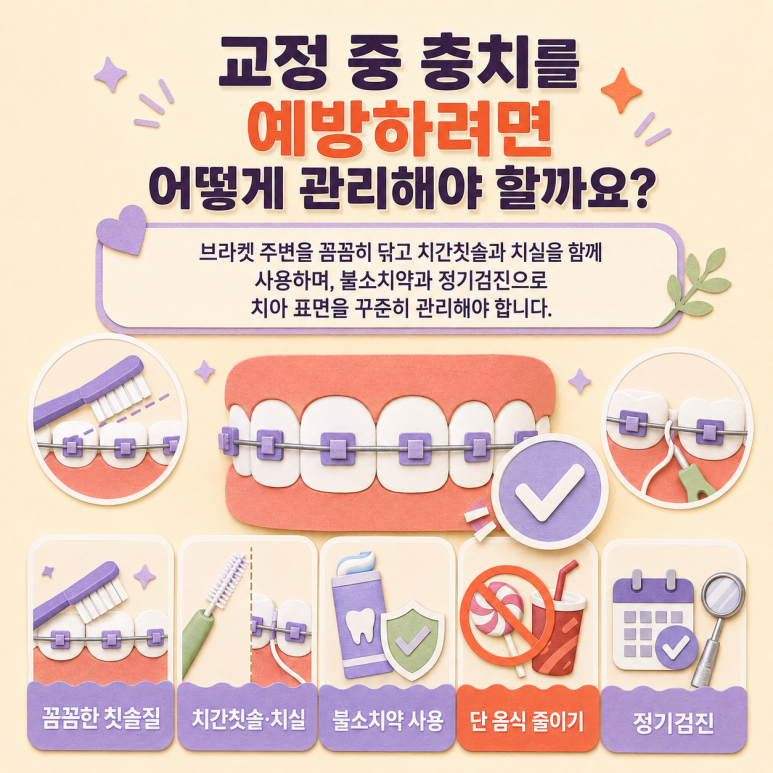
How should you manage your teeth to prevent cavities during orthodontic treatment?
1. Brush above and below the brackets separately
Angle the toothbrush slightly against the upper and lower sides of the brackets and brush with small movements. Be sure to clean not only the tooth surfaces but also the areas between the brackets and gums.
2. Use an orthodontic toothbrush together with an interdental brush
It may be difficult to clean sufficiently beneath the wires and along the sides of the brackets with a regular toothbrush alone. Carefully insert an interdental brush beneath the wire to remove remaining food particles and plaque. If the interdental brush is too large, it may injure the gums, so it is advisable to receive guidance on the appropriate size.
3. Use flossing aids
If fixed wires make it difficult to insert regular floss, you can use orthodontic floss or aids such as floss threaders. Because cavities between the teeth are difficult to see, consistent flossing is important.
- Use fluoride toothpaste
Fluoride helps remineralize teeth and can help prevent cavities. You may be advised not to rinse too many times with water after brushing so that some toothpaste ingredients remain. The type of toothpaste and how fluoride should be used may vary depending on age and oral condition, so follow your dental professional’s instructions.
5. Reduce the frequency of eating sugary foods
Cavity risk is related not only to the amount of sugary food eaten at one time but also to the habit of eating it frequently.
Frequently consuming small amounts of candy, gummies, chocolate, soft drinks, or sweet coffee may lengthen the amount of time the mouth remains acidic. It is beneficial to reduce the number of snacks and develop the habit of rinsing your mouth with water or brushing your teeth after eating.
6. Have regular cavity checkups and scaling
Even if you visit an orthodontic clinic regularly, separate general oral examinations to check for cavities and assess gum health may also be necessary.
Take thorough care of your oral health during orthodontic treatment
Together with S Leader Dental Hospital near Sagaejeong Station
The discovery of a cavity during orthodontic treatment does not mean that all orthodontic appliances must be removed or that treatment must be restarted from the beginning.
Small cavities can be treated while leaving the appliance in place. If a bracket or wire covers the treatment area, only the necessary part can be temporarily detached before cavity treatment. If the cavity is deep, root canal treatment and restorative treatment may be necessary. In this process, the current tooth-movement status and the future orthodontic plan must be considered together.
Most importantly, do not leave a cavity untreated after it is discovered. If treatment is postponed out of concern that the orthodontic period may be extended, the cavity may become deeper, potentially increasing the scope and duration of treatment instead.
S Leader Dental Hospital near Sagaejeong Station examines not only the orthodontic appliances and tooth-movement status but also the condition of cavities and gums. When necessary, we coordinate the schedules for orthodontic treatment and general dental care and provide treatment plans tailored to each patient.
If a particular tooth feels sensitive or painful during orthodontic treatment, or if you notice white spots or black spots around a bracket, do not dismiss them as simple appliance discomfort; please have the condition accurately checked.



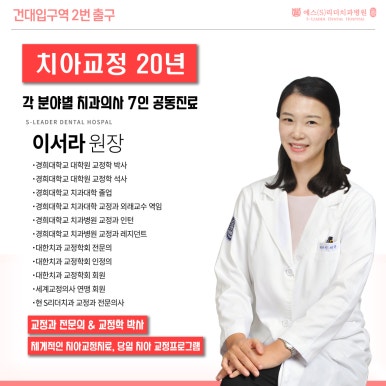
Sagaejeong Station Dental Clinic :: S Leader Dental Hospital.