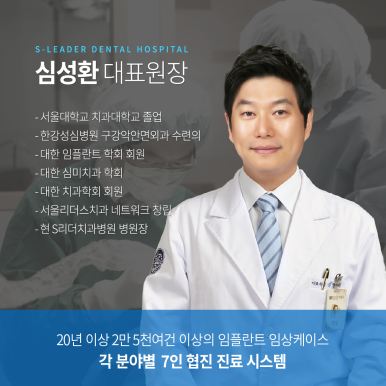
Hello, I am Shim Seong-hwan from S Leader Dental Hospital, a Seongdong-gu dental clinic celebrating its 22nd anniversary this year.

Dental implants are a treatment that helps restore chewing function and appearance by replacing missing teeth. Unlike natural teeth, implants do not develop cavities, but that does not mean they require no additional care after treatment.
In fact, because the long-term maintenance of an implant is significantly affected by the health of the surrounding gums and alveolar bone, consistent care is important.
However, while using an implant, you may notice an unpleasant odor coming from the area or a smell that differs from usual when brushing or flossing.
This may simply be a temporary issue caused by food getting stuck. However, if the odor keeps recurring along with symptoms such as gum bleeding, swelling, or pain, it is necessary to check the condition of the tissues around the implant.
Today, S Leader Dental Hospital, a Seongdong-gu dental clinic, will take a detailed look at what causes odors around implants and how they may be related to inflammation around an implant.
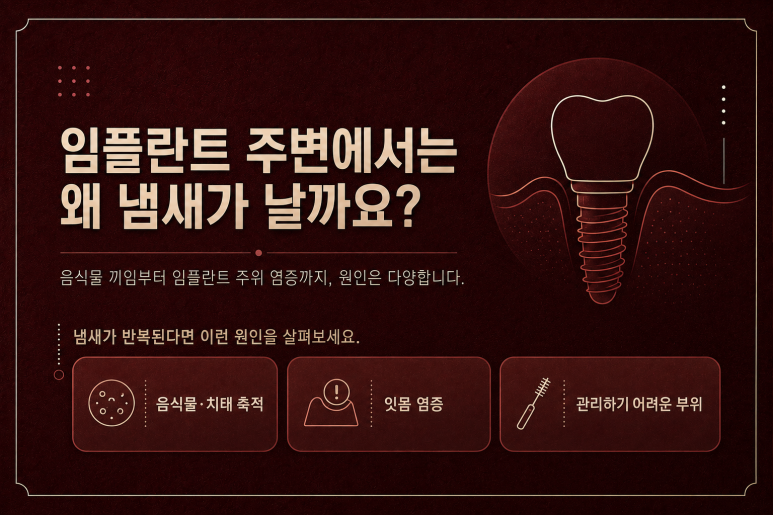
Why can an odor develop around an implant?
An odor around an implant does not necessarily mean that inflammation has developed.
One possible cause is the accumulation of food debris and plaque around the implant.
Just like natural teeth, implants can have food debris and plaque remain along the tooth–gum margin and between teeth after meals. Depending on the shape of the implant restoration and its contact with neighboring teeth, food may repeatedly become trapped in a particular area.
If these areas are not cleaned sufficiently with a toothbrush alone, food debris and bacteria can remain for a long time and cause an unpleasant odor.
If food frequently becomes trapped between the implant and the gums, or if the odor is particularly strong when you floss, it is a good idea to first check the hygiene of that area.
However, if the odor continues to recur despite careful cleaning, it is also necessary to check whether inflammation has developed in the gums around the implant.
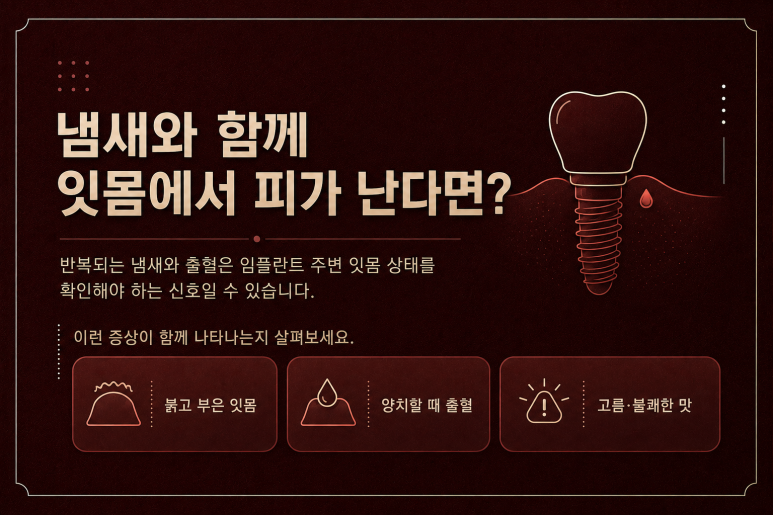
What if your gums bleed along with the odor?
Inflammation around an implant can be considered in terms of two conditions, depending on its progression: peri-implant mucositis and peri-implantitis.
Peri-implant mucositis is a condition in which inflammation develops in the gum tissue surrounding the implant.
Typical symptoms include redness or swelling of the gums and bleeding while brushing or flossing. At this stage, progressive loss of the jawbone supporting the implant has not occurred, so it is important to identify the condition early and manage its causes.
In contrast, peri-implantitis refers to a condition in which the inflammation extends beyond the surrounding gums and affects the alveolar bone supporting the implant.
As peri-implantitis progresses, symptoms may include not only gum bleeding and swelling but also pus, an unpleasant taste, or an odor, and the alveolar bone may gradually be lost. In severe cases, the implant may begin to feel loose.
Therefore, peri-implantitis should not be diagnosed based on odor alone. However, if recurring odor is accompanied by changes such as gum bleeding, swelling, or pus, it is advisable to undergo an examination to identify the cause.
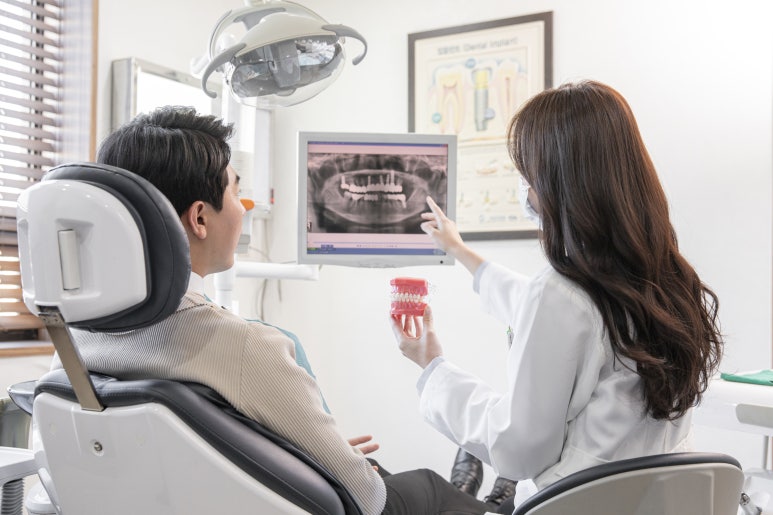
If you have these symptoms, have them checked
Some people believe that implants should not hurt, like teeth that have already undergone root canal treatment, and therefore think that problems may be difficult to notice.
In fact, conditions around an implant may not cause clear discomfort in the early stages, so it is important to observe even small changes in the gums.
Check whether you are experiencing any of the following changes.
✔ An odor repeatedly develops around the implant.
✔ The odor is strong when using floss or an interdental brush.
✔ The gums around the implant bleed frequently.
✔ The gums are redder or more swollen than before.
✔ Pus comes from around the implant, or you notice an unpleasant taste.
✔ Food continues to become trapped in a particular area.
✔ The gums have receded, making the implant look longer than before.
✔ The restoration or implant feels loose.
In particular, if multiple symptoms occur together rather than a single symptom appearing temporarily, or if they do not improve over time, it is best not to regard the issue as simple bad breath.
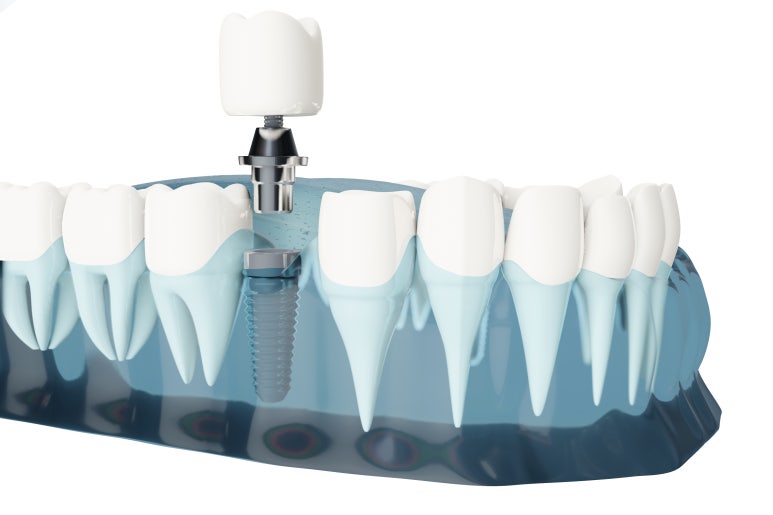
Why does inflammation around an implant develop?
Various factors can contribute to inflammation around an implant, but one of the main causes is inadequate management of plaque.
When plaque and bacteria continue to accumulate around an implant, an inflammatory response may develop in the gums.
In particular, the shape of the restoration may make certain areas around an implant difficult to clean with a regular toothbrush alone. It is therefore important to use floss, interdental brushes, and other cleaning tools appropriately.
In addition, a history of periodontal disease, inadequate oral hygiene, smoking, and uncontrolled diabetes may also be associated with the risk of disease around an implant.
Therefore, rather than stopping care simply because implant treatment is complete, implants should be maintained consistently along with your natural teeth.
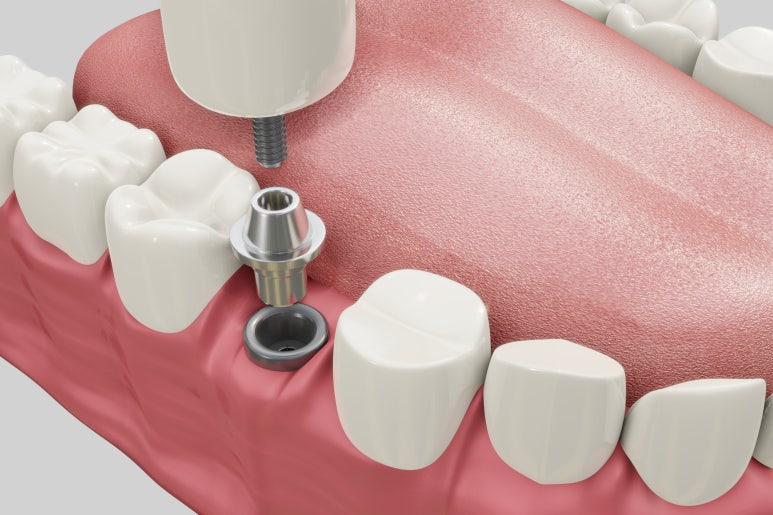
How should you care for it at home if there is an odor?
The basic step is to clean carefully around the implant after meals.
If food cannot be removed by brushing alone, using floss or an interdental brush to clean between the implant and neighboring teeth can also help. However, the size of the interdental space varies from person to person, so be careful not to force an interdental brush that is too large into the space or irritate the gums with excessive pressure.
It is also best to avoid trying to remove tartar around the implant yourself with a sharp instrument simply because there is an odor.
Using mouthwash or bad-breath products alone will not resolve the underlying cause. They may make the odor seem temporarily reduced, but if the cause is trapped food, plaque, or gum inflammation, that cause must be identified and managed.
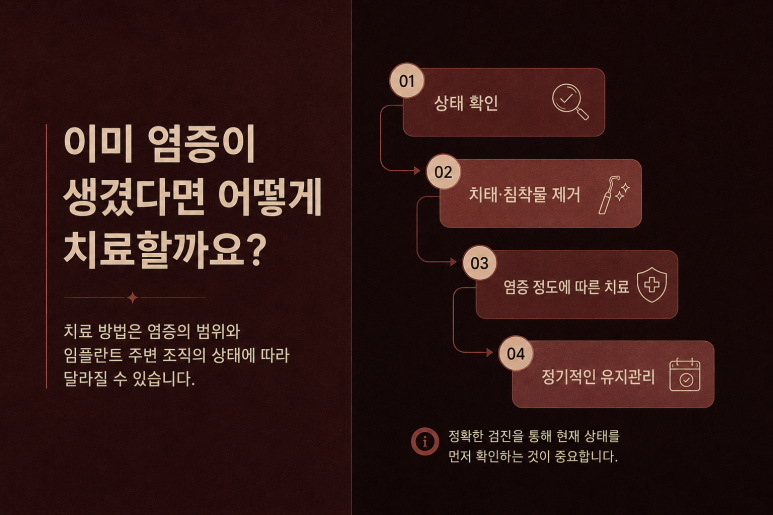
How is it treated if inflammation has already developed?
The treatment method may vary depending on the condition of the tissues around the implant and the extent of the inflammation.
First, the condition of the gums around the implant is examined, and, if necessary, the condition of the bone supporting the implant is also assessed through radiographic imaging and other examinations.
If the inflammation is relatively mild, it is important to remove plaque and deposits accumulated around the implant and improve oral hygiene practices.
On the other hand, if the inflammation has progressed deeply and is accompanied by alveolar bone loss, additional treatment may be required depending on the condition. Because the extent of peri-implantitis and the condition of the surrounding tissues vary from patient to patient, it is difficult to determine the treatment method based solely on symptoms such as odor or bleeding.
Therefore, rather than leaving the symptoms untreated for a long time, the priority is to confirm your current condition through an accurate examination.
S Leader Dental Hospital, a Seongdong-gu dental clinic,
provides ongoing care after implant treatment.
Care after treatment is complete is important for using an implant for a long time.
Although cavities do not develop in the implant itself, inflammatory disease can develop in the surrounding gums and jawbone.
It is advisable to keep the area around the implant clean through proper brushing and the use of floss or interdental brushes, and to have the restoration, gums, and alveolar bone checked regularly at the dentist even if you have no particular discomfort.
At S Leader Dental Hospital, a Seongdong-gu dental clinic, we comprehensively examine the condition of the gums around the implant, the restoration, and the bite relationship, and provide guidance on care methods suited to each patient’s oral condition.
If you have recently noticed a recurring odor around an implant that was not present before, together with gum bleeding or swelling, please have the implant and surrounding tissues checked rather than dismissing it as simple bad breath.
Early detection and consistent care may help maintain the health of the implant and the surrounding gums.




Seongdong-gu Dental Clinic :: S Leader Dental Hospital