Hello, this is S Leader Dental Hospital, a dental clinic in Dongdaemun-gu celebrating its 22nd anniversary this year.
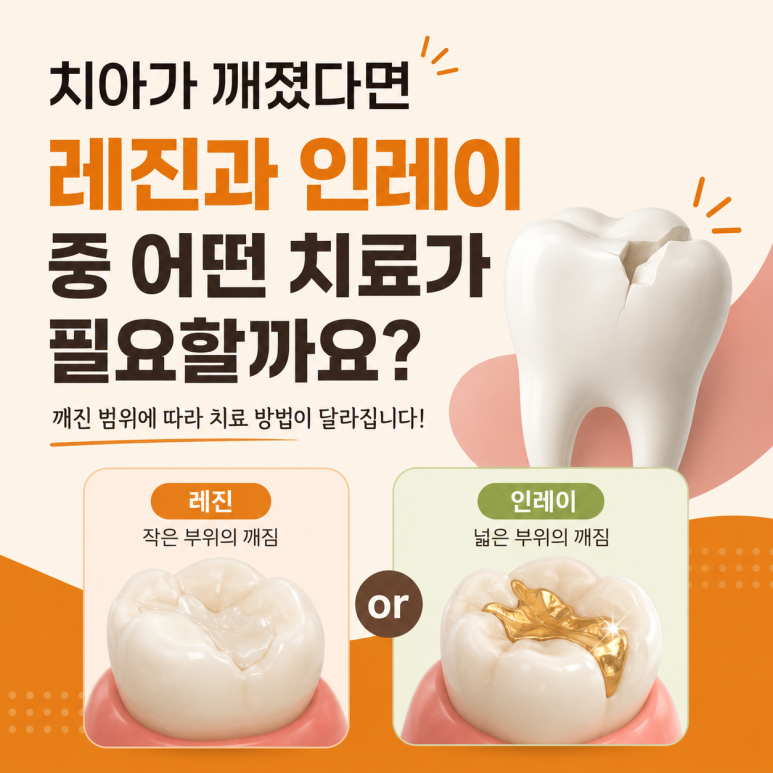
While eating as usual, you may suddenly feel a hard piece in your mouth or notice in the mirror that a small part of one side of a tooth has broken off.
If the tooth is not noticeably badly damaged, you may wonder whether you need to visit the dentist right away.
Especially when there is no pain, it is easy to think, “It looks like only a small piece has chipped off. Would it be okay to leave it as it is?”
However, the treatment needed for a broken tooth is not determined solely by whether there is pain. The treatment method may vary depending on the location and extent of the damage, the amount of tooth structure remaining, whether tooth decay is present, and whether the affected area receives significant chewing forces.
If the damage is relatively limited, resin can be used to restore the tooth’s shape. However, if the damage is extensive or affects an area that receives strong forces, such as a molar, treatment such as an inlay may be considered.
So, when a tooth is broken, what criteria are used to choose between resin and an inlay?
Today, S Leader Dental Hospital, a dental clinic in Dongdaemun-gu, will take a detailed look at the differences between these two treatments and the treatment options for broken teeth.
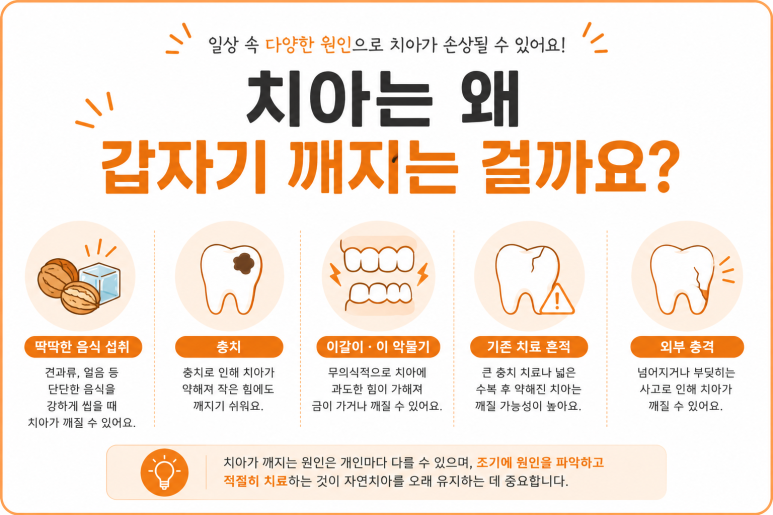
Why Do Teeth Suddenly Break?
Teeth are made of hard tissue, but that does not mean they cannot break under any circumstances.
A tooth may chip while forcefully chewing hard foods such as ice, candy, or nuts. If you habitually clench or grind your teeth, continuous force may be applied to them, increasing the possibility of microscopic cracks or fractures.
Tooth decay can also be a cause. Even if a tooth appears intact on the outside, extensive decay inside the tooth can weaken the remaining tooth structure, causing part of it to break away from the force of chewing alone.
Teeth that have previously received treatment for extensive decay or a large restoration may also become relatively weak depending on the amount of natural tooth structure remaining.
Therefore, when a tooth breaks, it is necessary not only to examine the part that has broken off but also to identify the cause of the damage.
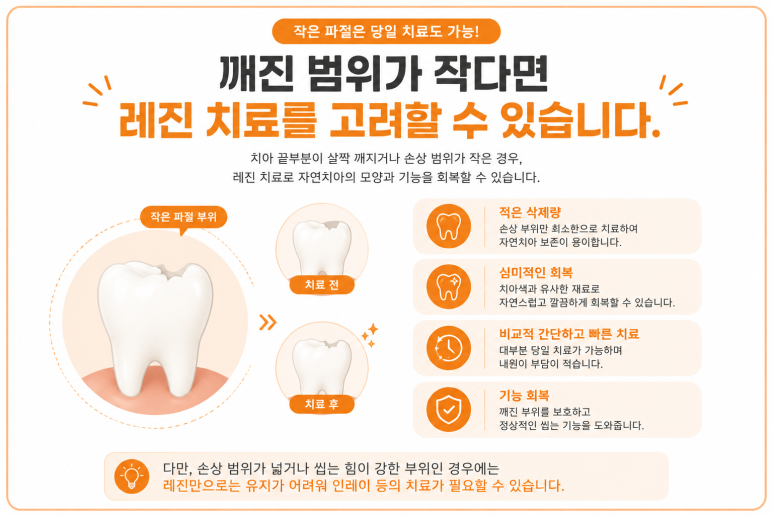
If the Damaged Area Is Small, Resin Treatment May Be Considered
Resin treatment involves directly filling the damaged area and restoring the tooth’s shape using a material similar in color to the tooth.
If a small amount has chipped from the edge of a tooth, the damaged area is relatively limited, and sufficient healthy tooth structure remains around it, resin treatment may be considered.
Because resin is applied to the chipped area and shaped to match the original tooth, relatively little natural tooth structure may need to be removed. Since a tooth-colored material is used, it may also be used for small fractures of the front teeth, where appearance is important.
In some cases, treatment can be completed on the same day depending on the extent of the damage, allowing the tooth’s shape and function to be restored relatively simply.
However, not every broken tooth can be treated with resin.
If the damaged area is extensive or located where strong chewing forces are applied, it may be difficult to maintain a stable shape with resin alone, so other treatment methods may need to be considered.
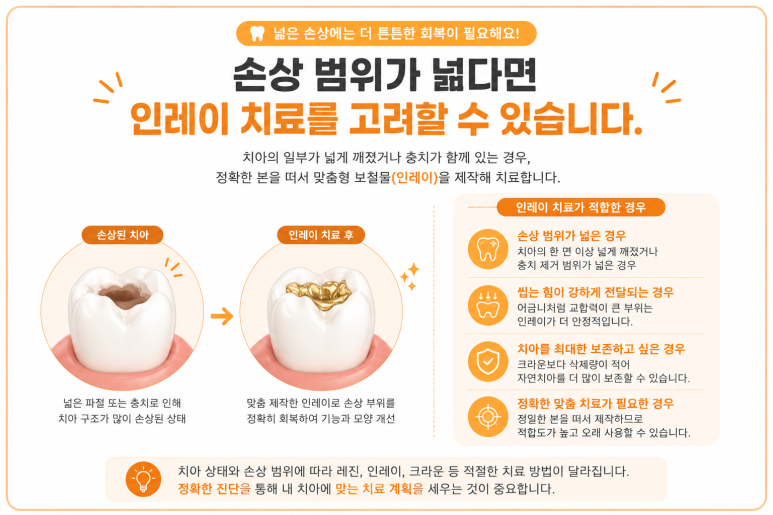
If the Damaged Area Is Extensive, Inlay Treatment May Be Considered
An inlay involves removing the damaged or decayed portion and bonding a restoration made to fit the shape of the tooth.
It may be considered when a certain amount of tooth structure has been damaged in an area that receives continuous force while crushing food, such as the chewing surface of a molar.
For example, if part of a molar breaks and existing decay is also found, or if a large amount of tooth structure needs to be removed, an inlay may be selected after considering the condition of the remaining tooth and the forces generated by the bite rather than simply filling the area with resin.
An inlay also focuses on treating the damaged portion, so it differs from a crown, which covers the entire tooth.
However, there is no uniform standard for exactly how much damage requires an inlay. Even if two teeth appear to have chipped by the same amount, the appropriate treatment may differ depending on the tooth’s location, the thickness of the remaining tooth walls, and the chewing forces involved.
What Is the Difference Between Resin and an Inlay?
The greatest difference between the two treatments lies in the extent of the tooth damage and the way the tooth is restored.
Resin is a direct restoration method in which the material is applied directly to the damaged area and shaped. It is often used for relatively small fractures or areas of decay.
An inlay, on the other hand, involves shaping the damaged tooth and fabricating a restoration to fit it, which is then bonded to the tooth. It may be used when the damage is relatively extensive for resin restoration or in molars where chewing forces need to be taken into account.
Therefore, it is difficult to say that one is unconditionally better by asking questions such as, “Is resin the better treatment?” or “Is an inlay stronger?”
The important thing is to choose an appropriate method by considering the natural tooth structure that remains as much as possible, along with the forces the tooth will receive in the future.
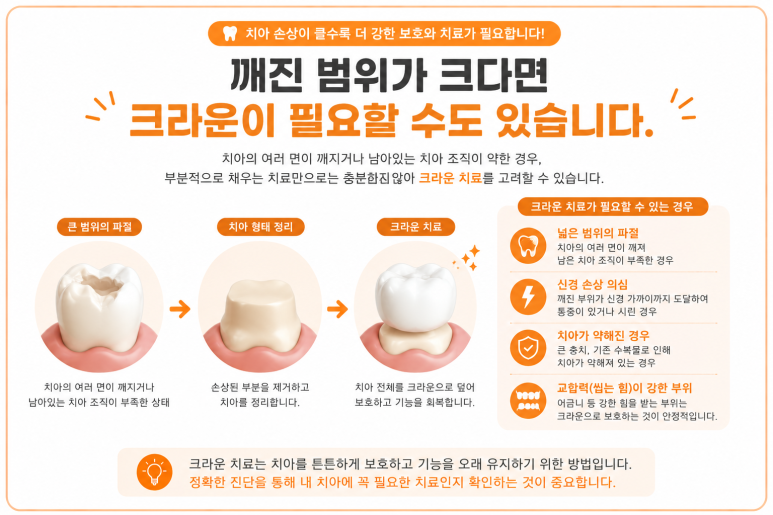
If the Damage Is Extensive, a Crown May Be Necessary
Treatment for a fractured tooth does not consist only of resin and inlays.
If multiple surfaces of the tooth are damaged because the fracture is extensive, or if the remaining tooth walls are weak, treatment that only partially fills the tooth may not be sufficient.
In such cases, crown treatment, which surrounds and protects the entire tooth, may be considered.
In particular, if the damage has progressed close to the nerve inside the tooth or severe pain occurs, the condition of the nerve must also be checked. If inflammation or damage has occurred in the nerve tissue, root canal treatment followed by a crown may be necessary to protect the tooth.
Conversely, if a crack or fracture extends deep into the root, there may be situations in which preserving the tooth is difficult, making an accurate examination important.
Ultimately, the treatment method should not be determined simply by the visible size of the chip. It must be decided after examining the tooth’s overall condition, including the inside of the tooth and the root.
Is It Okay to Wait a Little If There Is No Pain?
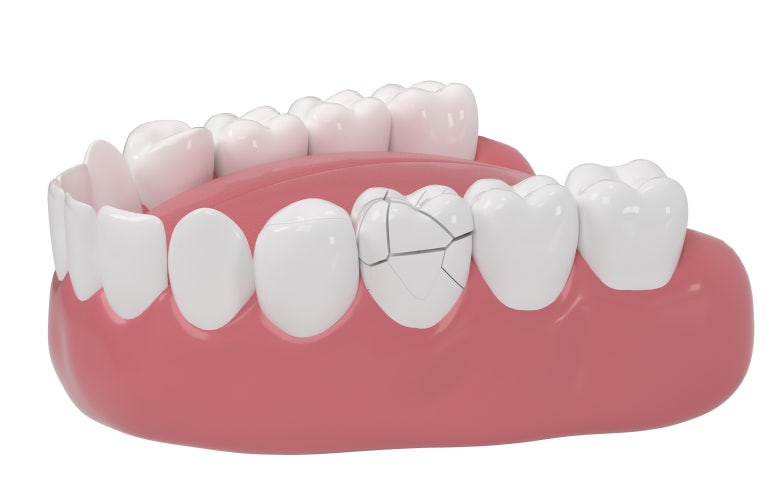
When a tooth is broken but does not hurt, it is easy to postpone treatment. However, the absence of pain does not necessarily mean that there is no problem inside the tooth.
A small chip may become larger over time, and food particles and bacteria may accumulate around rough areas or through microscopic gaps, potentially leading to tooth decay.
Molars receive strong chewing forces repeatedly every day. If these forces continue to be applied to an already weakened tooth, the extent of the fracture may increase.
A tooth that could initially have been treated within a relatively limited scope with resin or an inlay may require a different treatment approach, such as a crown or root canal treatment, if the damage expands.
Therefore, if you discover that a tooth is broken, it is better to first check the current extent of the damage rather than waiting until pain develops.

Whether Resin or an Inlay Is Needed Depends on the Condition of the Tooth
When a tooth breaks, the question patients are ultimately most curious about is likely, “Can mine be treated with resin, or do I need an inlay as well?”
However, the treatment method is not determined by the size of the chip alone.
The damaged location and extent must be assessed along with whether decay is also present, whether enough natural tooth structure remains, how much chewing force is transmitted to the tooth, and whether the damage extends close to the nerve.
If the fracture is small, the shape may be restored with resin. If the damage is more extensive, an inlay may be considered. If the damage to the tooth structure is even greater, a crown or root canal treatment may be necessary.
At S Leader Dental Hospital, a dental clinic in Dongdaemun-gu, we do not examine only the broken area. We also assess the remaining tooth structure, the presence of decay, the extent of the fracture, and the bite before determining the treatment needed for the tooth’s current condition.
A slightly broken tooth does not automatically require extensive treatment. Conversely, the absence of pain does not mean it is safe to leave the tooth untreated.
Because the treatment required can vary depending on the initial condition of the tooth damage, if you discover a broken area, it is important to check its current condition as soon as possible and choose an appropriate treatment method within the necessary scope while preserving the natural tooth.





Dongdaemun-gu Dental Clinic :: S Leader Dental Hospital