Hello, this is S Leader Dental Hospital, a Jayang-dong dental clinic celebrating its 22nd anniversary this year.
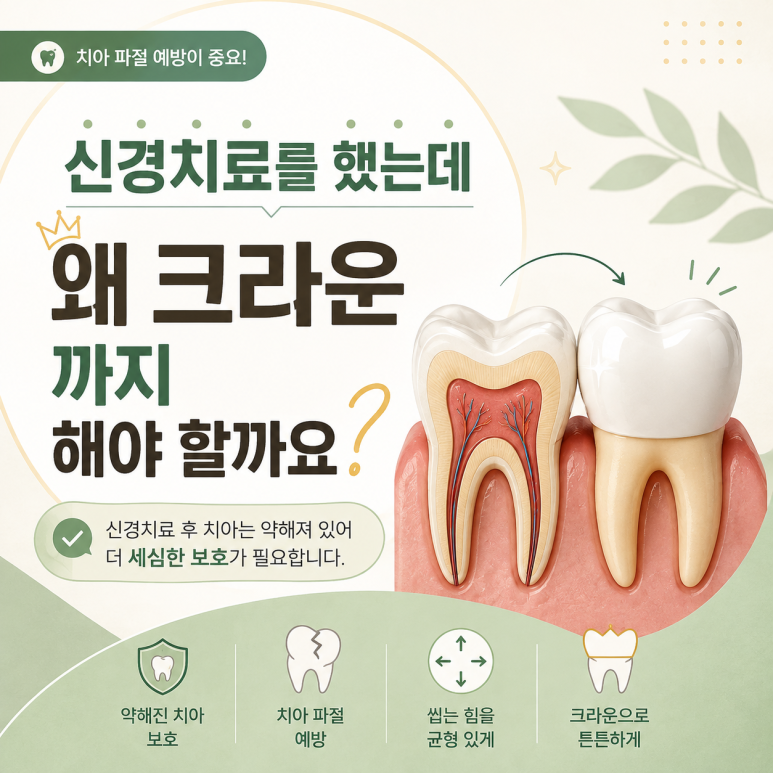
Some people visit the dentist because of severe tooth pain and are told that root canal treatment is necessary. After root canal treatment is completed over several appointments, the pain often becomes much more comfortable.
But just when you think the treatment is over, you may hear:
“Do I need to get a crown now?”
“The root canal treatment is finished, so why do I need more treatment?”
This can understandably feel puzzling.
In particular, if the tooth still appears intact from the outside and the pain has decreased, you may wonder whether it is really necessary to cover the entire tooth.
One important reason for considering a crown after root canal treatment is to protect the remaining tooth structure and reduce the risk of fracture.
Today, S Leader Dental Hospital, a Jayang-dong dental clinic, will explain in detail how a tooth changes after root canal treatment and why crowns are often placed after treatment.
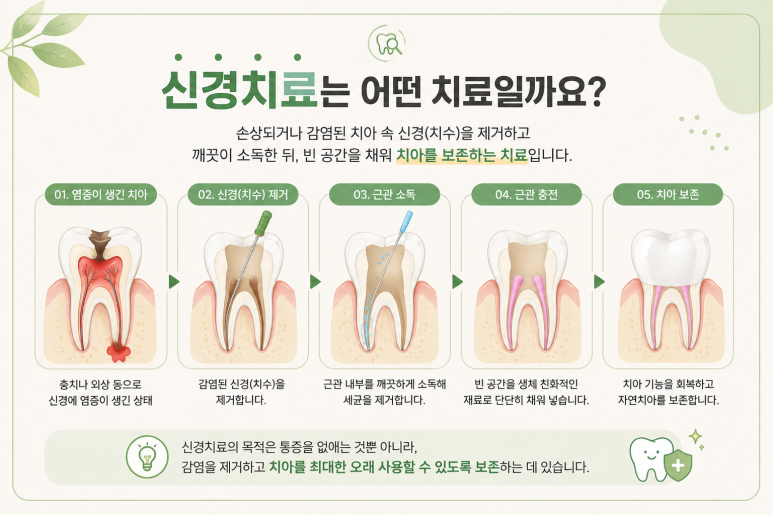
What is root canal treatment?
Inside a tooth is a tissue commonly called the “nerve,” or the dental pulp. The pulp contains not only nerves but also blood vessels and other tissues.
When inflammation develops in the pulp because tooth decay has progressed deeply or the tooth has developed a crack or suffered trauma, severe pain may occur.
Root canal treatment involves removing the damaged pulp, thoroughly cleaning the canals inside the tooth, disinfecting them, and filling them with an appropriate material.
Therefore, the primary purpose of root canal treatment is not simply to eliminate pain.
An important goal is to remove infected tissue and treat the inside of the tooth so that the natural tooth can be preserved whenever possible.
If root canal treatment has been completed successfully, does that mean all treatment is finished?
There is one more thing to examine: the condition of the tooth remaining after root canal treatment.
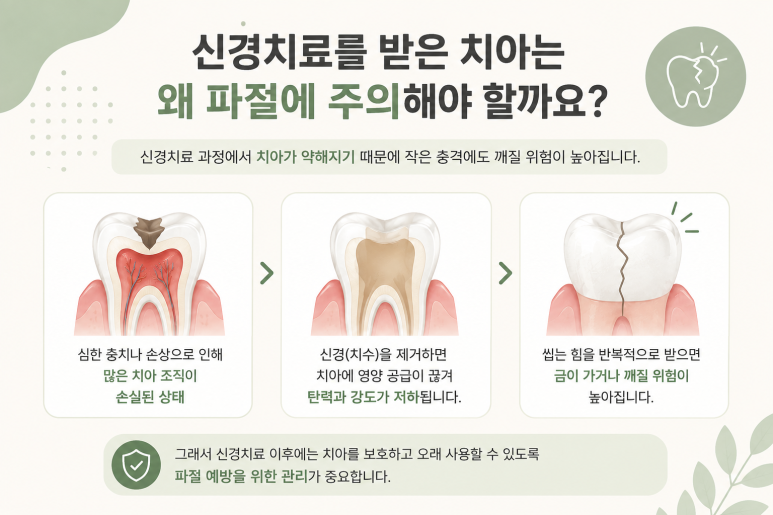
Why should teeth that have undergone root canal treatment be protected against fracture?
Having undergone root canal treatment often means that the tooth has already experienced a significant problem.
A typical example is tooth decay that has progressed deep into the tooth, making root canal treatment necessary.
When deep decay is removed, the damaged tooth structure must also be removed. As a result, less tooth structure may remain when treatment is complete than was originally present.
In addition, a passage must be created in the upper part of the tooth to access the canals inside it during root canal treatment.
In other words, the loss of tooth structure caused by the original decay and the removal of tooth structure needed for root canal treatment may occur together, meaning that the treated tooth may be structurally weakened.
Molars, in particular, receive strong chewing forces repeatedly during every meal.
If the remaining tooth walls are thin or the tooth has undergone treatment for decay over a wide area, the risk of part of the tooth chipping or cracking while chewing hard or tough foods may increase.
Therefore, after root canal treatment, it is important not to simply think, “The nerve has been removed, so everything is fine.” It is also important to consider how the tooth will be protected in the future.
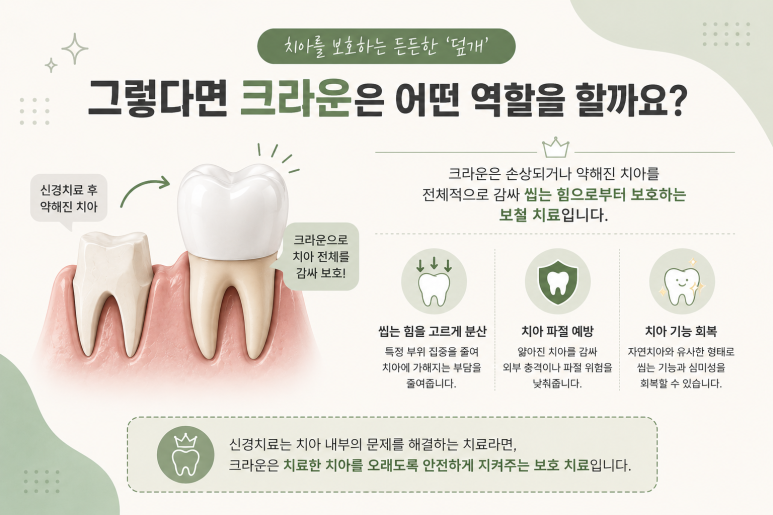
What role does a crown play?
A crown is a prosthetic restoration that protects a damaged tooth by covering its outer surface completely.
Simply put, it can be thought of as creating a protective covering around the outside of a weakened tooth.
Placing a crown on a tooth that has undergone root canal treatment helps reduce the concentration of chewing forces on a particular area and allows those forces to be distributed more stably across the tooth.
In particular, when the remaining tooth walls are thin, chewing forces can cause the walls to flex outward and break.
Because a crown surrounds the tooth as a whole, it can help reduce this movement and prevent tooth fracture.
Ultimately, root canal treatment is a process that treats a problem inside the tooth, while a crown protects the treated tooth from the outside so that it can continue to be used. Understanding the two this way may make their relationship easier to understand.
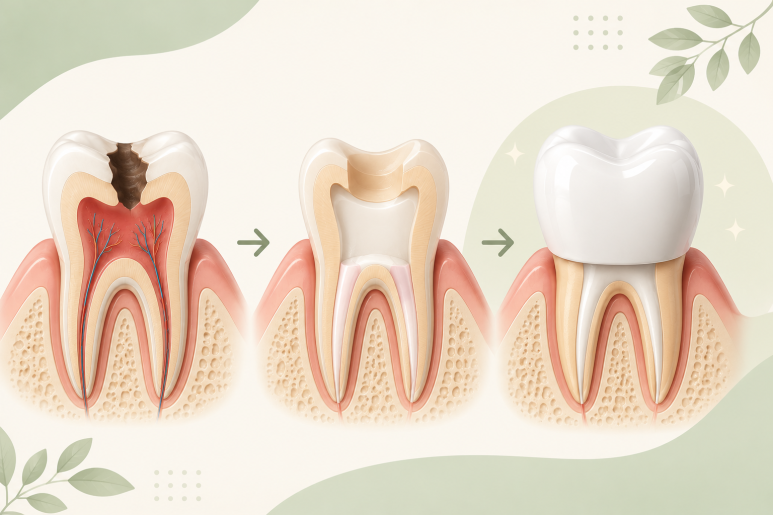
What happens if a crown is not placed after root canal treatment?
This does not mean that a tooth without a crown will necessarily break simply because it has undergone root canal treatment.
However, if only a small amount of tooth structure remains and the tooth receives substantial chewing forces, the possibility of fracture over time should be considered.
At first, there may be no particular discomfort.
However, repeated forces during eating can cause tiny cracks in the thin remaining tooth walls, and at some point, part of the tooth may break significantly while chewing hard food.
The treatment options may vary depending on how far the tooth has fractured.
If the fracture is relatively small, the tooth may sometimes be preserved through retreatment, a crown, or another restoration.
However, if a crack or fracture line extends deep into the root, it may become difficult to save the tooth.
After going through root canal treatment in an effort to preserve the natural tooth, it can be especially unfortunate if the tooth later fractures extensively.
Therefore, a crown is not simply an additional treatment step. Rather, it serves as protective treatment intended to prevent a tooth preserved through root canal treatment from becoming damaged again.
Crowns are often needed for molars in particular.
One important factor in determining the need for a crown after root canal treatment is the tooth’s location.
This is because the forces received and the roles of front teeth and molars differ when chewing food.
Molars, in particular, are responsible for crushing and chewing food, so they repeatedly receive considerable force.
In addition, when decay in a molar has progressed to the point that root canal treatment is necessary, a substantial amount of tooth structure has often already been lost.
If the tooth is used for a long time without a crown in this condition, continuous forces may be transmitted to the remaining tooth walls, increasing the risk of fracture.
For this reason, after root canal treatment on a molar, a crown is often considered after examining the amount of remaining tooth structure and the condition of the bite.
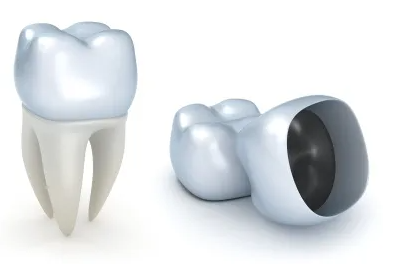
Does every tooth that undergoes root canal treatment require a crown?
Crown treatment is not applied in the same way to every tooth that has undergone root canal treatment.
The decision should be made by considering the tooth’s location, the extent of damage, the amount of natural tooth structure remaining, the size of any existing restoration, whether cracks are present, and the patient’s bite forces as a whole.
For example, the prosthetic treatment needed after treatment may differ between a front tooth with a relatively large amount of tooth structure remaining and a molar with extensive damage.
In addition, if strong forces are repeatedly applied to a particular tooth, such as in people who clench or grind their teeth, the risk of fracture should be assessed especially carefully.
Rather than simply thinking, “A crown is mandatory because I had root canal treatment,” it is important to determine how much of the tooth remains and how much force it will need to withstand in the future before choosing the appropriate treatment.
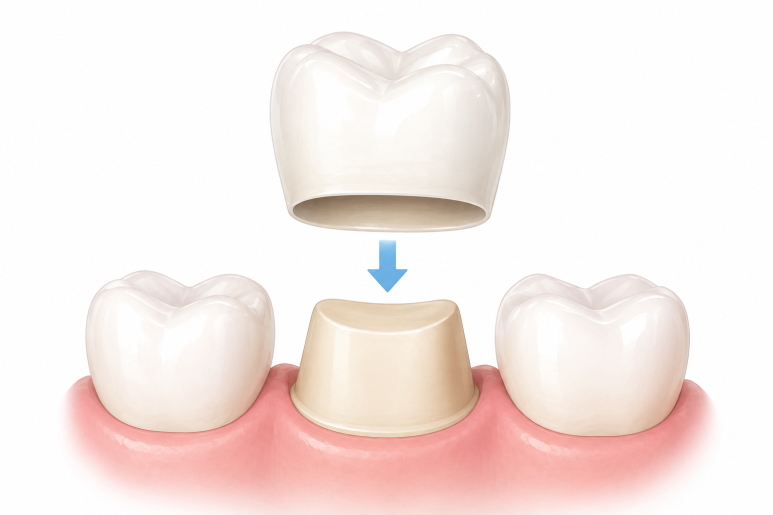
It is also important to check the condition of the tooth before placing a crown.
The important thing after root canal treatment is not only to place the final crown immediately after the procedure is complete.
It is also necessary to check whether symptoms are improving steadily during treatment and whether there are any particular problems in the tissues surrounding the tooth.
In addition, the space created inside the tooth during root canal treatment and the lost tooth structure are appropriately reinforced before the crown is made.
If there is not enough remaining tooth structure, the inside may be reinforced with a material such as a core before the crown is made.
Although root canal treatment and crowns may appear to be separate treatments, they are often connected as one overall treatment process intended to preserve the natural tooth for as long as possible.
Care is still necessary after a crown is placed.
Having a crown does not mean that the tooth can be used for life without any care.
Although cavities do not form on the crown itself, plaque can accumulate at the boundary where the crown meets the natural tooth. If this area is not properly maintained, decay can develop again in the remaining natural tooth.
Therefore, thorough daily care with toothbrushing, dental floss, and interdental brushes is recommended.
Also, repeatedly biting down on ice or very hard foods, or clenching your teeth, can place stress on the tooth and the restoration, so care should be taken.
Because the nerve has been removed from a tooth that has undergone root canal treatment, the way pain is experienced when a new problem develops may differ from before.
Therefore, even if there is no particular pain, it is advisable to have regular examinations to check the crown, the surrounding teeth, and the condition of the gums together.

Protect your tooth for a long time after root canal treatment with S Leader Dental Hospital, a Jayang-dong dental clinic
When root canal treatment is needed because of severe tooth decay or inflammation of the pulp, many people may find it easy to think that all treatment is over as soon as the pain disappears.
However, an important purpose of root canal treatment is not merely to remove the painful nerve, but to preserve the natural tooth as much as possible so that it can continue to be used.
If a significant amount of tooth structure has already been lost, it is also necessary to examine whether the remaining tooth can adequately withstand chewing forces after treatment.
In this situation, a crown is a treatment that may be considered to cover the weakened tooth completely, protect it from external forces, and reduce the possibility of fracture.
After root canal treatment, S Leader Dental Hospital, a Jayang-dong dental clinic, examines the tooth’s location, the amount of remaining tooth structure, the extent of damage, and the condition of the bite before determining what treatment may be needed next.
Rather than stopping treatment on your own because the pain has disappeared after root canal treatment, it is advisable to check whether the current condition of the tooth requires additional protection.
Because a natural tooth has been preserved through difficult treatment, continuing with protection and consistent care afterward can be an important part of using the tooth for a long time.






Jayang-dong Dental Clinic :: S Leader Dental Hospital