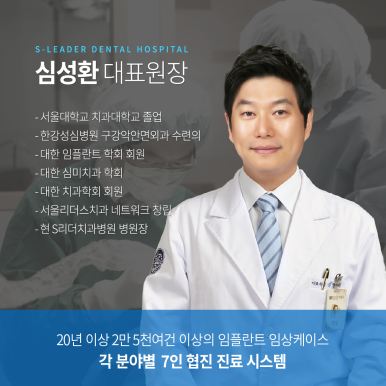
Hello, this is Gwangjang-dong Dental Clinic, S Leader Dental Hospital, which is celebrating its 22nd anniversary this year.
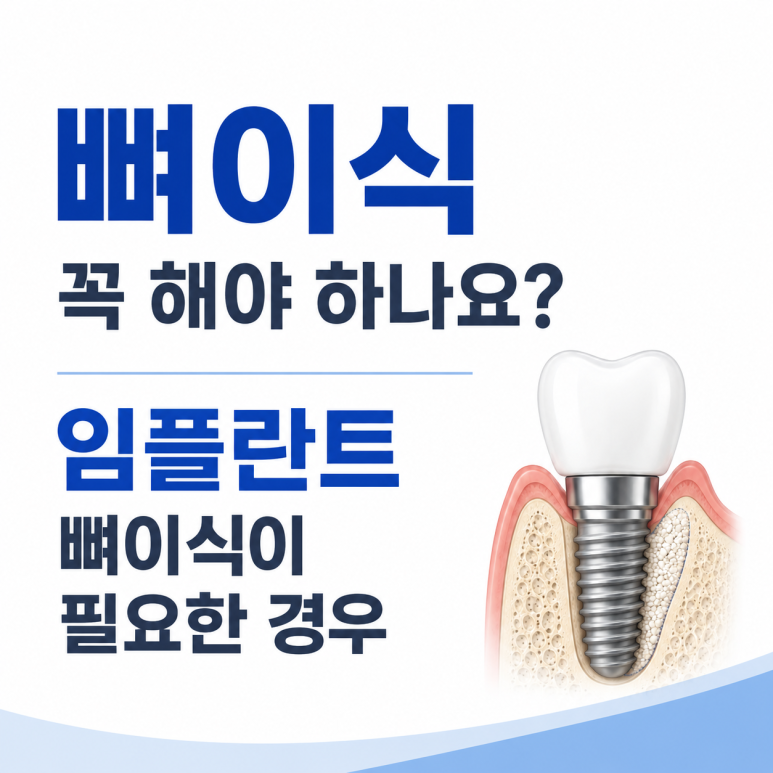
Some people feel surprised and confused when they hear something unexpected during a dental implant consultation.
“I thought I only needed an implant, but they said I also need bone grafting.”
You may know that an implant involves placing an artificial tooth where a tooth is missing. However, when you are told that bone grafting is also needed, you may first worry that the treatment will become more complicated, that the pain will be worse, or that the treatment period will be longer.
You may also wonder, “Is this really a necessary treatment?”—especially when someone else says they received an implant without bone grafting, but you are told that you need it.
To give you the conclusion first, bone grafting is not necessary for every implant patient. If the amount, width, and height of the jawbone are sufficient, implants can often be placed without bone grafting. Conversely, if there is not enough bone to stably support the implant, reinforcing the bone to the necessary extent before proceeding with the implant may be helpful.
Today, Gwangjang-dong Dental Clinic, S Leader Dental Hospital, will take a closer look at bone grafting, a topic that many people have questions about before undergoing implant treatment.
Why Is the Jawbone Important for Dental Implants?
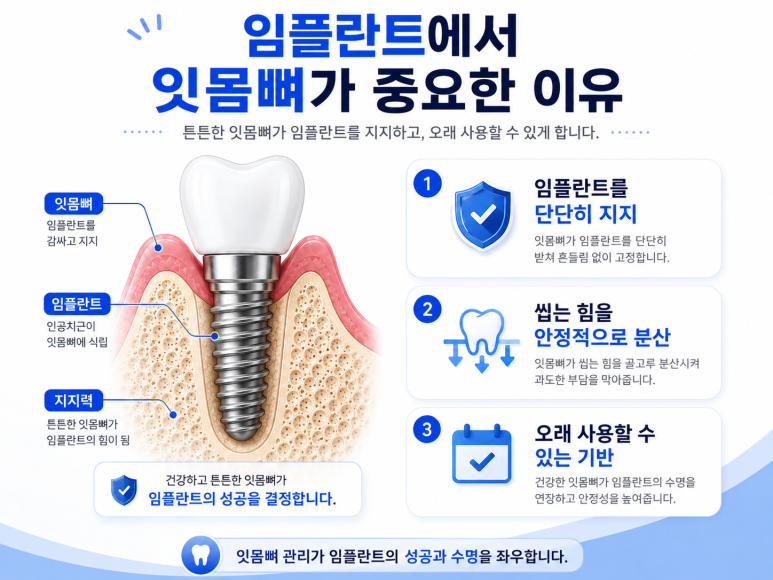
Dental implant treatment does not simply involve attaching a tooth-shaped prosthesis to the gums.
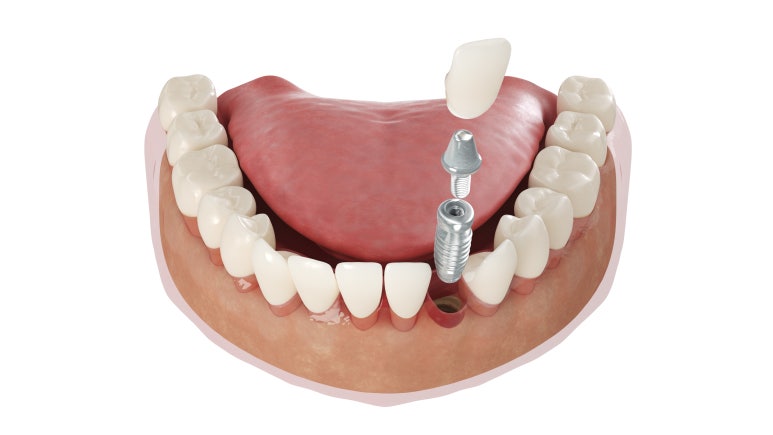
An artificial tooth root, which serves the role of a natural tooth root, is placed in the jawbone, and a prosthesis is connected on top of it so that it can function similarly to a natural tooth.
Simply put, it is similar to the need for a building to have a strong foundation. For an implant to function stably over a long period, sufficient jawbone is needed to surround and support the artificial tooth root.
However, as time passes after a tooth is lost, the jawbone in that area may gradually decrease. This happens because the stimulation once transmitted through the tooth root disappears, causing the bone to be gradually resorbed.
Therefore, when a long time has passed since a tooth was extracted, it may be found that the bone is not sufficiently wide or high for implant placement.
The process of reinforcing the bone in an area where it is insufficient is called bone grafting for dental implants.
When Is Bone Grafting Necessary?
Whether bone grafting is needed is not determined solely by age.
Even among people in the same age group, the time since tooth loss, gum condition, severity of periodontal disease, and shape of the bone around the teeth can all differ.
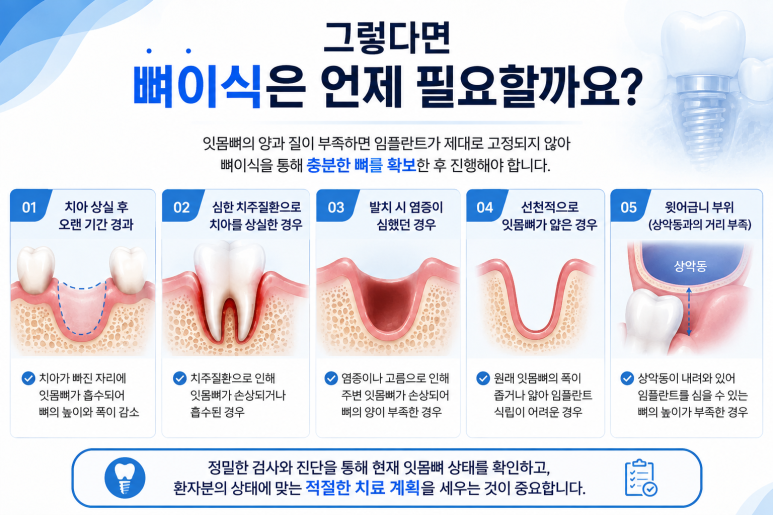
Bone grafting may typically be considered in the following cases.
The first is when a long period has passed since the tooth was lost.
If implant treatment was not performed for a long time after tooth loss, the jawbone may gradually be resorbed, causing it to become narrower or lower.
Even if the gums appear normal on the outside, a CT scan may reveal that there is not enough bone for implant placement. Therefore, it is difficult to make a judgment based only on visual examination.
The second is when a tooth was lost due to severe periodontal disease.
When periodontal disease, commonly called gum disease, progresses, the jawbone around the tooth can be damaged.
If the periodontal disease progressed to the point that the tooth became loose and had to be extracted, the bone in that area may also have been lost. In such cases, the insufficient bone may need to be supplemented to place the implant stably.
The third is when there was severe inflammation at the time of extraction.
If inflammation or pus around the tooth root persisted for a long time, it may also affect the surrounding alveolar bone.
Even if the inflamed tissue is thoroughly removed after extraction, if the extent of bone damage is substantial, bone grafting may be considered before or at the same time as implant placement.
The fourth is when the jawbone is naturally thin.
Some people have a naturally narrow alveolar bone width even if it has not been long since they lost their tooth.
In particular, the jawbone is relatively often thin around the front teeth, so the surrounding bone may need to be reinforced to prevent the implant from becoming exposed outside the bone.

“Maxillary Sinus Bone Grafting,” Often Mentioned for Upper Molar Implants
Many people first hear the term “sinus lift” during a consultation for an upper molar implant.
The maxillary sinus is an empty space located above the upper molars.
After an upper molar is lost, as time passes, the jawbone may decrease while the maxillary sinus space expands downward. This can leave insufficient bone height for placing an implant.
In such cases, one option is to carefully lift the sinus membrane and supplement the required space with bone graft material.
However, maxillary sinus bone grafting is not automatically necessary simply because you are receiving an upper molar implant. Depending on the height and condition of the remaining jawbone, implant placement without bone grafting may be possible, so this must be determined through detailed imaging examinations.
Can Bone Grafting and Implant Placement Be Performed at the Same Time?
This is another question many people have.
A lack of bone does not always mean that you must undergo bone grafting first, wait several months, and then have the implant placed.
If the amount of missing bone is not substantial and the conditions allow for initial stability, bone grafting and implant placement may be considered at the same time.
Conversely, if bone loss is extensive or it is difficult to secure the implant stably, it may be more appropriate to perform bone grafting first, wait for a certain period for the bone to settle, and then place the implant.
In other words, the treatment sequence and duration also vary depending on the patient’s oral condition.
One person may be able to complete treatment with a single surgery, while another may need staged treatment to achieve a more stable result.
Will It Hurt a Lot If Bone Grafting Is Also Performed?
The term “bone grafting” itself may make the treatment seem like a very major surgery.
However, the actual treatment area varies greatly from person to person. In some cases, only a small amount of bone needs to be supplemented, while in others, bone must be built over a relatively wide area.
Therefore, it is difficult to determine the amount of pain or swelling based solely on whether bone grafting is performed.
After treatment, swelling or a dull, aching sensation may occur around the surgical site. Depending on the individual, bruising or discomfort may also be felt. Most people go through the recovery process with prescribed medication, cold compresses, and lifestyle management.
The important thing is not to expand the treatment unnecessarily, but to reinforce only the amount needed at present and do so accurately.
How Much Longer Will Implant Treatment Take If Bone Grafting Is Needed?
When bone grafting is necessary, the treatment period may be longer than that of a typical implant procedure.
This is because time is needed for the grafted bone to settle stably with the surrounding tissue and integrate with the implant.
However, if only a small amount of bone grafting is needed and it is performed at the same time as implant placement, there may not be a significant difference in the treatment schedule.
On the other hand, when extensive bone grafting is required, the next stage may be carried out after allowing sufficient time for recovery.
Therefore, rather than assuming that the period mentioned online—“implant treatment is completed in a few months”—will be your treatment period, it is better to receive an estimated schedule based on the current condition of your jawbone and the treatment method.
Is It Better to Avoid Bone Grafting If Possible?
From a patient’s perspective, it is natural to prefer a simpler treatment process and a shorter treatment period.
However, the important thing is not to avoid bone grafting unconditionally, but to create an environment in which the implant can function stably.
There is no reason to undergo unnecessary bone grafting when the jawbone is sufficient. Conversely, it is not advisable to place an implant hastily in an insufficient bone environment merely to shorten the treatment process.
Ultimately, what matters is not whether bone grafting is performed, but accurately determining whether your current jawbone is capable of sufficiently supporting the implant.
Gwangjang-dong Dental Clinic, S Leader Dental Hospital
A Dental Implant Treatment Plan Suited to the Condition of Your Jawbone Is Important
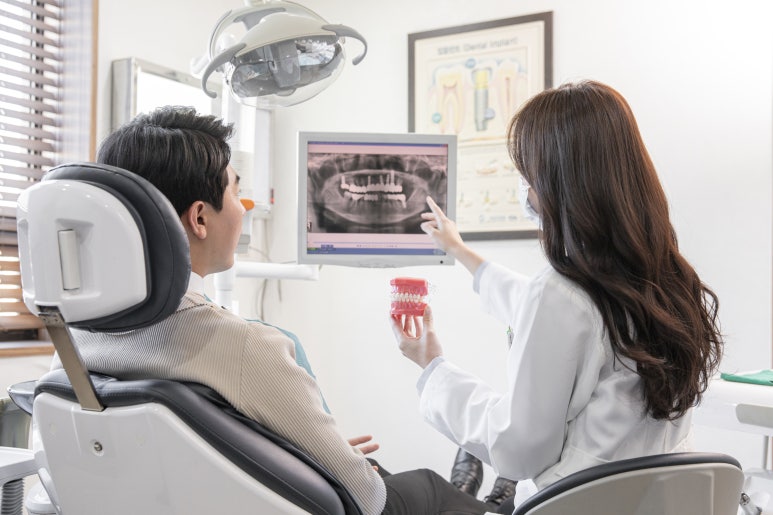
When planning implant treatment, it is important to examine not only the area where the tooth is missing, but also multiple factors, including the height and width of the jawbone, the condition of the surrounding teeth, the location of the nerve canal, and the distance from the maxillary sinus.
In particular, because it can be difficult to determine whether bone grafting is needed through visual examination alone, it is important to assess the condition of the jawbone three-dimensionally through imaging examinations such as CT scans when necessary and establish a treatment plan accordingly.
You may wonder, “Someone else didn’t need bone grafting, so why do I need it?” However, treatment methods may differ even when implants are placed in the same location because the cause and duration of tooth loss, as well as the amount and condition of the remaining jawbone, vary from person to person.
Therefore, if you are told that bone grafting is needed, it is important not to worry excessively. Conversely, rather than avoiding bone grafting unconditionally because of concerns about the treatment period, you should accurately assess your current oral condition and plan the treatment you need.
At Gwangjang-dong Dental Clinic, S Leader Dental Hospital, we carefully examine the condition of the teeth and jawbone before implant treatment and provide guidance on whether bone grafting is needed and on an implant treatment plan suited to each patient’s oral condition.
If you have been considering implants but are worried because you were told that bone grafting may be necessary, please first have your current jawbone condition checked through an accurate examination.




Gwangjang-dong Dental Clinic :: S Leader Dental Hospital