Hello, I am Dr. Ho-san Park, a U.S. board-certified periodontist.
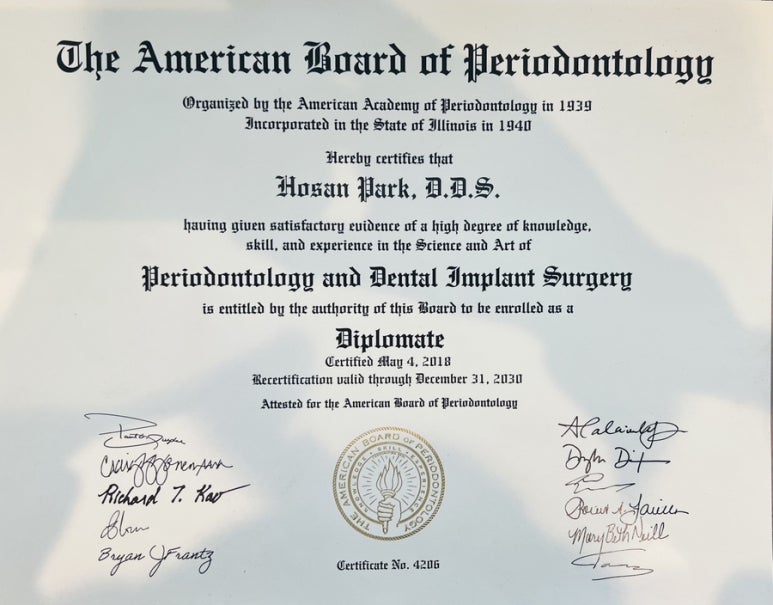
U.S. board-certified periodontist and implant surgery specialist certification documents — Ho-san Park
Yes, I studied abroad for three years at Columbia University College of Dental Medicine in New York and also worked as a periodontist in Seattle for five years.
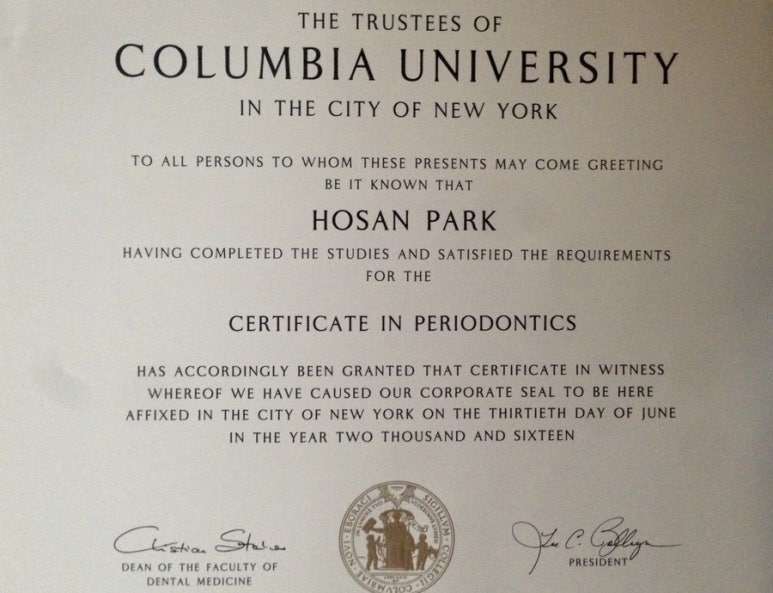
Periodontics residency graduation certificate from Columbia University College of Dental Medicine in New York — Dr. Ho-san Park
“Doctor, my teeth are sensitive, so I’ve been using toothpaste for sensitive teeth and taking gum medication from the pharmacy for several months. But my teeth seem to be getting longer and longer.”
This is something I hear fairly often in the clinic. To give you the conclusion first,
Gum recession cannot be reversed with medication alone.
(As of July 12, 2026. Medication may be developed in the future, though, haha.)
Once the gums have receded, they do not naturally move back up just because you take medication. As for the claims circulating online that gum recession was completely covered by taking some kind of probiotic... well, I’ll just say I have no words. Please, everyone, don’t get taken in by those claims. At the very least, ask an AI!
So today, I will explain:
-
The causes and symptoms of gum recession
-
Root coverage surgery using a collagen matrix to cover the roots without removing tissue from the palate, along with an actual case.
Symptoms of gum recession
Gum recession refers to a condition in which the edge of the gum moves toward the tooth root, exposing the root, which should normally be covered by gum tissue. You should suspect gum recession if you have any of these symptoms.
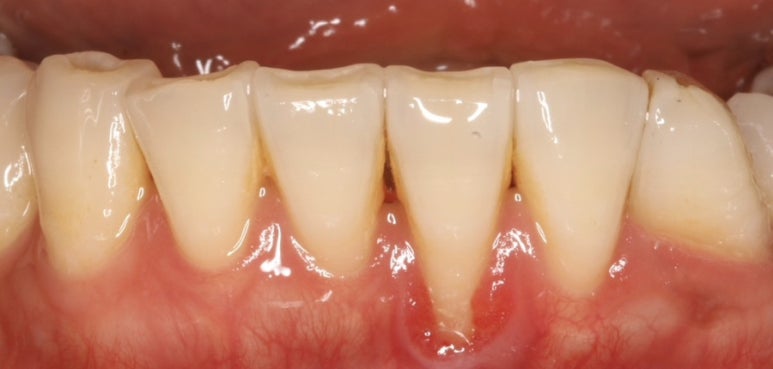
Gum recession
-
Your teeth feel sensitive to cold water or cold air (exposed roots are sensitive to stimuli because they do not have enamel)
-
Your teeth look longer than before
-
A yellowish band appears along the border between the teeth and gums (this is the exposed root surface)
-
The gumline looks indented or scooped out (with cervical wear)
-
Only that area feels particularly sensitive when you brush your teeth
The problem is not limited to sensitivity. Because exposed roots are much softer than enamel, they are vulnerable to root decay and wear, and if left untreated, the gum recession may continue to progress.
Causes of gum recession
-
Improper toothbrushing — The most common cause is the habit of scrubbing forcefully from side to side with a hard-bristled toothbrush.
-
Thin gum type (thin biotype) — People who naturally have thin gum tissue and thin bone can experience recession easily from the same type of irritation.
-
Periodontitis — As the supporting bone is lost, the gums recede along with it.
-
History of orthodontic treatment — The gums may become thin when the teeth move toward the outside of the bone.
-
Teeth grinding and clenching — Excessive biting forces become concentrated around the necks of the teeth and accelerate recession.
Because these are the causes, gum medication or toothpaste cannot resolve the problem. Gum medication is only an aid for reducing inflammation; it cannot cover roots that have already been exposed. Covering them requires surgery to reposition or graft tissue.
Criteria for determining whether surgery is possible — Miller classification
Not every case of gum recession can be completely covered. Periodontists use the Miller Classification to assess the prognosis.
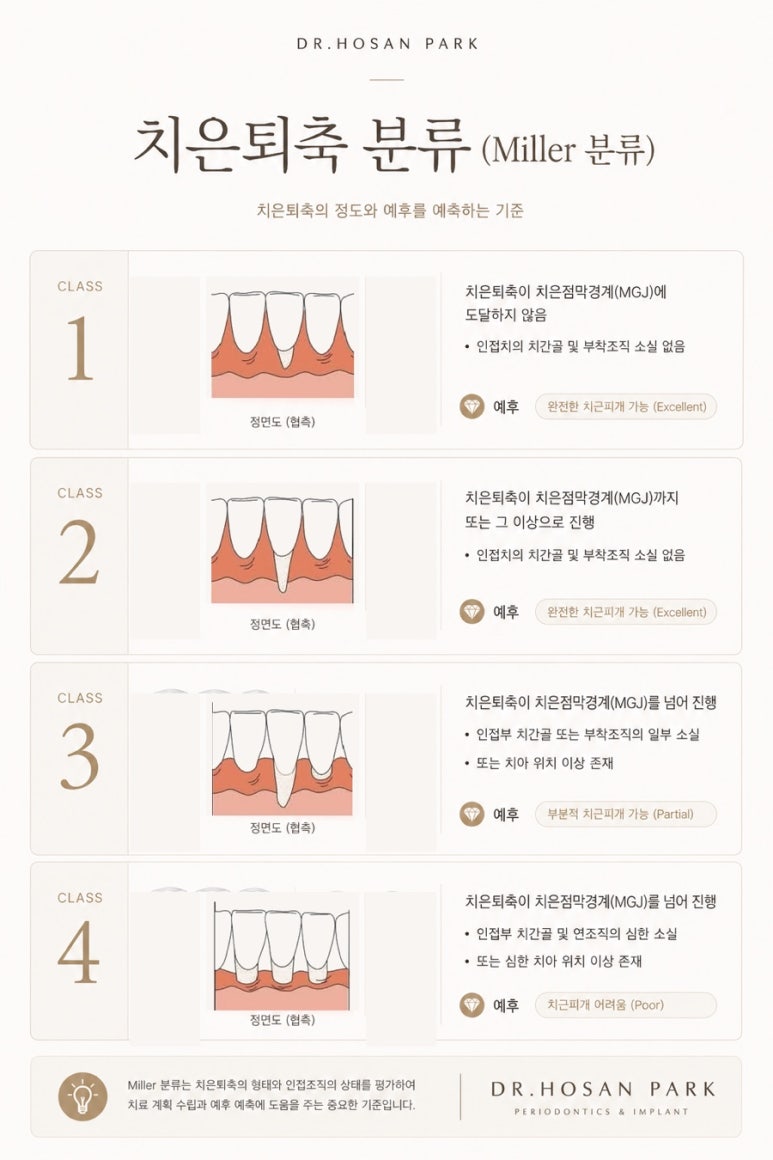
Miller classification of gum recession
The key question is whether the gum tissue and bone between the teeth are still intact. When surgery is performed in Class I or II cases, the roots can be completely covered, but once the condition has progressed to Class III, only partial coverage may be possible. Therefore, rather than waiting and saying, “I’ll do it if it gets worse,” the best results are achieved when surgery is performed while the tissue between the teeth is healthy.
When root coverage surgery is recommended (indications)
-
When sensitivity cannot be controlled even with toothpaste for sensitive teeth
-
When wear or early decay begins to develop on an exposed root
-
When the recession is progressing (if the gumline has changed compared with photos from several years ago, it is progressing)
-
When the appearance of the front teeth is a concern
-
When the gums are thin and preventive reinforcement is needed before orthodontic treatment
Surgery without removing tissue from the palate — pinhole surgical technique
Traditional root coverage surgery involves removing connective tissue from the palate and grafting it (CTG). The results are excellent, but what patients find most difficult is often not the actual surgical site, but the pain in the palate where the tissue was removed.
That is why using a collagen matrix as the graft material, without harvesting tissue from the palate, has become a good alternative.
-
There is no wound on the palate, significantly reducing pain and the burden of recovery
-
The surgery takes less time
-
It is advantageous when treating several teeth at once (the amount of tissue that can be harvested from the palate is limited)
-
The collagen matrix acts as a regenerative scaffold for the patient’s own tissue and reinforces gum thickness
Actual case — Gum recession affecting multiple teeth, covered with a collagen matrix
This case involved generalized gum recession affecting multiple teeth in both the upper and lower jaws due to a combination of toothbrushing habits and a thin gum type. The patient was concerned about sensitivity, severely worn areas on the teeth, and portions of the gumline that continued to recede.
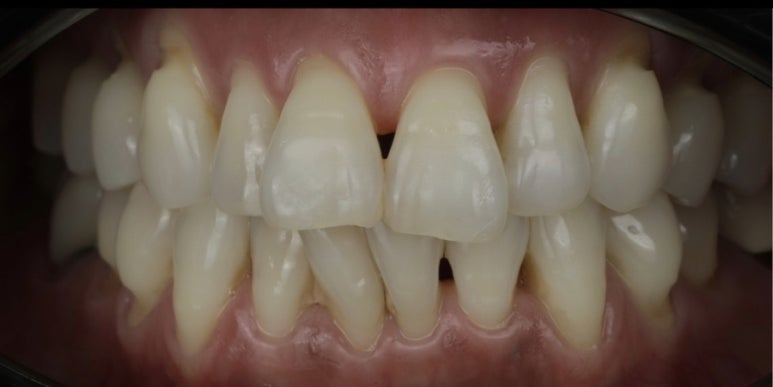
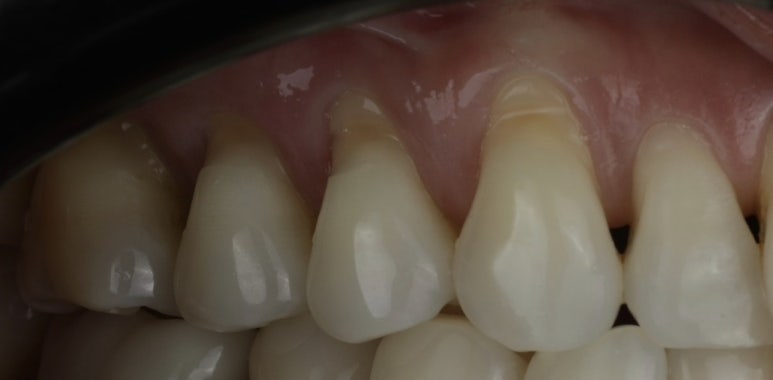
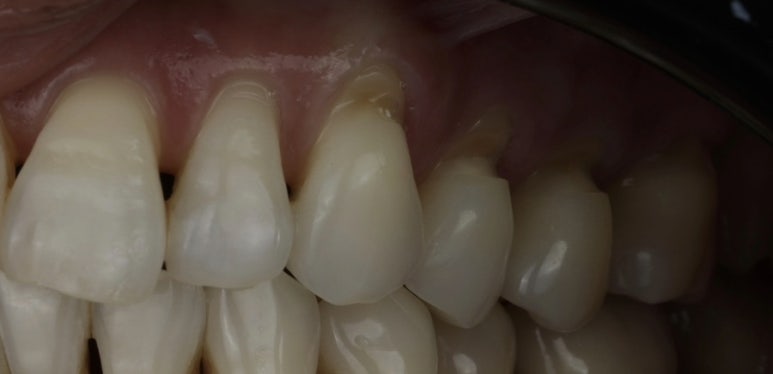
Before surgery — Gum recession and cervical tooth wear
In the preoperative photos, the gums around the canines and premolars have receded, exposing the yellowish roots, and the gum heights vary from tooth to tooth. Some of the interdental gum tissue had also receded, corresponding to Miller Class III, so the treatment was planned to achieve partial coverage and prevent further recession by increasing gum thickness.
The surgical procedure proceeds as follows.
-
Creating the pinhole — Instead of making an incision in the gums, a small hole is made to create space for the instruments. Minimizing incisions helps preserve blood flow and promotes healing.
-
Root surface treatment — The contaminated layer on the previously exposed root surface is removed, and the surface is smoothed so that new tissue can attach.
-
Collagen matrix grafting — The shaped matrix is adapted inside the gum tissue and secured.
-
Coronal advancement suturing — The gum flap is pulled upward, toward the crown of the tooth, to completely cover the matrix and root, then microsutured or, in some cases, left without sutures.
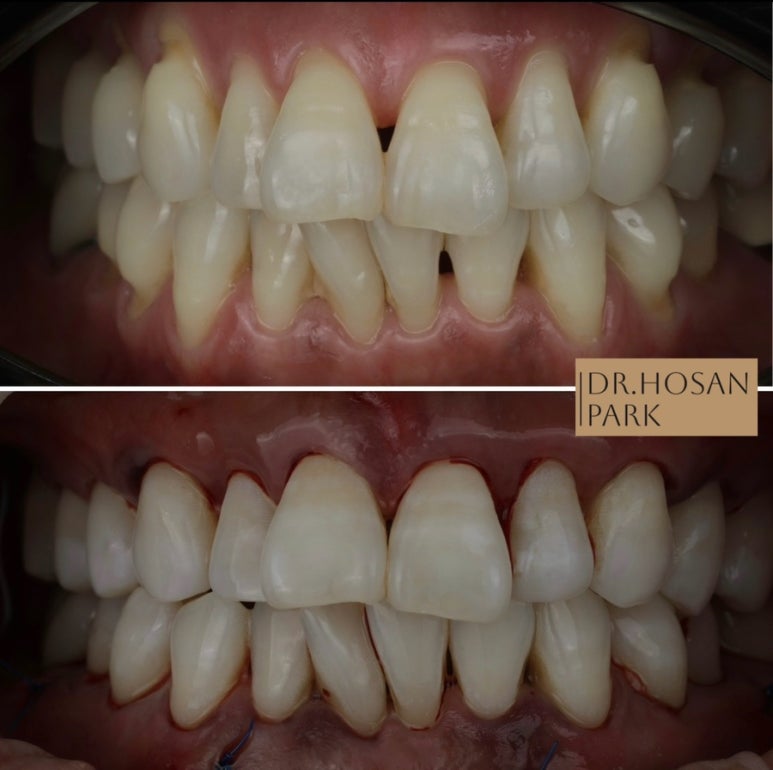
Before surgery (top) / Sutured immediately after surgery (bottom)]
This photo was taken immediately after surgery. The previously receded gumline has been raised to a position covering the root and has been sutured in place. Immediately afterward, traces of bleeding and sutures are visible like this, but swelling and discomfort usually subside within two to three days.
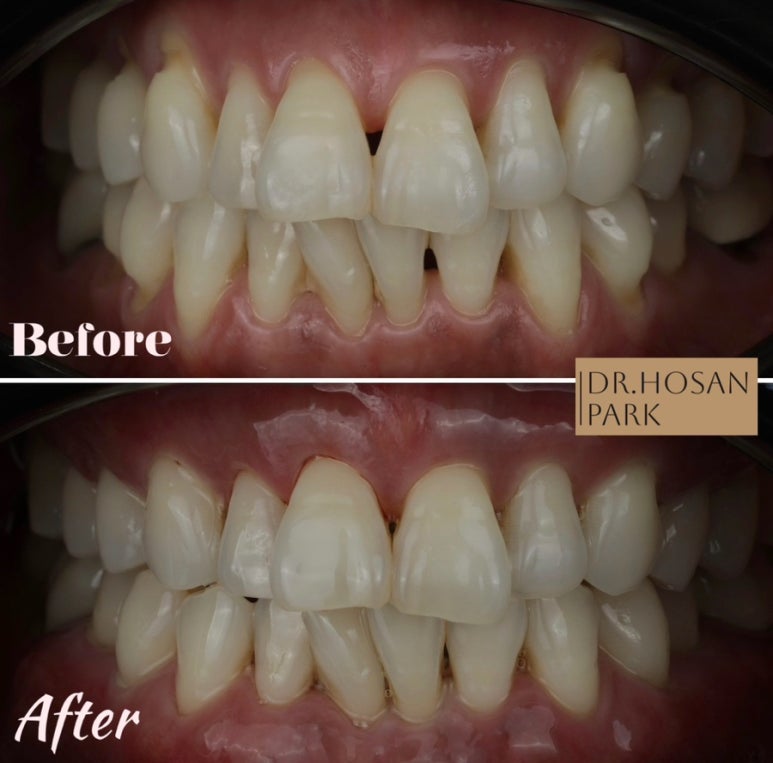
Before surgery (top) / After healing (bottom)
As healing progresses, the sutures are removed, and the color and texture of the gums blend naturally with the surrounding tissue. As the previously exposed roots become covered, sensitivity also improves.
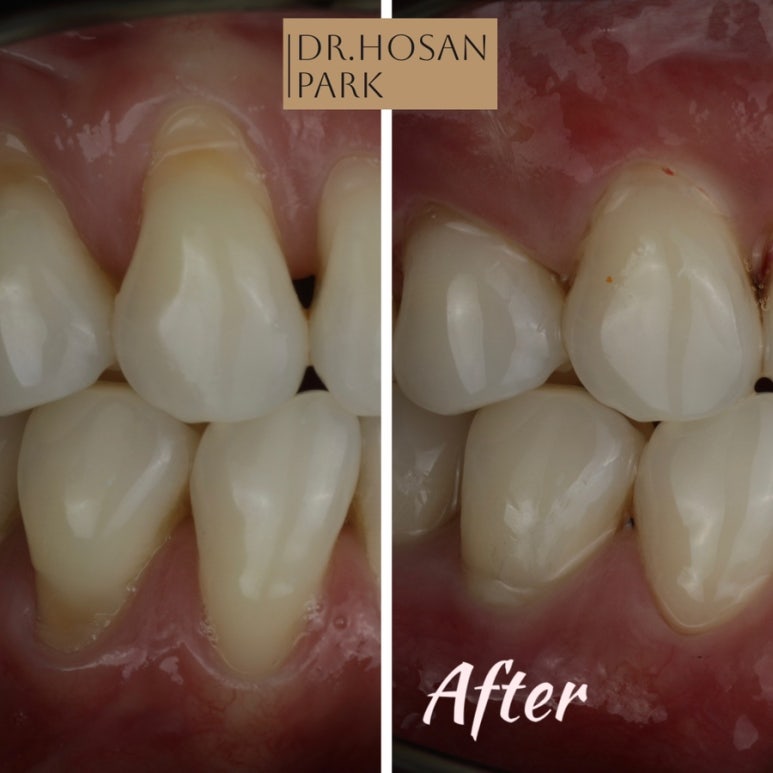
The difference is even clearer in the enlarged side view. Before surgery, the yellowish root surface was exposed and the gumline was indented, but after coverage, the gums appear thicker and reinforced, and the tooth-gum border is smooth. Because the gum tissue itself has become thicker, resistance to future recession also improves.
I am a certified practitioner of the pinhole surgical technique, having received certification from Dr. Chao, the developer of the U.S. pinhole gum grafting technique, of whom there are only a few certified practitioners in Korea. (That was already 10 years ago ㅠㅠ)

Fee information
At our clinic, pinhole gum grafting costs 770,000 won per tooth (non-covered treatment; soft-tissue augmentation using a collagen matrix). Since multiple teeth are often treated in a single surgery, the exact scope and fee will be explained after examination based on the Miller classification and the number of teeth. If there are a very large number of teeth, discounts may also be available according to our internal policy 😎
Frequently asked questions (FAQ)
Q1. Is pinhole surgery very painful?
The procedure is performed under local anesthesia, so there is generally little pain during treatment. After the anesthesia wears off, you may feel soreness or swelling, but postoperative discomfort is reported to be less than with conventional grafting procedures involving incisions and sutures. However, the level of pain varies depending on the extent of surgery and the individual, and prescription medication can be used if needed.
Q2. How long does the surgery take?
It varies depending on the number of teeth treated and the condition of the gums. If the area is limited, the procedure may be completed relatively quickly; treating several teeth together takes correspondingly longer. The exact duration can be accurately explained after diagnosis. On average, surgery for four teeth takes about one hour.
Q3. What is the recovery period? Can I go to work the next day?
Because there is no large incision or extensive suturing, a quick return to daily activities is generally expected. However, the gum tissue needs time to settle into its new position, so you should not immediately return to your previous habits, such as vigorous brushing or eating hard foods, just because the surface appears healed. Early care determines the stability of the result.
Q4. Is the pinhole technique possible for every case of gum recession?
No. Because the pinhole technique covers the roots by repositioning the gums, there must be sufficient remaining gum tissue and thickness, along with adequate supporting bone. When the recession is severe or there is insufficient keratinized gum tissue, conventional grafting may be more appropriate, and the two methods may also be combined. The appropriate method is determined through examination and diagnosis.
Q5. Can the gums recede again after being raised once?
Even if the gum position is restored through surgery, the recession may progress again if the original causes—such as forceful brushing, periodontitis, or teeth grinding—remain unchanged. Therefore, correcting brushing habits and maintaining regular gum care must be carried out alongside surgery, and these factors are just as important as the surgery itself for long-term results.
Q6. Will the sensitivity improve as well?
Sensitivity caused by exposed roots due to gum recession often improves as the roots are covered again. However, sensitivity may not be caused solely by gum problems (tooth wear, cracks, etc.), so identifying the exact cause comes first.
Q7. Can several teeth be treated at once?
One feature of the pinhole technique is that multiple adjacent tooth areas can be treated through a small access point. The actual range that can be treated depends on the pattern of recession and the condition of the gums, so this is planned during diagnosis. In some cases, all the teeth may be treated in one day.
Q8. Are there possible side effects or a risk of failure?
As with any surgery, swelling, bruising, and temporary discomfort may occur, and in rare cases the gums may not fully settle into the planned position. The key to increasing the success rate is selecting cases appropriate for the procedure and following postoperative care instructions. Before the procedure, it is important to receive a thorough explanation of the expected outcomes and limitations for your individual condition.
In closing...
Let me say this again: gum recession does not improve if you simply wait, and it cannot be covered with medication. In fact, once the tissue between the teeth has also deteriorated, complete coverage becomes difficult even with surgery. If you have sensitivity or your roots are beginning to show, I recommend being examined by a periodontist while coverage is still possible.

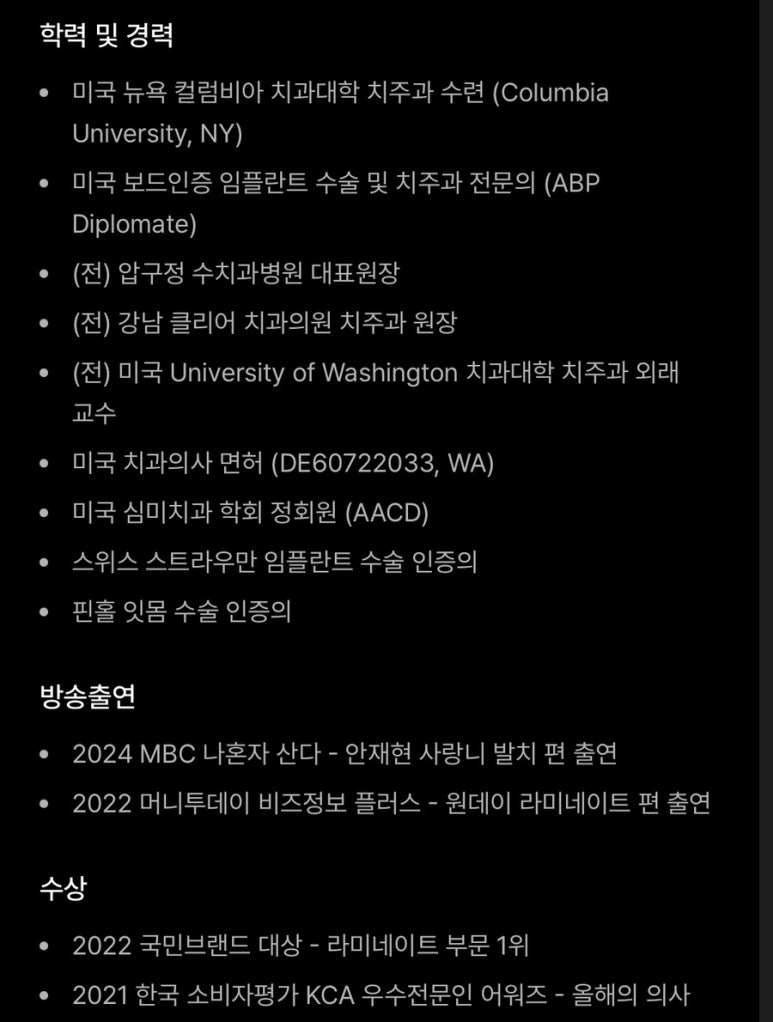
Treatment inquiries:
Seoul Gangnam Sera Dental Clinic www.ceradento.com
Changwon Hana Dental Clinic: www.hanadental.co.kr
The case photos in this post were published with the patient’s consent and were taken under the same conditions. Treatment outcomes may vary from person to person. Depending on the individual, side effects such as pain, swelling, infection, sensitivity, or contraction of the grafted area may occur after surgery. Please consult thoroughly with a specialist before undergoing the procedure.
#GumRecession #PinholeGumGrafting #CollagenMatrixRootCoverage #DrHoSanPark