Hello, I am Dr. Park Ho-san, director of Changwon Hana Dental Clinic.
After working as the director of Apgujeong Soo Dental Hospital for five years, where I treated approximately 5,000 laminate and implant cases, I returned this year to Changwon Hana Dental Clinic, which my parents have operated for 39 years, and began practicing here.
Today, I would like to briefly share the principles I consider most important in implant surgery for those considering implant treatment in Changwon.
In Korea's Ministry of Health and Welfare–certified specialist system, there is actually no category called an “implant specialist.” There are specialists in periodontics and oral and maxillofacial surgery.
However, the United States does have specialists in implant surgery. The United States has a board-certification system for specialists, known in English as “Board-certified dental specialist.” There are boards that certify specialists in each field, and among them, the ABP (American Board of Periodontology) certifies dental implant surgeons after written and oral examinations.
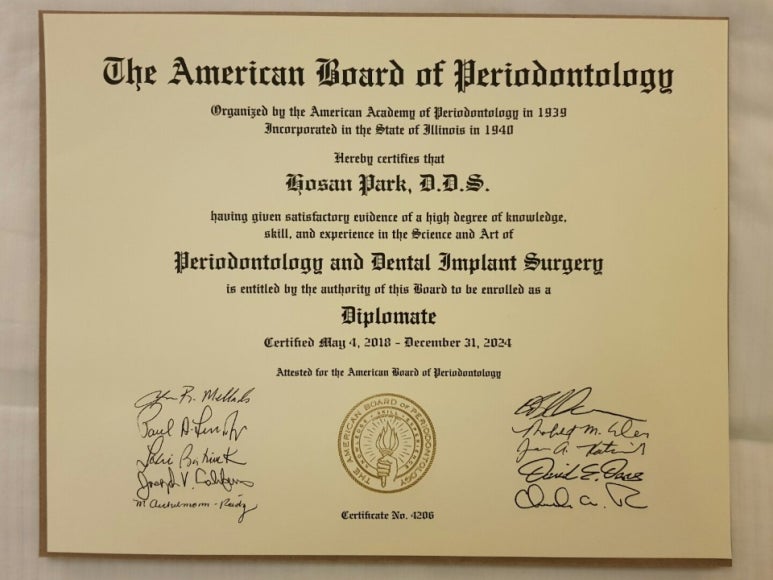
Specialists certified by this board may advertise using the phrase “board-certified dental implant surgeon” without violating medical advertising review standards.
However, obtaining this certification is quite difficult. Unlike in Korea, where the process ends with a single written examination after residency training, the U.S. process includes a first-stage written examination and a second-stage interview and oral examination. The second-stage oral examination is particularly demanding. To pass, candidates must be able to present and discuss surgical methods and supporting evidence based on research papers in real time before two professors or examiners.
In some ways, I may have been happier the moment I passed this specialist board examination than when I received my diploma from Columbia University College of Dental Medicine in New York. After preparing for two years, I ultimately passed and received board certification. I was certified in 2018, so I have now been a U.S.-certified specialist for eight years.
In the United States, most general dentists do not perform implant surgery themselves and instead refer patients to specialists like me. Because the risks of surgical medical accidents and disputes are significant, general dentists may feel uncomfortable taking on these procedures. In addition, the treatment must be defensible based on research evidence, which is why they entrust the surgery to specialists.
Now, let me get to the main point and discuss the three principles I consider essential in implant surgery.
① It should be minimally invasive
Surgery itself is an act that causes harm to the human body. Although it is justified because the benefits outweigh the harm, it is ultimately an invasive procedure. Therefore, a good surgery is one that minimizes harm as much as possible.
When placing a titanium implant into the jawbone, the least invasive approach is the flapless technique, which minimizes gum incisions and does not even require sutures.
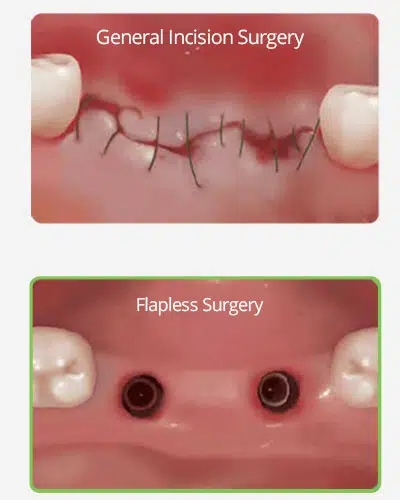
In cases where there is too little bone and extensive bone grafting is required, or where there is insufficient gum tissue—known as attached gingiva—and gum grafting is needed, a traditional approach may be necessary. However, when a flapless procedure is possible, I consider it my first choice.
② It should be positioned accurately so that the prosthesis can be placed easily
The ultimate purpose of implant surgery is not the surgery itself, but placing a prosthesis on top of the implant so that the patient can chew comfortably. If the position or angle of the implant deviates significantly from where the tooth crown should be, it becomes difficult to create a normal crown prosthesis. In severe cases, the implant may need to be removed and placed again.
This is especially important for front teeth. The bone is thinner than it is around molars, and even a slight positioning error can cause the screw portion to become exposed outside the gum.
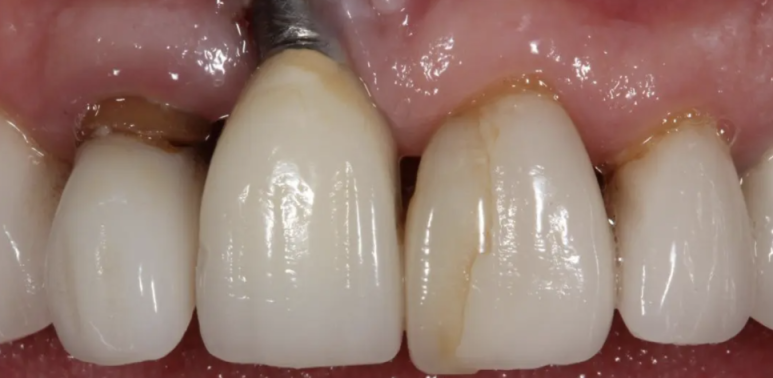
As in the case above, when implant surgery is performed incorrectly, it can potentially lead to an unaesthetic result. That is why performing the surgery correctly from the outset is important.
③ It should restore damaged tissue as much as possible
When the bone has already resorbed or the gum tissue has been damaged, the true essence of surgery lies in how predictably the area can be restored surgically. Undergoing multiple unnecessary surgeries is also painful for the patient, so whenever possible, I follow the principle of “One surgery to achieve everything, if possible.”
I will explain this principle using a case I personally treated during my time in Apgujeong.
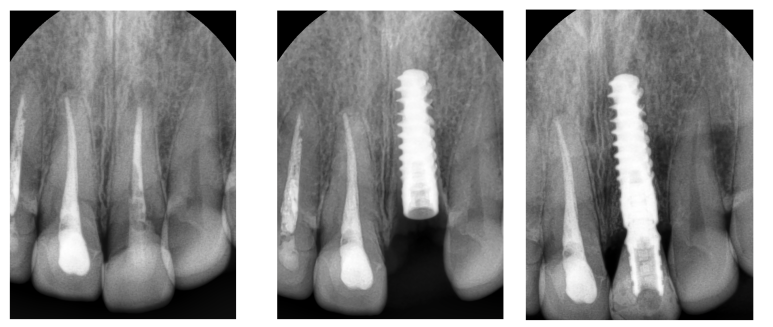
The patient visited us because the root of the left front tooth had fractured. When the middle portion of a root fractures, it is difficult to save the tooth, so the usual course is extraction followed by implant placement. In this case, we also had to address the asymmetry in tooth size caused by differences in gum height.
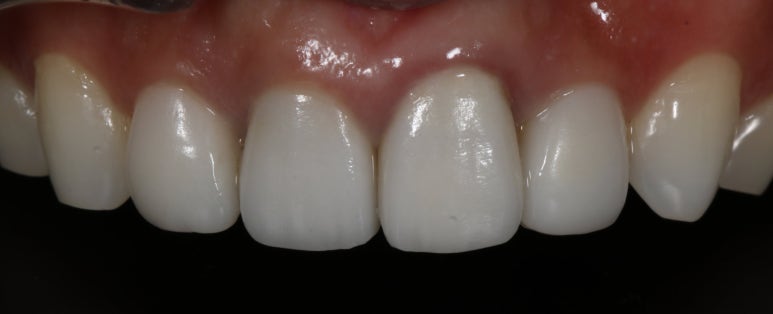
Before surgery
This is a photograph taken before surgery. The tooth appeared normal on the outside, but it was extremely loose. An X-ray revealed that the middle of the root had fractured.
Following the first principle, we extracted the tooth using a minimally invasive technique and immediately placed the implant on the same day. We used a Straumann BLX implant, which makes it easier to obtain initial stability during immediate placement after extraction. We performed the extraction and implant placement using a flapless, or incision-free, technique, added bone graft material around the implant, and immediately connected a temporary tooth to the implant, adjusting it so that the gum height would be as symmetrical as possible. We completed the surgery without sutures. In other words, we achieved everything we wanted in a single surgery.
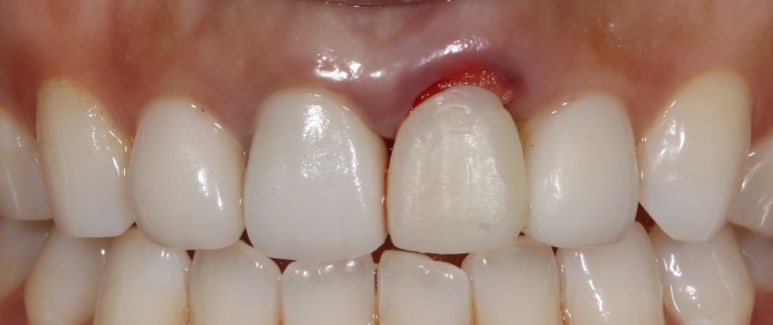
Photographs showing the temporary tooth placed immediately after surgery.
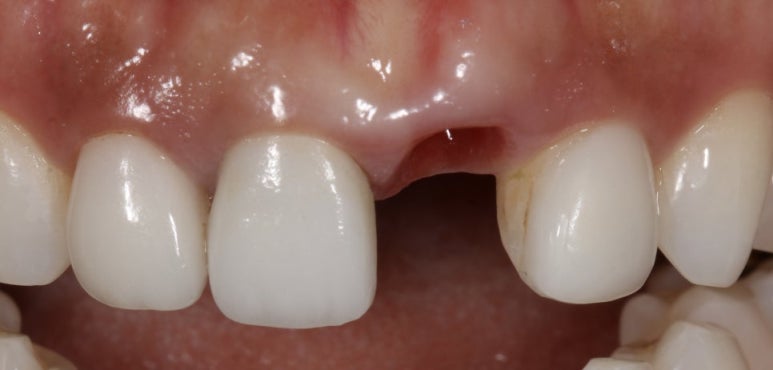
The tissue around the gums healed healthily, and the gum height healed with good symmetry relative to the adjacent tooth.
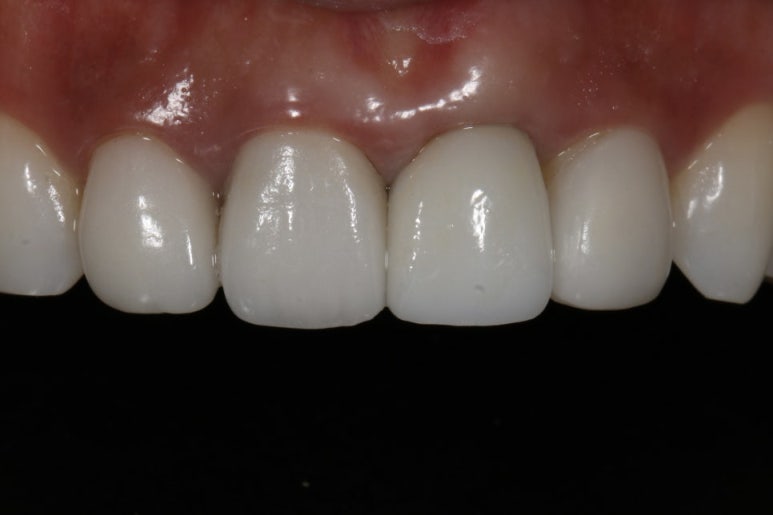
Fortunately, the case was completed successfully, and the shade and shape of the front-tooth prosthesis were also satisfactory. The total treatment period was approximately four months.
Today, I have summarized the principles of implant surgery as considered by an American board-certified dental implant surgeon. These principles do not change whether I practice in Apgujeong or Changwon. At Changwon Hana Dental Clinic, I use Straumann implants in the same way, adhering to the same three principles: a minimally invasive approach, accurate positioning, and tissue restoration.
Postoperative care is just as important as implant surgery itself. Regular checkups to identify peri-implantitis or screw loosening in advance can have a significant effect on the long-term prognosis. Even those who found it burdensome to travel to Seoul can receive regular, convenient checkups in Changwon.
Changwon Hana Dental Clinic is a family dental clinic founded in 1987 by my father, Dr. Park Seong-hwan, and my mother, Dr. Kang Gyeong-ja. It has remained in the same location for 39 years. Dr. Park Seong-hwan is a prosthodontics specialist who has treated implant patients for 39 years, and I joined the clinic as the second generation in 2026. You can receive implant treatment in Changwon based on the same experience I gained in Apgujeong, without having to travel all the way to Gangnam.
▶ Changwon Hana Dental Clinic Information
Address: 2nd Floor, Sangnam Officetel, 648 Woni-daero, Seongsan-gu, Changwon-si, Gyeongsangnam-do (near Sangnam Fountain Square)
Phone: 055-266-2833 / KakaoTalk Channel: “Hana Dental Clinic”
Hours: Monday, Tuesday, Wednesday, and Friday 9:30–18:00 (lunch 13:00–14:30); Thursday and Saturday 9:30–13:00; closed Sundays and public holidays
Dr. Park Ho-san’s consultation days: Monday, Tuesday, and Wednesday
Parking: Sangnam Parking Lot or the public parking lot in front of Lotte Medical (parking validation available)
www.hanadental.co.kr
*The case photographs in this post were published with the patient’s consent and show a case personally treated by Dr. Park Ho-san under the same photographic conditions. Treatment results may vary from person to person, and side effects may occur after the procedure. Please consult thoroughly with a specialist before undergoing treatment.
#ChangwonDentalImplants #ChangwonStraumannImplants #ChangwonHanaDentalClinic