Hello~ This is AB Plastic Surgery.
We will select one of the questions we receive often and answer it through our blog!
�00
After nose surgery, some people experience nasal congestion.
Some worry that their rhinitis has gotten worse or that something went wrong,
so let’s take a look at what situations can cause these symptoms~!
- Swelling
The space inside the nostrils is called the nasal cavity, and the tissue that makes up the nasal cavity is the mucosa.
Mucosa is a tissue rich in blood vessels and is sensitive, so it swells easily even with small irritation.
During nose surgery, the septum must be separated from this mucosa during dissection, so irritation is unavoidable.
In other words, swelling inside the nose can also cause nasal congestion.
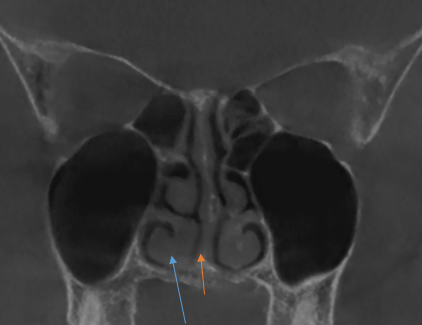
(CT viewed from the front.
Light blue arrow: inferior turbinate mucosa, orange arrow: septal mucosa,
As shown here, the nasal cavity is made up of mucosa.)
As you can see in the CT above, if the mucosa on both sides swells, the black space between them, which is the airway, becomes narrower.
- Secretions
When you have nose surgery, the mucosa becomes irritated and produces more secretions.
Normally, the mucosa has cilia, which are hair-like structures that move secretions outward.
After nose surgery, this ciliary movement also slows down due to swelling. As a result, secretions keep building up.
However, because there is a risk of infection, it is not recommended to remove secretions inside the nose on your own.
Because of these secretions, you may feel that nasal congestion has temporarily worsened.
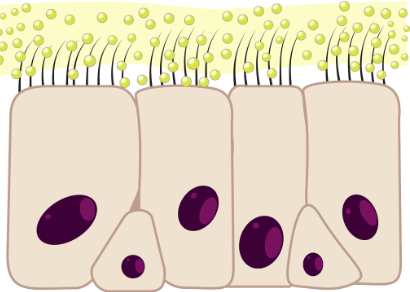
(Image source: nasal-mucosa-cilia-cells - Otolaryngology Specialists of North Texas (entkidsadults.com))
- Septal deviation
Since septal cartilage is harvested during nose surgery, if the septum was already deviated and the harvested area matches that deviation, it can be corrected to some extent.
However, in some cases, the septum is naturally thin, weak, and fragile.
When raising the nasal tip during nose surgery, septal extension grafting is performed. This is a method of grafting cartilage onto the remaining septal area after septal harvest.
As the cartilage is grafted, pressure is inevitably applied, so if the septum was originally weak, additional bending may occur.
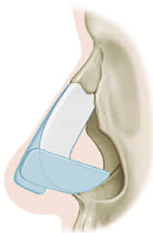
(Image source: Revision Rhinoplasty for Short Noses in the Asian Population, June 2015, JAMA Facial Plastic Surgery 17(5), DOI:10.1001/jamafacial.2015.0645)
- Narrowing of the nasal valve
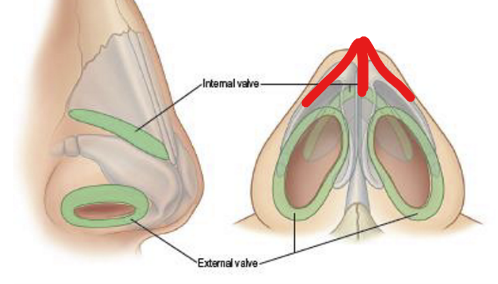
(Image source: Plastic Surgery, Neligan, volume 2, 3rd edition, Elsevier)
The nasal valve is the narrow part of the airway within the nasal cavity.
The narrower it becomes, the greater the air resistance, making it harder to breathe.
However, when the nasal tip is raised, as shown in red in the figure above, the cartilage is pulled upward, which can inevitably make the nasal valve area narrower.
This is also an inevitable result.
To compensate for this, cartilage may be grafted to the valve area in cases of severe nasal valve obstruction.
We have looked at various cases in which nasal congestion can occur.
In cases 1 and 2, if you wait a little longer, it will improve, so there is no need to worry too much.
In cases 3 and 4 as well, there are ways to compensate by undergoing functional rhinoplasty together, so if it is causing significant discomfort, you can decide after consulting with a doctor.