Hello. I’m Seo Chan-eol, Director of AB Plastic Surgery.
The nose tip is often called a bulbous nose when it looks blunt and broadly spread out. When looking into improving this kind of bulbous nose because you dislike the swollen look, you may come across reviews saying the concern was solved with cartilage suturing or cartilage stacking. I’ll explain whether the bulbous nose you have can really be improved that simply.
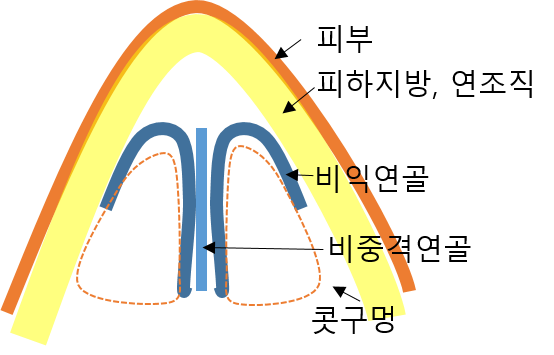
First, let’s look at a schematic of the nose tip from the front. Inside the nostrils are the alar cartilages extending on both sides, and between them in the center is the septal cartilage. These are covered by soft tissue, subcutaneous fat, and, on the outermost layer, the skin.
Bulbous nose shapes can generally be divided into two types depending on how these structures are formed.
The first type has a thick subcutaneous fat layer, while the supporting cartilages underneath are weak and spread out broadly. This type is commonly seen in East Asians. The cartilage at the nose tip is not easily felt, and the texture feels rounded or soft.
The second type has supporting cartilages that are strong and spread out broadly. The subcutaneous fat and soft tissue are not very thick. This type is commonly seen in Westerners. Since the area where the two alar cartilages separate at the nose tip is often sunken, that part is also visible to the eye.
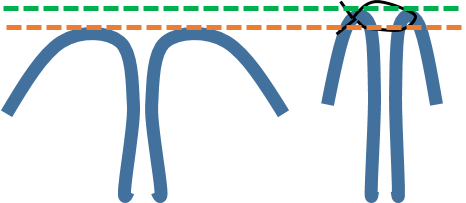
Then for which type are non-open cartilage suturing or cartilage stacking helpful?
It is the second type. As shown in the schematic above, if the cartilage is strong but spread out widely, bringing it together and suturing it can raise the height of the nose tip’s supporting structure, as shown in the illustration.
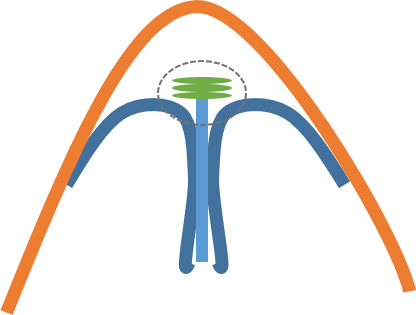
What about cartilage stacking? When performed alone, cartilage stacking may provide some help for both types, but it is difficult to achieve a dramatic effect. The area and amount of cartilage that can be stacked are limited, and while it may slightly increase height, if the skin is thick or there is a lot of subcutaneous fat, even that change may be hard to notice. You can think of it in the same way that wearing a long padded coat can hide even a more protruding abdomen.
In conclusion, cartilage suturing helps improve the nose tip shape only in the second type, and stacking is not very helpful. Then what method is better for the first type of bulbous nose, which is common in Korea?
As mentioned, the fundamental issues in the first type of bulbous nose are a large amount of subcutaneous fat and low, weak alar cartilages. In the end, to clearly improve a bulbous nose, it is necessary to remove the subcutaneous fat and create a supporting structure by raising the low alar cartilages.
Rather than a temporary improvement due to swelling, if you want a clear and definite result, surgically raising the nose tip and refining the subcutaneous fat is a more suitable and better approach. And if desired, an implant-free procedure that also adds height to the bridge can be considered so that the result matches the improved shape of the nose tip.
I hope this was helpful to those who are considering their options, and I’ll end here.