Hello, this is AB Plastic Surgery.
Today, together with Director Seo Chan-eol,
we will look at how to reduce swelling quickly after nose surgery😊
When you undergo nose surgery, swelling is usually worst on days 2 to 3,
and it is known to take a long time to go down.
Today, I’ll share a few tips on how to help reduce this swelling faster.
The first is applying compresses.
For the first 2 to 3 days, cold compresses are recommended, and after that, warm compresses are recommended.
Cold compresses in the early stage constrict blood vessels, which can help reduce bruising,
and warm compresses promote circulation, which can help swelling go down faster.
However, there is one precaution to keep in mind with warm compresses.
Right after surgery, the surgical area may have reduced sensation,
and if you apply warm compresses too diligently, you could get burned.
So it is best to place a towel or gauze underneath and use a temperature that is not too hot.
The second is taking a light walk.
For the first 2 to 3 days, the nose is packed with cotton, and during this period,
breathing is uncomfortable, so it is better to take simple walks after 2 to 3 days.
If you do strenuous exercise, blood may rush to the head, causing more swelling, worsening bruising,
or even triggering bleeding again at the surgical site.
Also, because sweating can create an excessively humid environment, which is not good for wound healing,
it is better to avoid strenuous exercise.
Swelling is ultimately caused by fluid not being able to drain and becoming trapped, but moderate exercise such as walking
promotes blood circulation and helps swelling go down faster.
The third is maintaining the right posture and an appropriate amount of sleep.
Just as water flows from top to bottom, keeping the surgical area, meaning the head, higher than the heart helps circulation.
Therefore, it is recommended to keep the upper body raised at least 45 degrees or to sit upright.
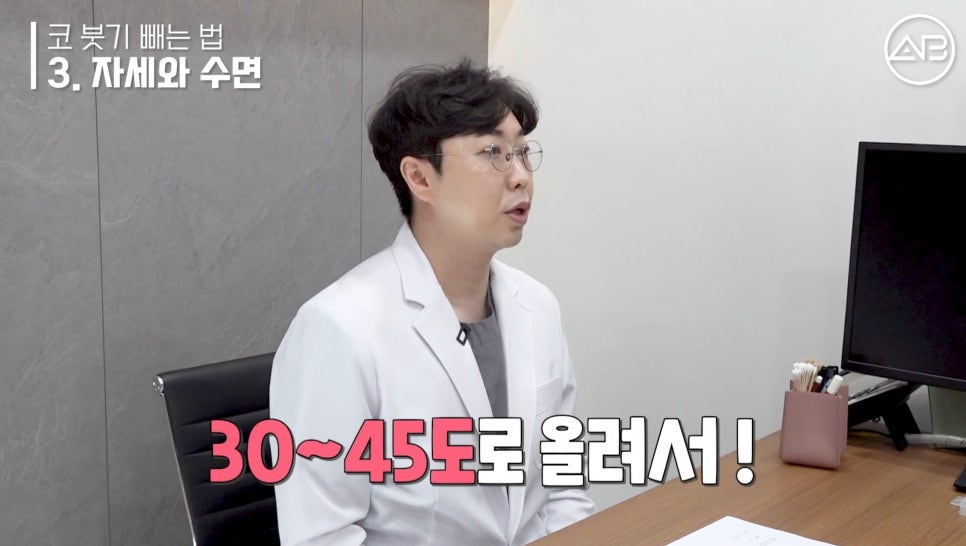
When sleeping, it is not necessary to sleep sitting up completely, but it is better to place pillows or cushions so that you are elevated about 30 to 45 degrees.
Too much or too little sleep is not good, and maintaining an average sleep duration of 7 to 8 hours
helps with swelling and wound recovery.
The fourth is paying attention to food.
First, you should avoid spicy and salty, irritating foods.
Just as eating ramen and sleeping can make your face very puffy the next day, salty and spicy foods can
cause more swelling, so please be careful with those.
The effect varies from case to case.
These kinds of foods are known to promote diuresis and reduce facial swelling.
However, since the effect is quite small, I’m not sure whether they are of much help personally.
Lastly, alcohol and smoking should be avoided for at least a month.
Alcohol and smoking increase the risk of inflammation, not just swelling.
The problem with smoking is not simply that smoke enters the wound and causes harm;
among the substances inhaled into the body, nicotine constricts blood vessels
and interferes with blood circulation.

If blood supply to the wound area is poor, wound healing is delayed, and when localized inflammation occurs,
natural healing inside the body is slowed, so it can worsen quickly.
And alcohol, on the other hand, increases overall blood flow in the body, which worsens swelling,
and if you become fatigued from repeated drinking, you may become more vulnerable to inflammation.
After more than a month, wound regeneration and related processes have stabilized, so there is less risk of significant worsening.
And some people ask whether e-cigarettes are okay.
Because they have less smell but the ingredients can be considered the same, e-cigarettes are not allowed either!
Today, I explained how to reduce swelling quickly after nose surgery.
The points mentioned above are the kinds of guidance we provide at the hospital before and after surgery.
Please review them several times and keep them in mind, and I hope they help you reduce swelling.