
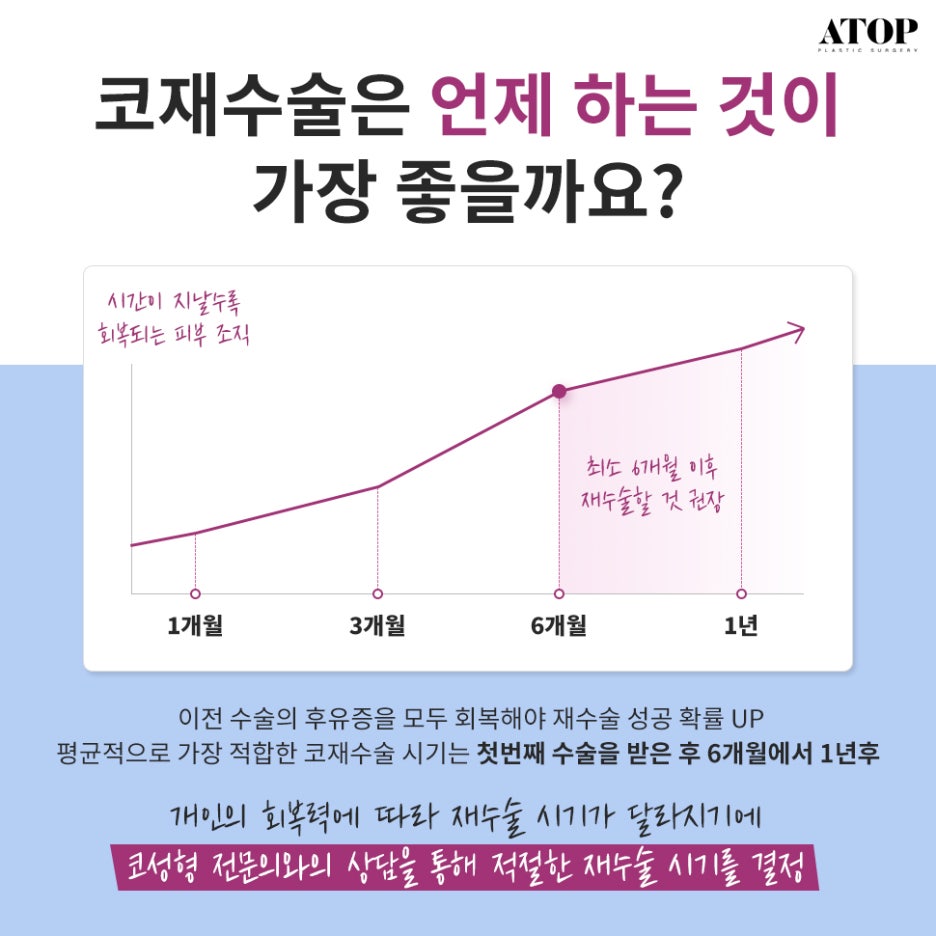
Plastic surgery can leave you satisfied or dissatisfied depending on the outcome. People decide to undergo revision surgery for a variety of reasons, and since revision surgery is more difficult than the first operation, it should be carefully considered before making a decision. Rather than rushing into it simply because you are unhappy, if the nose itself has become deformed and functional problems have followed, as in nasal contracture revision surgery, it should no longer be delayed. Like the revision surgery cases in the Atop Plastic Surgery reviews, think of this surgery as the last one and make a plan so it does not have to be repeated several times.

Nasal revision surgery, customized according to various causes
The reasons for nasal revision surgery differ from person to person. Because the internal structure of the nose is also complex, if you undergo nasal contracture revision surgery, the medical team's extensive experience and technical skill are important. The causes vary widely, from cosmetic dissatisfaction to functional problems and side effects, so they must be systematically analyzed and reflected in the revision surgery.
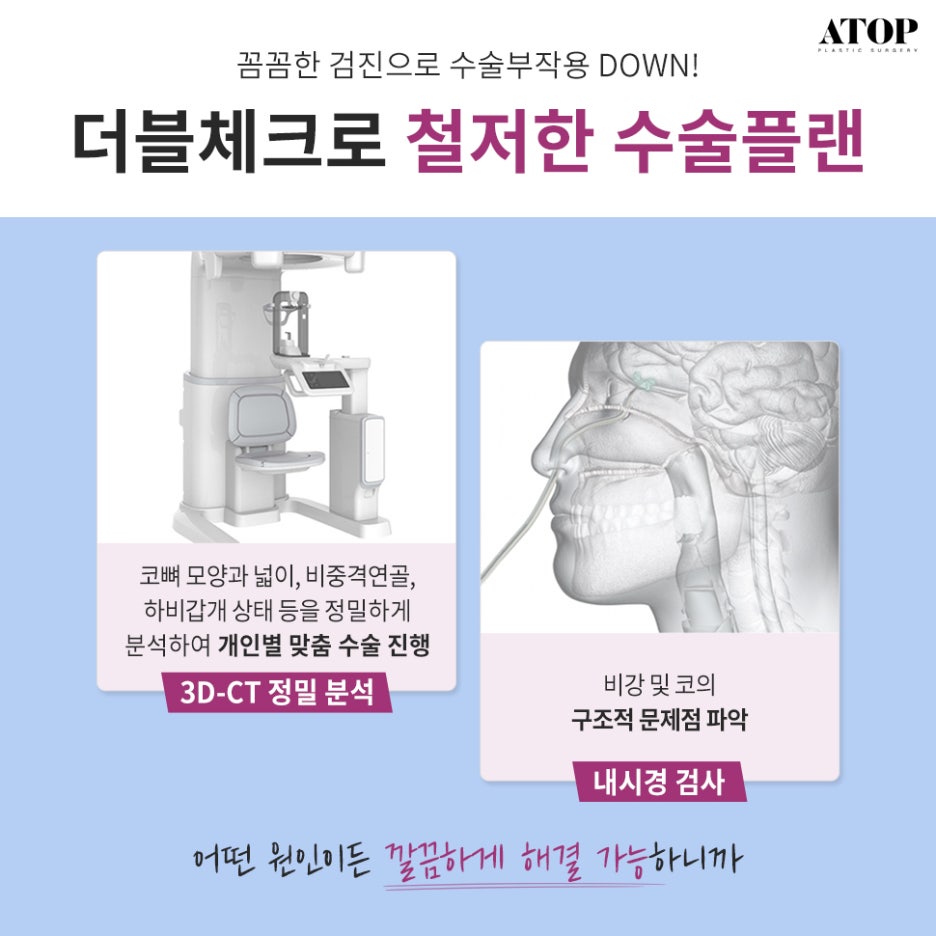
Unlike what it looks like from the outside, the nose is made up of structurally complex elements, so it can be somewhat difficult to identify the problem by visual inspection alone. If a detailed examination is performed through 3D-CT imaging and a surgical plan is established based on those results, a better outcome may be achieved. Revision surgery is more difficult and burdensome than the first surgery, and nasal contracture revision surgery in particular often involves both cosmetic and functional problems, so it must be approached carefully.
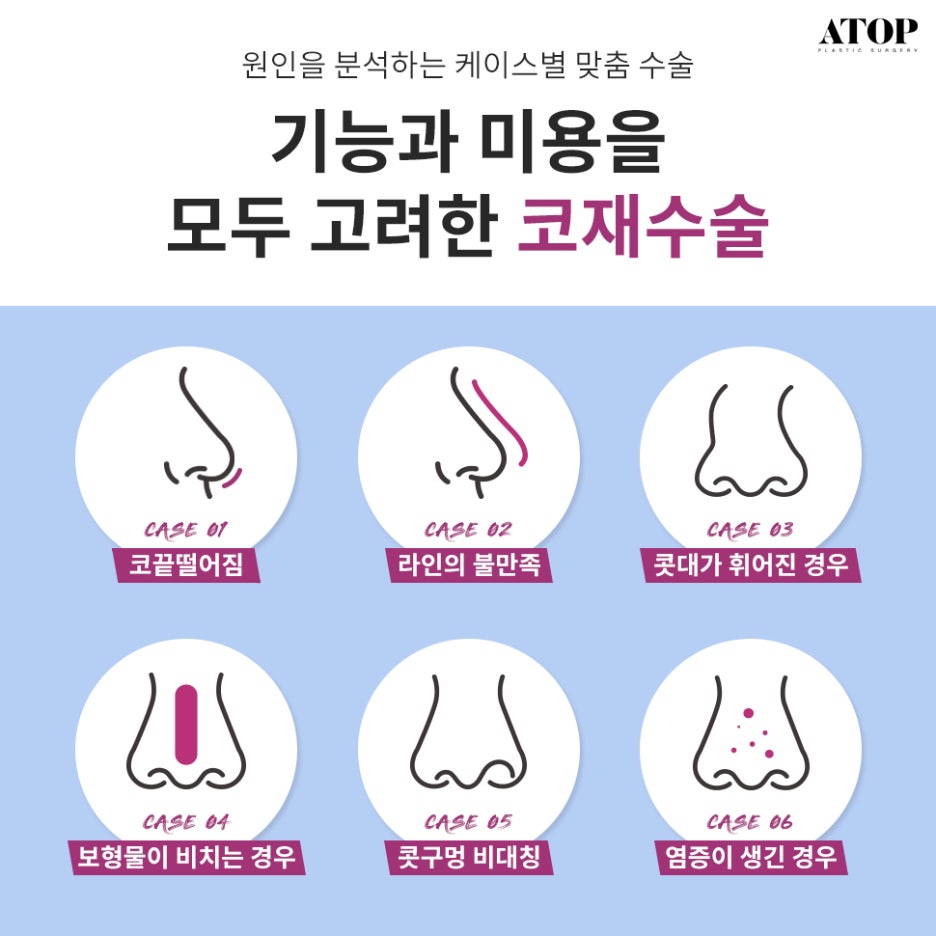
About the various types of nasal revision surgery
Revision surgery is performed for many different reasons, and the symptom of a “drooping nasal tip” is caused by weak nasal tip cartilage and a shortened columella. In this case, the septum is extended further or the columella is strengthened to lift and correct the nasal tip. “Dissatisfaction with the line” refers to cases in which the desired nasal bridge or nasal tip line was not achieved after the previous surgery, leading the patient to want another operation. The line can be corrected again with the overall proportions in mind to create the desired shape.
A “crooked nasal bridge” is also one of the common types of revision surgery. The implant can be repositioned correctly or replaced with a new implant to straighten a crooked bridge. If the nasal bone or septum is deviated, a septoplasty can also be performed to straighten the crooked area.
Those who develop a “nasal infection” may also be candidates for nasal contracture revision surgery. It is characterized by redness and pain in the surgical area. If it is simply an infection, the cause can be identified and treated to improve the condition. However, if the infection progresses further and contracture appears, causing the tip to lift and the shape itself to become deformed, revision surgery becomes unavoidable.
The phenomenon of “implant visibility” refers to the implant appearing visible through the skin, making the bridge area look translucent to the naked eye. In such cases, the implant can be moved deeper to reposition it and then covered with temporalis fascia so that it is no longer visible. In the case of “nostril asymmetry,” the shape of the nostrils can be improved by repositioning the alar cartilage, correcting the septum, or performing a skin graft.
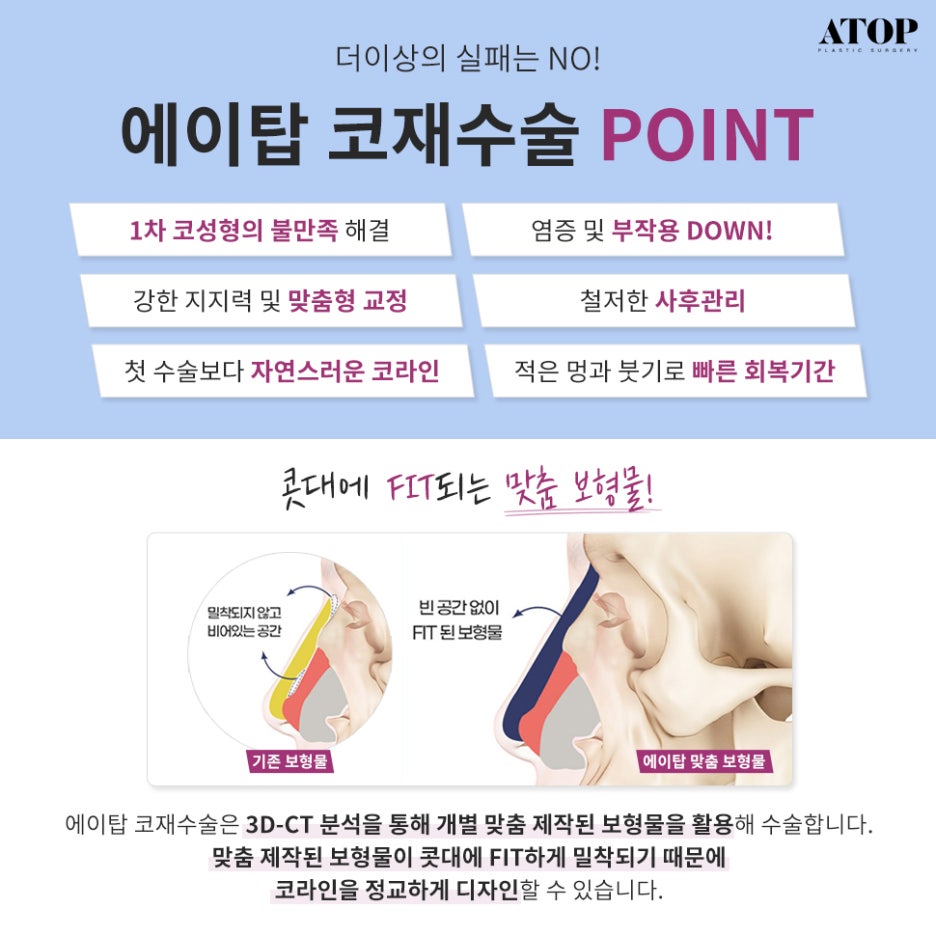
About nasal contracture revision surgery
Nasal contracture is one of the side effects that can occur after rhinoplasty. It is characterized by blood pooling due to infection, inflammation, or bleeding, which causes the capsule to thicken and leads to deformation of the nose. With nasal contracture, the nasal tip appears lifted, the nostrils are noticeable from the front, and the overall shape of the nose is not straight but uneven.
Once contracture begins in the nose, it does not return to its normal appearance. When deformation starts, the shape of the nose itself changes, which also affects the overall facial appearance and impression, so nasal contracture revision surgery is necessary. If the problem is caused by an implant that was inserted, the existing implant must be completely removed. After removal, the nose is reconstructed. At this stage, the nose can be improved to its original shape without using an implant, or an implant can be used if the goal is to raise the bridge and lift the nasal tip.
If the existing implant was not in close contact and left a gap, the nose shape itself may have felt insufficient. When a custom-made implant is used, it fits tightly to the nasal bridge, making the nasal line much more refined and eliminating any empty space. After identifying the problem through 3D-CT analysis, an implant can be made and used for nasal contracture revision surgery.
Types of implants used in revision surgery
If silicone was used in the previous surgery and caused problems, there is no need to use the same implant again during nasal contracture revision surgery. Cartilage harvested from the patient’s own body or autologous tissue is generally more biocompatible, so it can be used instead. Common examples include ear cartilage and septal cartilage, and in the case of contracture nose, because nasal deformity is already present and reconstruction is needed, costal cartilage may also be used. Other options include donated dermis and donated cartilage.
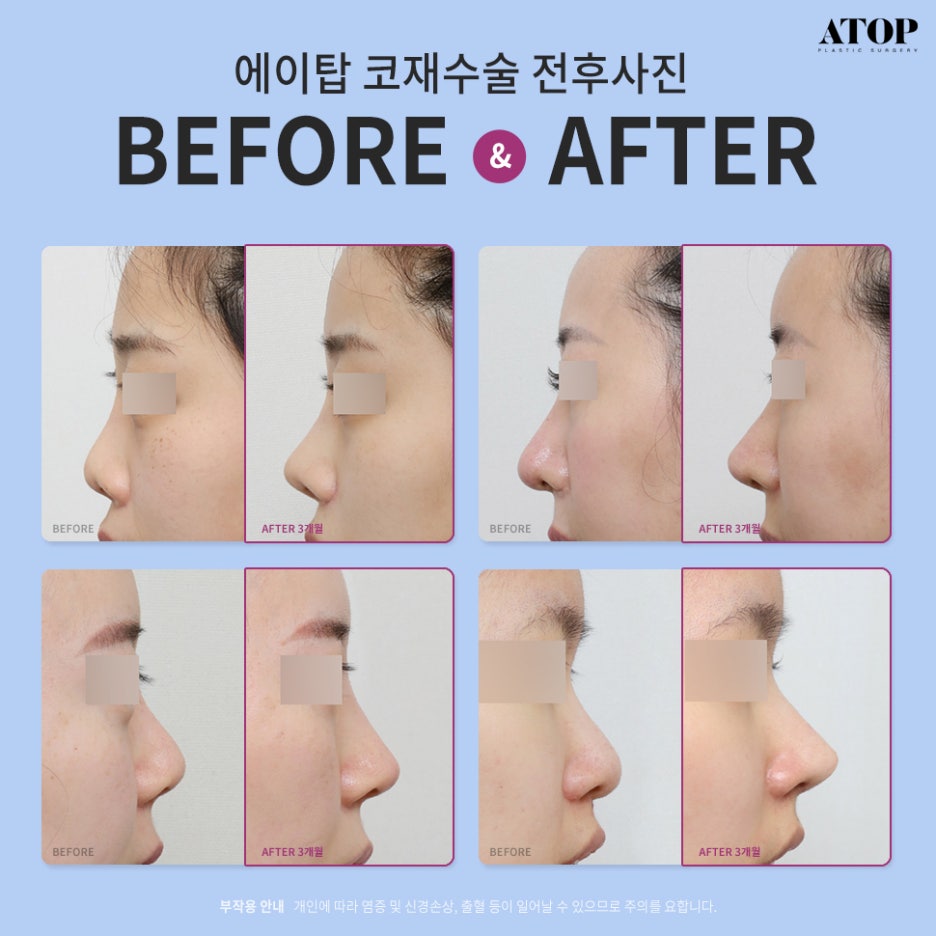
Ear cartilage is round and elastic because it is similar in shape to the nose, helping the bridge or tip look more natural. Septal cartilage is located inside the nose, so it can be cut and shaped for uses such as lengthening the nose and lifting the tip. Costal cartilage has relatively few side effects and is strong in support and durability. It is used in nasal contracture revision surgery, and because contracture nose involves a lifted tip that needs to be brought down again and the nose reinforced, using costal cartilage may help achieve the desired Atop Plastic Surgery review result.










 Previous image
Next image
Previous image
Next image









 Previous image
Next image
Previous image
Next image