
If you classify breast surgery,
you might naturally think that
small breasts get augmentation surgery
and large breasts get reduction surgery.
However, there are also cases
that are difficult to classify
so simply.

In other words, the breasts may not seem large,
but they are sagging.
To improve breast sagging,
a breast lift is usually performed.

A breast lift is a surgery that
raises the nipple position upward
and removes the lower tissue
and stretched skin of the sagging breast.
However, some people may feel
unfamiliar with breast lift surgery.
That is because when people think of breast surgery,
they often only think of
augmentation or reduction.

Among people whose breasts are not very large
but do have sagging,
many choose augmentation surgery
rather than considering a lift.
From the patient's point of view,
the augmentation surgery they often see
on TV or online may seem simple,
so they go ahead with it lightly.

If you undergo the relatively unfamiliar
lift surgery,
you may feel that it must be a dangerous operation,
or hesitate because of concerns about pain
or scarring.

And some people think that if they fill
their sagging breasts with implants,
remembering the firm, full breasts they had before,
the skin will stretch and the breasts will become
firm and beautiful again like before.
However, putting in an implant simply to improve sagging,
rather than size alone,
is not a good method.

The first reason is that once the skin has stretched,
it is hard for it to return to the same firmness as before.

The second is that even if your breasts are not large,
the tissue below the nipple tends to be abundant and heavy.
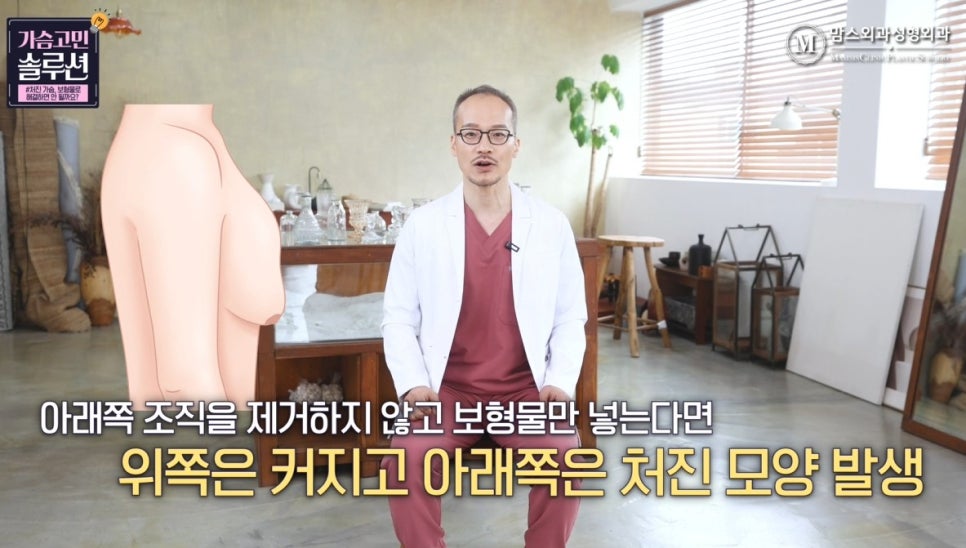
If you do not remove the tissue in this area
and only place an implant in the upper area,
the upper breast may become fuller,
but the lower part will remain sagging.

So, in what cases should you have
a breast augmentation with implants,
and in what cases should you
have a lift?

In 1976, someone named Regnault
presented a classification system
that divides the degree of breast sagging.
This classification system has been used
with only minor modifications up to now.

The key point in Regnault's system
is the relationship between the nipple
and the inframammary fold.
If the nipple is above the inframammary fold,
it is considered normal;
if it is at the same height,
it is classified as stage 1 sagging;
and if it is below that level,
it is classified as stage 2.

If the breasts are normal or stage 1 sagging,
augmentation surgery alone may improve them,
and you may even expect the nipple position
to rise slightly by about less than 2 cm.

However, if the sagging has progressed a lot
and the nipple is positioned below the inframammary fold,
good results are difficult to expect with augmentation alone.
If an implant is placed in this case,
only the upper part becomes fuller while the sagging remains,
and it may actually look even more sagging.
Therefore, in such cases,
a breast lift is necessary.

If you ignore these standards
and undergo augmentation surgery without considering them,
there are many cases that end up requiring revision surgery.
People who undergo augmentation surgery because of sagging
rarely have had small breasts to begin with,
and the purpose of surgery is often unrelated
to simply making the breasts larger.
However, because they do not have information
about the criteria for surgery,
many people undergo augmentation with vague expectations.

But after surgery,
they often regret it because the result is somehow
different from what they wanted.
In such cases, only after removing the awkward implant
and receiving a lift to improve sagging
do they feel that it is the surgery they originally wanted.

I hope this helps answer your question
about whether you should have augmentation
or a lift.