One of the most common questions from people who have decided to undergo breast reduction surgery is:
“How much can be removed from my breasts?”

To estimate this,
you first need to check the current size of your breasts,
that is, how much volume your breasts currently have.
So today, I’ll first explain a method you can use at home
to measure your own breast volume.

This is a volume calculation method
using tape.
First, you can buy cotton adhesive tape
online or at a pharmacy.
Other types of tape can irritate the nipples or skin,
so cotton adhesive tape is recommended.
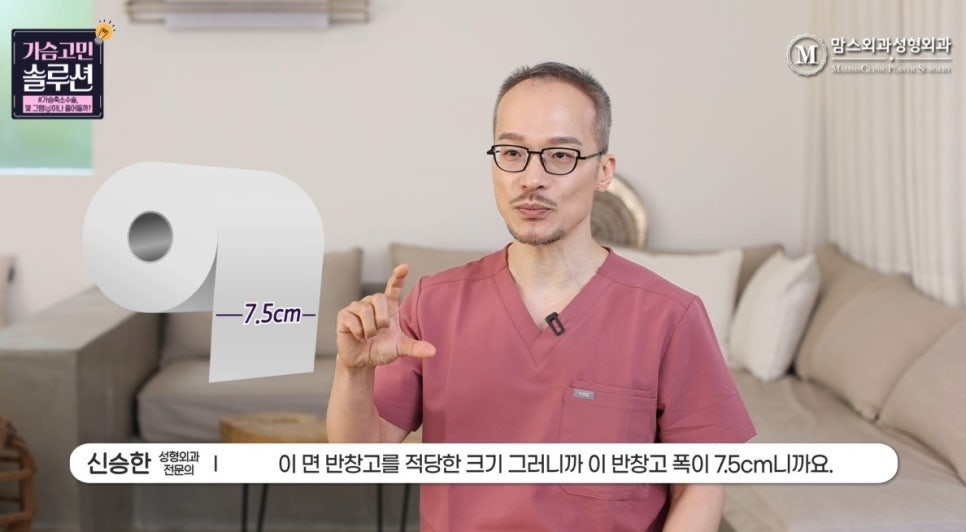

Since the width of the cotton adhesive tape is 7.5 cm,
cut about twenty 10 cm strips lengthwise
and tape them so that they cover the breasts.


Since water will later be poured into this,
there should be no gaps.
Apply the tape in 2 to 3 layers,
covering the breast completely with tape.

Then slowly remove the tape
so that the whole thing becomes one single piece,
and you will see a mold shape like a large bowl.

If you fill this with water and then transfer it to a measuring cup,
you can measure your current breast volume.
It may look like a rather primitive method,
but it was actually used in hospitals even 20 years ago,
so it is quite accurate for what it looks like.

Once your breast volume is determined this way,
it becomes possible to predict the amount to be removed during reduction surgery.
In general, about one-third to one-half of this measurement can be reduced.

Another way to think about it is that,
when performing breast reduction surgery,
it is common to leave about 300 to 500 cc behind.
Taking that into account, you can roughly estimate the amount to be removed during surgery
by subtracting that amount from the total measured volume.

Of course, since this is a volume calculation,
it may differ a little from weight.
It can vary slightly depending on whether the removed tissue is fat or glandular tissue,
but in general, estimating 1 cc as 1 g
is not far off.

If using this kind of method is difficult for you,
I can also tell you a rough estimate of the removal amount based on body weight.
A foreign paper presented the following guideline:
if body weight is under 60 kg, 400 g;
between 60 kg and 80 kg, 700 g;
and if over 80 kg, more than 1000 g should be removed.
You can refer to this guideline.

Of course, these days hospitals do not use such cumbersome measurement methods
based on tape.
They can measure the current breast volume and the expected amount to be removed
through 3D image synthesis.

The amount to be removed is certainly a very important issue
for many breast reduction patients.
However, there is a clear difference in perspective
between doctors and patients.

From the patient’s point of view,
the amount removed is seen as an important measure
that determines the surgical result.
But from the perspective of the medical team performing the surgery,
they look at this reduction surgery from a completely different angle.

What is considered most important in this surgery
is not the amount removed,
but how much is left.
I believe that is the key factor that determines success or failure.
In fact, the part that has already been cut away and is gone
is not very meaningful.
What matters more is:
“Which parts should be left, and how should they be left
to maintain blood flow to the nipple while leaving a beautiful, small breast shape?”
That is the important issue.

No matter how satisfying the removed gram amount may be,
it is ultimately the part that is gone.
What remains in the body is the result of the surgery,
so this is the key point of reduction surgery.

In other words, rather than focusing on the weight of the removed tissue,
I would like to say that it is better to focus on
how to create a small, beautiful, and natural-looking breast
and discuss that with the medical team.
This is the way to achieve a better result.