
When undergoing breast surgery,
there is one question
that comes up very often.
It is whether nipple sensation
disappears after surgery.
You may strongly want to look better,
but if you can no longer feel anything,
your worries are bound to grow.
Whether it is breast reduction surgery
or breast augmentation,
reduced nipple sensation is one
of the possible side effects.
But by understanding how to reduce it,
or why it happens,
I thought patients would be able
to make better decisions,
so I prepared this post.
If you had to choose between
pretty breasts and nipple sensation,
the 고민 would naturally be significant.
In particular, losing a part of the body
that has a major impact on female sensation
is not an easy decision.
It would be nice to know in advance
how much sensation will return after surgery,
but since that cannot be known,
I think the concern becomes even greater.
However, if you already feel a major complex
about your breasts,
you may think that surgery is important
even if sensation is reduced.
But does breast surgery always
cause sensation loss?
When talking about this, nipple sensation
comes from the fourth intercostal nerve.
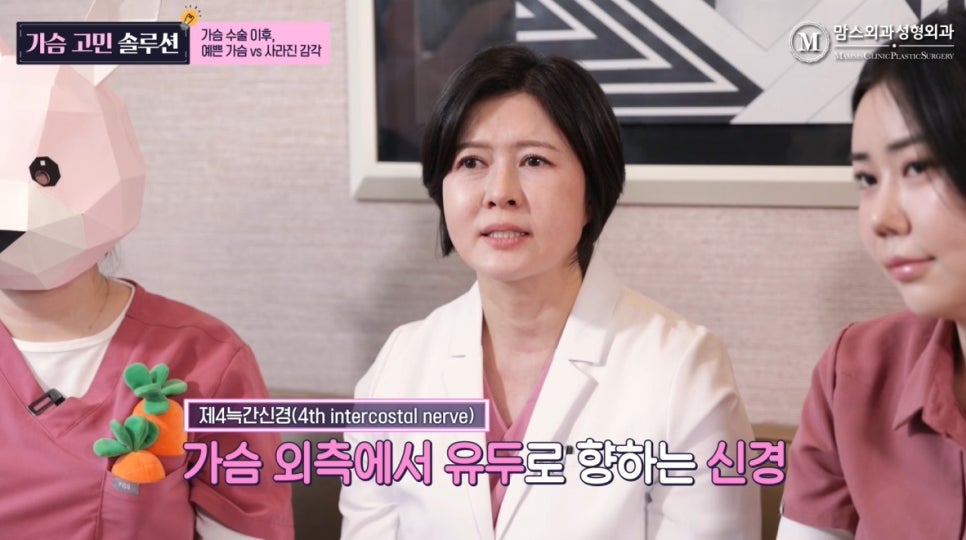
This nerve enters radially from the outer side
of the breast toward the nipple,
and because this path inevitably has to
be touched during surgery,
reduced sensation often occurs.

This reduced sensation can cause
considerable inconvenience,
especially because it is a sexual area,
but more important than reduced sensation
may be improving quality of life.
In particular, breast reduction surgery
is performed because the breasts are heavy
and uncomfortable.
Many people undergo surgery because sweating
and skin irritation become severe.
After surgery, the removed tissue
is weighed on a scale.
When you see how heavy it is,
even making your hands tremble as you lift it,
you can sense how difficult it must have been.
Because we understand these difficulties,
efforts are made to preserve sensation.
However, the more reduction is performed,
the higher the probability of reduced sensation
becomes.

Since we understand the anatomy of the nerves well,
we can preserve them,
but breast reduction surgery includes a process
of lifting the nipple,
so even if the nerve is not cut,
reduced sensation can occur because
the nerve is stretched.
People undergoing breast augmentation
can also experience these symptoms.
Because augmentation involves inserting implants,
it may not seem like it would happen,
but the sensation changes after augmentation
can vary depending on the incision site
and the implant size.
For example, an areolar incision can directly
affect the nerves around the areola,
so the risk of reduced sensation is relatively high.
If the skin is tight and a large implant
is inserted, the dissection has to extend
more widely to the outside,
which can also lead to this.
When I explain to patients that this kind
of reduced sensation can occur,
they do worry and want to avoid it,
but for those who are truly struggling,
it is not usually the number one reason
for deciding against surgery.
Many patients worry at first
about reduced sensation,
but as time passes after surgery,
it often returns significantly.

Statistically, from slight reduction
to significant reduction,
if you include all early cases,
about 50% are reported to have mild reduction,
and after about 1 to 2 years,
around 80% of patients tend to return
to normal sensation.
Still, there are occasionally cases
where it does not return at all.

Therefore, I think the reason for wanting
surgery is quite important.
You may choose prettier breasts,
or you may prioritize preserving sensation,
so it seems only right to respect that.
Therefore, I hope you will take time to think
together through careful and detailed consultation.